


By J. H. Irwin
Author | Storyteller | Capturing Life, Memory, and Meaning
Author’s Note
“As both a lifelong writer and a technology professional, I have found myself standing at the intersection of two worlds that are now colliding faster than almost anyone expected. One world is built on memory, emotion, creativity, and the deeply human instinct to tell stories. The other is built on systems, automation, analytics, software engineering, and now artificial intelligence.
For years, AI felt distant to many people, almost experimental in nature. Today it has become impossible to ignore. Writers are debating it. Developers are integrating it into their daily work. Corporations are restructuring around it. Entire industries are attempting to determine whether AI represents the next great technological revolution or the beginning of something far more disruptive.
The truth is that AI is not going away, and pretending otherwise is not a serious response to the moment humanity now finds itself in. What matters is how we choose to use it, how we adapt to it, and whether we remember that efficiency and humanity are not the same thing.
That distinction matters enormously for writers.”
The Fear Surrounding AI Is Real
One of the most fascinating recent examples of this cultural anxiety appeared in the latest season of The Comeback starring Lisa Kudrow. In the storyline, Valerie Cherish discovers she has been hired to star in a television series written entirely by artificial intelligence. What follows is controversy, fear, outrage, and confusion among writers and creatives who begin questioning what this technology means for the future of storytelling itself.
The reason the storyline resonates is because it reflects a very real conversation already taking place throughout creative industries. For the first time in modern history, humanity has created a technology capable of producing language, structure, dialogue, imagery, and content at a scale and speed that would have seemed impossible only a few years ago.
That reality is understandably unsettling for writers because writing has always felt deeply personal. Stories are not merely assembled information. At their best, stories become emotional translations of human experience. Writers often spend years developing their voice, learning how to communicate pain, humor, memory, love, fear, vulnerability, identity, and grief in ways that feel honest.
Now suddenly a machine can generate pages of readable text within seconds.
Of course people are nervous.
AI Is Already Transforming the Technology Industry
In my own professional world of software engineering, reporting, analytics, cloud services, and digital transformation, the disruption is already impossible to deny.
Tasks that once required entire development teams and months of work can now be accelerated dramatically through AI-assisted development. Applications, dashboards, reporting structures, automation flows, documentation, and even large portions of code can now be generated from a carefully written prompt. What once consumed weeks of development time can often be accomplished in hours, sometimes minutes.
What is most remarkable is not simply the speed, but how capable these systems have become at identifying patterns, troubleshooting issues, reducing repetitive work, and helping developers move through projects more efficiently. AI is rapidly changing expectations surrounding productivity, staffing, development timelines, and even the skills organizations prioritize.
There is no question that artificial intelligence represents one of the most disruptive technological shifts humanity has ever experienced. It will reshape industries, redefine careers, alter educational systems, and force society to reconsider long-standing assumptions about work itself.
Unlike previous technological revolutions, however, AI is not limited to physical labor or repetitive processes. It has now entered spaces once believed to belong exclusively to human creativity.
That is why this moment feels different.
But Creativity Is More Than Information Processing
Despite everything AI can now accomplish, there is still an essential difference between generated output and authentic human experience.
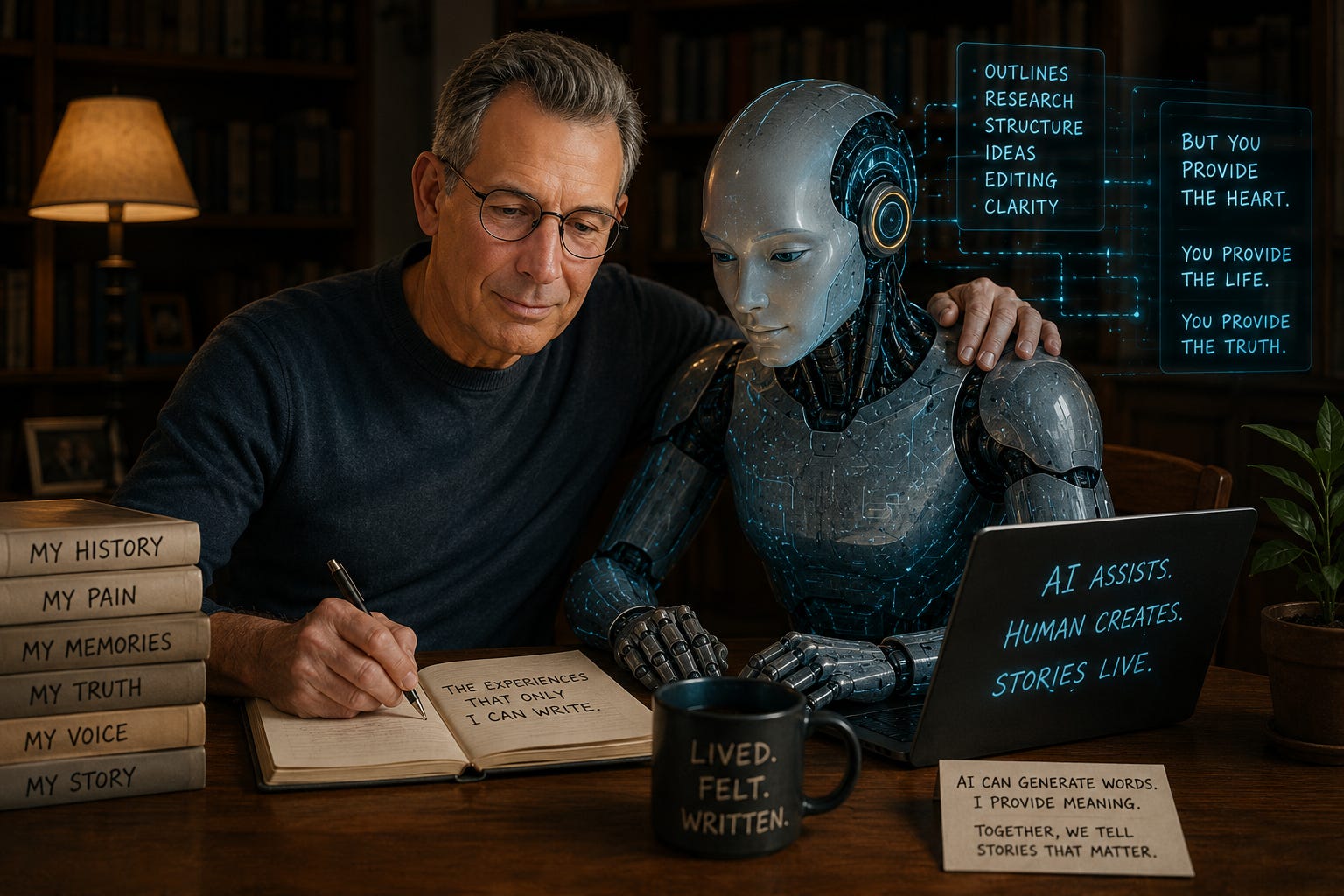
AI can assist with outlines, structure, grammar, continuity, brainstorming, editing, and research. It can organize information with extraordinary speed and suggest possibilities a writer may not initially consider. Used responsibly, it can become an incredibly valuable creative assistant.
But AI does not live a human life.
It does not know what it feels like to lose someone you love and then spend months moving through ordinary days while carrying extraordinary grief. It does not understand the quiet emotional exhaustion that can accompany depression or the internal negotiations many people fight every single day simply to keep moving forward.
AI cannot emotionally understand what it means to grow up LGBTQ+ in a world where acceptance often felt conditional, uncertain, or unsafe. It cannot genuinely comprehend the emotional weight of hiding parts of yourself, fearing rejection, searching for belonging, or eventually learning how to live openly despite the risks that once accompanied honesty.
It cannot truly know the devastation of losing a spouse, a child, a parent, or a beloved family pet whose absence changes the emotional rhythm of a home forever. Those experiences are not informational data points waiting to be categorized by an algorithm. They are deeply human experiences carried inside memory, emotion, and lived reality.
That is why I believe AI can imitate emotional language, but it cannot independently create authentic emotional truth.
Without human guidance, AI is still interpreting patterns rather than genuinely understanding suffering, resilience, love, identity, joy, or grief. It can generate words about these subjects because humans have written about them for centuries, but the emotional core behind those words still originates with people who have actually lived those experiences.
As a writer, that distinction matters to me enormously.
AI cannot write my lived experiences unless I choose to share them. It cannot know my memories, my fears, my heartbreaks, my struggles, or the emotional context behind the stories I tell unless I bring those experiences into the work myself. The emotional architecture of meaningful storytelling still belongs to the human being behind the keyboard.
That is why I view AI as a tool rather than a replacement.
I use AI because it is genuinely useful. It can accelerate research, help organize thoughts, improve structure, identify weaknesses, and assist with technical tasks that once consumed enormous amounts of time. In many ways, it represents one of the most remarkable technological tools ever created.
But no matter how advanced AI becomes, it will never replace what exists inside a human heart.
It will never independently possess memory.
It will never independently possess grief.
It will never independently possess empathy.
And it will never truly understand the emotional complexity of surviving a human life.
Writers Should Not Fear Using AI Responsibly
Writers have always adapted to new tools.
Typewriters changed writing. Word processors changed writing. Internet research changed writing. Digital publishing transformed access to audiences and completely altered the publishing landscape.
Artificial intelligence is simply the newest and most powerful tool to emerge in that long progression.
Used responsibly, AI can help writers develop outlines, organize research, maintain continuity, brainstorm possibilities, refine pacing, troubleshoot structural problems, and streamline editing. It can remove technical obstacles that often slow creativity down and allow writers to spend more time focused on the emotional and imaginative aspects of storytelling.
What it should never replace, however, is the humanity at the center of the work.
The most memorable stories have never succeeded merely because they were technically efficient. Great writing resonates because readers recognize emotional honesty within it. Readers respond when they sense vulnerability, authenticity, insight, compassion, and lived truth behind the words.
Those qualities still belong to human beings.
The Real Risk Is Losing Our Humanity Within the Convenience
I do not fear AI nearly as much as I fear a world where people slowly surrender their own creativity, emotional intelligence, and critical thinking because machines can imitate those things more quickly.
Technology should enhance humanity rather than flatten it.
The danger is not simply automation itself. The danger is the possibility that people stop observing deeply, questioning thoughtfully, imagining courageously, or expressing themselves honestly because AI can produce immediate answers and endless content with almost no effort.
Human creativity requires reflection. It requires emotional risk. It requires curiosity, memory, empathy, and perspective. Those are not inefficiencies to eliminate. They are part of what makes art meaningful in the first place.
The future will belong to the people who learn how to work alongside AI while still protecting the uniquely human qualities machines cannot genuinely replicate. Compassion, emotional depth, moral reasoning, lived experience, and authentic human connection remain irreplaceable.
That is especially true for writers.
We Are Entering a New Era of Human Creativity
Whether people are prepared for it or not, artificial intelligence is going to reshape modern life in ways we are only beginning to understand. Some professions will disappear. Others will evolve dramatically. Entirely new careers and industries will emerge from technologies that are still in their infancy.
Governments will struggle to keep pace. Educational systems will need to adapt. Ethical debates surrounding ownership, originality, labor, creativity, and truth itself are only beginning.
But even as all of this transformation unfolds, one truth remains remarkably consistent.
Human beings still need stories told by other human beings.
We still search for connection.
We still respond to emotional honesty.
We still recognize authenticity when we encounter it.
AI may someday generate endless amounts of content, but meaning still comes from people. Emotional truth still comes from people. The stories that stay with us for decades will still emerge from human beings willing to share parts of themselves honestly.
That is why I believe writers should embrace AI carefully, intelligently, and responsibly without ever surrendering the humanity that gives storytelling its power.
The machine may assist the process.
But the soul of the story must remain human.
Words can still move the world. Read mine → https://substack.com/@jhirwin
#AI #ArtificialIntelligence #WritingCommunity #Authors #Storytelling #Creativity #Technology #Humanity #DigitalTransformation #SoftwareEngineering #ContentCreator #HumanRights #FutureOfWork #Innovation #JHIrwin #JHIrwinMultimedia