



By J. H. Irwin
Author | Storyteller | Capturing Life, Memory, and Meaning
There are moments when I find myself wondering just how far we are willing to drift from the principles that once defined us as a nation
Moments when something is announced by our government that should give every American reason to stop, think, and question not only what is being done, but what it says about who we are becoming.
Today was one of those moments.
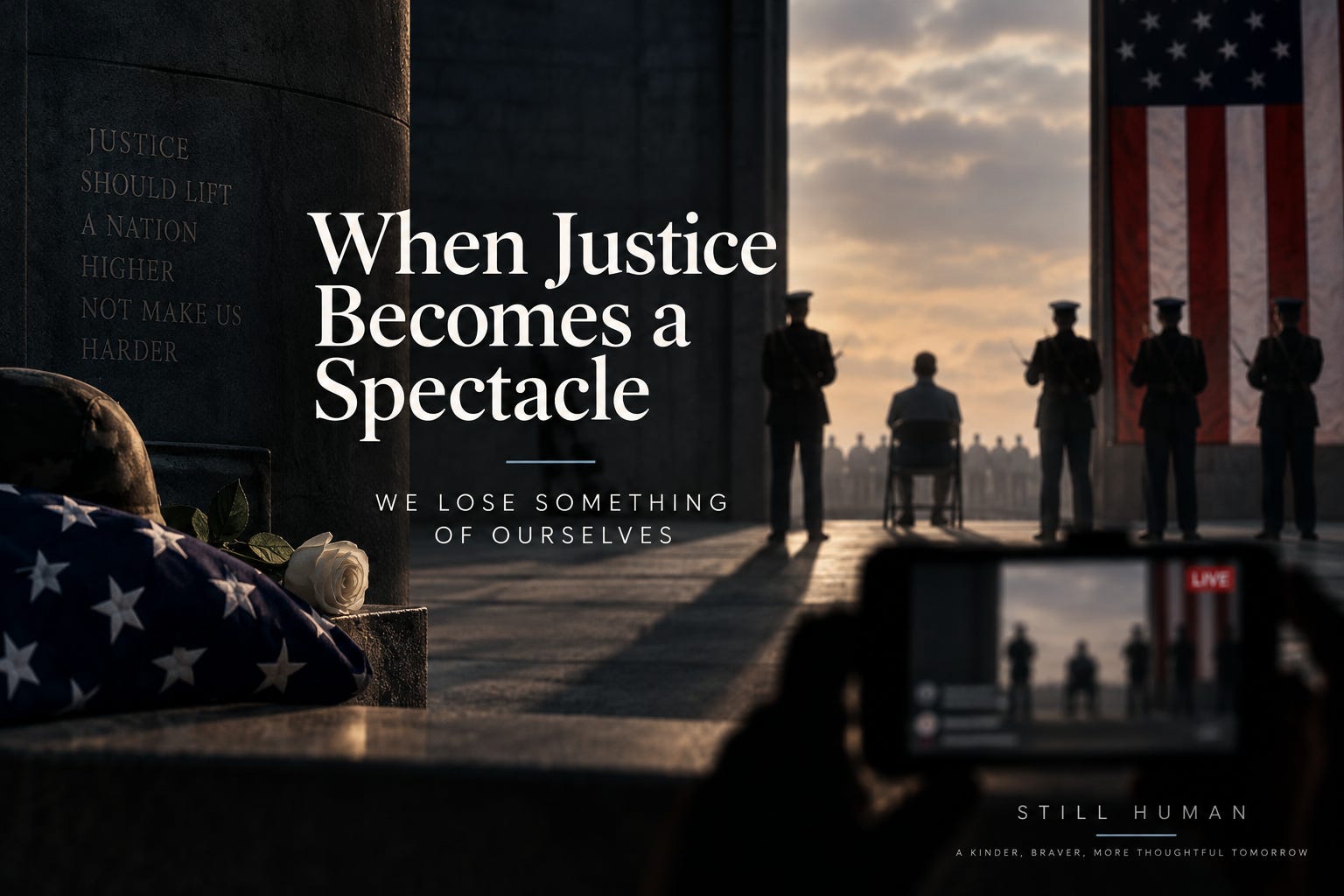
Defense Secretary Pete Hegseth has announced that the execution of Nidal Malik Hasan, the former Army psychiatrist responsible for the horrific 2009 massacre at Fort Hood, will be carried out by firing squad and made available for the public to watch. The execution is scheduled for December 3, and the Pentagon has confirmed plans to livestream it.
I find this deeply disturbing. Not because I have sympathy for the man who committed those murders, but because I believe we should be profoundly concerned when our government begins treating the deliberate taking of a human life as something the public should witness.
This is not who we are. Or at least, it is not who we should aspire to be.
The Horror of Fort Hood Must Never Be Forgotten
On November 5, 2009, Nidal Hasan opened fire at Fort Hood, Texas, killing 13 people and wounding 32 others. Twelve of those killed were soldiers, and one was a civilian. They were human beings with families, friends, dreams, and futures that were stolen from them in an act of unimaginable violence.
Their families have lived with that loss for nearly seventeen years. No punishment, however severe, can return their loved ones or erase the pain they have endured. Their suffering deserves our compassion, our respect, and our remembrance.
Hasan was convicted in 2013 and sentenced to death by a military jury. His crimes were horrific, his responsibility was established through the judicial process, and the families of his victims deserve to know that justice has been taken seriously.
I understand that some of those families may welcome his execution. I would never presume to tell someone who has endured such a loss how they should feel about the person responsible. Grief is deeply personal, and the desire for justice can take many forms.
But there is a profound difference between carrying out a sentence imposed by a court and turning that sentence into a public spectacle.
That distinction is where my concern begins.
When Did We Decide That Watching Someone Die Was Justice?
According to the reporting, Hegseth has said that people should be able to watch the execution because they need to understand that there are serious consequences for such crimes.
But I have to ask: What exactly are we hoping to accomplish by inviting Americans to watch a man being shot to death?
Are we teaching respect for human life? Are we demonstrating the strength of our justice system? Are we honoring the victims and their families?
Or are we satisfying something far darker within our collective consciousness?
For centuries, public executions were a form of entertainment. Crowds gathered in town squares to watch hangings, beheadings, and other brutal punishments. Governments justified these spectacles as deterrents, warnings to anyone who might challenge authority or violate the law.
Over time, many societies began to recognize that the public display of suffering and death did little to elevate civilization. Instead, it risked normalizing cruelty, reducing human life to a spectacle, and teaching citizens to associate justice with the visible suffering of another person.
We should have learned something from that history.
And yet here we are, in 2026, discussing the livestreaming of a military firing squad as though it were an appropriate demonstration of American resolve.
Technology has changed the venue. The town square has become the television screen, the computer monitor, and the smartphone.
But the underlying question remains the same.
What happens to a society when it begins to view the death of another human being as something worth watching?
Justice Does Not Require an Audience
I am not writing this to debate whether Nidal Hasan deserves forgiveness. Nor am I suggesting that the suffering he caused should somehow be diminished by concern for his humanity.
I am writing because I believe a civilized society must be capable of holding people accountable without abandoning its own moral standards.
The justice system exists to establish responsibility, protect society, uphold the law, and impose punishment through a process governed by rules rather than emotion.
Vengeance is something different.
Vengeance seeks satisfaction through suffering. It appeals to anger, and it can become especially dangerous when those entrusted with governmental power encourage the public to participate emotionally in another person’s death.
Some Americans support capital punishment, believing it represents a proportionate response to the most terrible crimes. Others oppose it on moral, religious, or practical grounds. That disagreement has existed for generations and will not be resolved by a single article.
But even among those who support the death penalty, there should be room to question the wisdom and humanity of broadcasting an execution.
A government does not become stronger by making death more visible. Its strength should be measured by its restraint, its respect for the law, and its refusal to allow cruelty to become an instrument of public messaging.
The question is not simply whether the government has the legal authority to carry out this sentence.
It is whether turning that execution into a public event serves any purpose worthy of a nation that claims to value human dignity.
The Dangerous Normalization of Cruelty
One of the things that troubles me most about the times in which we are living is how easily we seem to be growing accustomed to things that once would have shocked us.
We have become increasingly comfortable with harsh rhetoric, public humiliation, threats, and the dehumanization of those we consider enemies. Social media rewards outrage, political discourse frequently substitutes hostility for reason, and empathy is too often dismissed as weakness.
Now we are being presented with the prospect of watching a human being executed by soldiers of the United States Army.
Think about that for a moment.
Not simply learning that a sentence has been carried out. Not reading about the conclusion of a legal proceeding. But actually watching the government deliberately end a human life.
What does that teach our children about the value of life? What does it communicate to the rest of the world about the values we claim to uphold? And what does it do to us, as individuals, when the suffering of another human being becomes something we are encouraged to witness?
There is a psychological and moral distance between knowing that violence occurs and being invited to observe it as a demonstration of power.
I worry about what happens when that distance disappears.
Human beings are capable of extraordinary compassion, but history has repeatedly shown that we are also capable of becoming desensitized to cruelty when it is normalized, justified, and repeated.
That is why the manner in which governments exercise power matters so much.
The standards we accept today have a way of becoming the precedents we live with tomorrow.
Our Military Deserves Better Than This
There is another aspect of this announcement that I find especially troubling.
The United States military is an institution whose members are entrusted with extraordinary responsibilities. They are trained to defend our country, protect one another, and operate within a framework of discipline, law, and accountability.
Military service necessarily involves the possibility of taking life in defense of the nation. But that responsibility is not something to celebrate casually, and it should never be confused with the deliberate staging of death for public consumption.
The soldiers murdered at Fort Hood deserved to live. Their fellow service members deserve our gratitude and respect. And those who may be ordered to participate in this execution deserve to have their responsibilities treated with gravity rather than spectacle.
We honor our military by holding it to the highest standards, not by turning its exercise of lawful authority into a public demonstration of lethal force.
I cannot help but wonder what message we send to the men and women who wear our country’s uniform when an execution becomes something designed to be watched.
Surely, we can demonstrate accountability without making death a public performance.
The America I Still Believe In
I have lived long enough to know that America has never been the flawless nation we sometimes imagine it to be. Our history is filled with extraordinary achievements and profound moral failures. We have demonstrated tremendous compassion while also committing acts that contradict the very principles upon which our democracy was founded.
But I have always believed that the measure of our progress lies in our willingness to recognize those contradictions and become better.
We should aspire to be a country that values life, even when confronting those who have shown no regard for it. A country that can impose consequences without celebrating suffering. A country whose leaders understand that strength and cruelty are not interchangeable.
I do not believe compassion means excusing violence. I do not believe empathy requires us to overlook evil. And I certainly do not believe that respecting human dignity means abandoning accountability.
Quite the opposite.
I believe our humanity is most clearly revealed when we are confronted with people whose actions make compassion difficult.
It is easy to speak of human rights when defending the innocent. The harder test comes when those rights and principles must be considered in the treatment of someone who has committed a terrible crime.
That is when our values are tested.
Not when they are convenient, but when they require restraint.
We Must Decide What Kind of People We Want to Be
I keep returning to one simple thought.
The families of the thirteen people murdered at Fort Hood deserve justice. They deserve compassion, remembrance, and a country that has not forgotten their loved ones.
But I struggle to see how broadcasting the execution of their killer honors those lives.
I understand the anger. I understand the desire for consequences. I understand why some will see this execution as justice finally being delivered after years of waiting.
What I cannot accept is the notion that making death available for public viewing somehow elevates that justice.
We have spent generations trying to build a society in which the rule of law stands above the impulses of anger and revenge. That work has never been perfect, and it remains unfinished. But abandoning restraint does not bring us closer to justice. It takes us further from the ideals we claim to cherish.
I want to live in an America where our leaders demonstrate moral seriousness rather than an appetite for spectacle. Where accountability is firm but never theatrical. Where the value of human life is not determined solely by whether we approve of the person living it.
And where we understand that refusing to celebrate death is not a sign of weakness.
It is a sign of civilization.
We cannot undo the terrible violence of November 5, 2009. We cannot return thirteen people to their families or erase the suffering of those who survived.
But we can still decide how we respond to that violence, what we teach future generations, and what kind of nation we choose to become.
We do not honor the dead by teaching the living to watch another person die.
We honor them by protecting the humanity that violence seeks to destroy.
That is the America I believe in. And it is an America still worth fighting for.
A Human Moment
I know some readers will disagree with me, particularly those who believe the death penalty is justified for crimes of this magnitude. I respect that disagreement. But my concern extends beyond the fate of one convicted murderer. It is about what happens to us when we begin to confuse the public display of death with the pursuit of justice.
I believe we are better than that. Or at least, I believe we still have the capacity to be.
And perhaps that is the most important thing we must never stop believing.
Words can still move the world. Read mine → https://substack.com/@jhirwin