

Digital Ghosts
What happens when AI can recreate the voices, personalities, and memories of the dead?


By J. H. Irwin
Author | Storyteller | Capturing Life, Memory, and Meaning
A Human Moment
“Not long ago, if someone died, all we truly had left were memories.
Photographs.
Home movies.
Old letters.
Voicemails we could not bear to delete.
A favorite shirt hanging in the closet longer than it probably should.
A chair left untouched.
A voice fading slowly in our memory until one day we realize we can no longer perfectly hear it in our minds.
That has always been one of grief’s cruelest truths.
Eventually, memory begins to soften around the edges.
But now, for the first time in human history, technology is attempting to interrupt that process.
Artificial intelligence can already recreate voices from just a few seconds of audio. It can generate conversational avatars from text messages, emails, videos, social media posts, and recorded conversations. Entire companies are emerging around what some are calling “grief technology,” systems designed to preserve or simulate the personalities of loved ones after death.
And honestly, I do not know yet whether humanity is crossing a beautiful line or a dangerous one.
Maybe both.”
Imagine this.
A woman loses her husband after 20 years together.
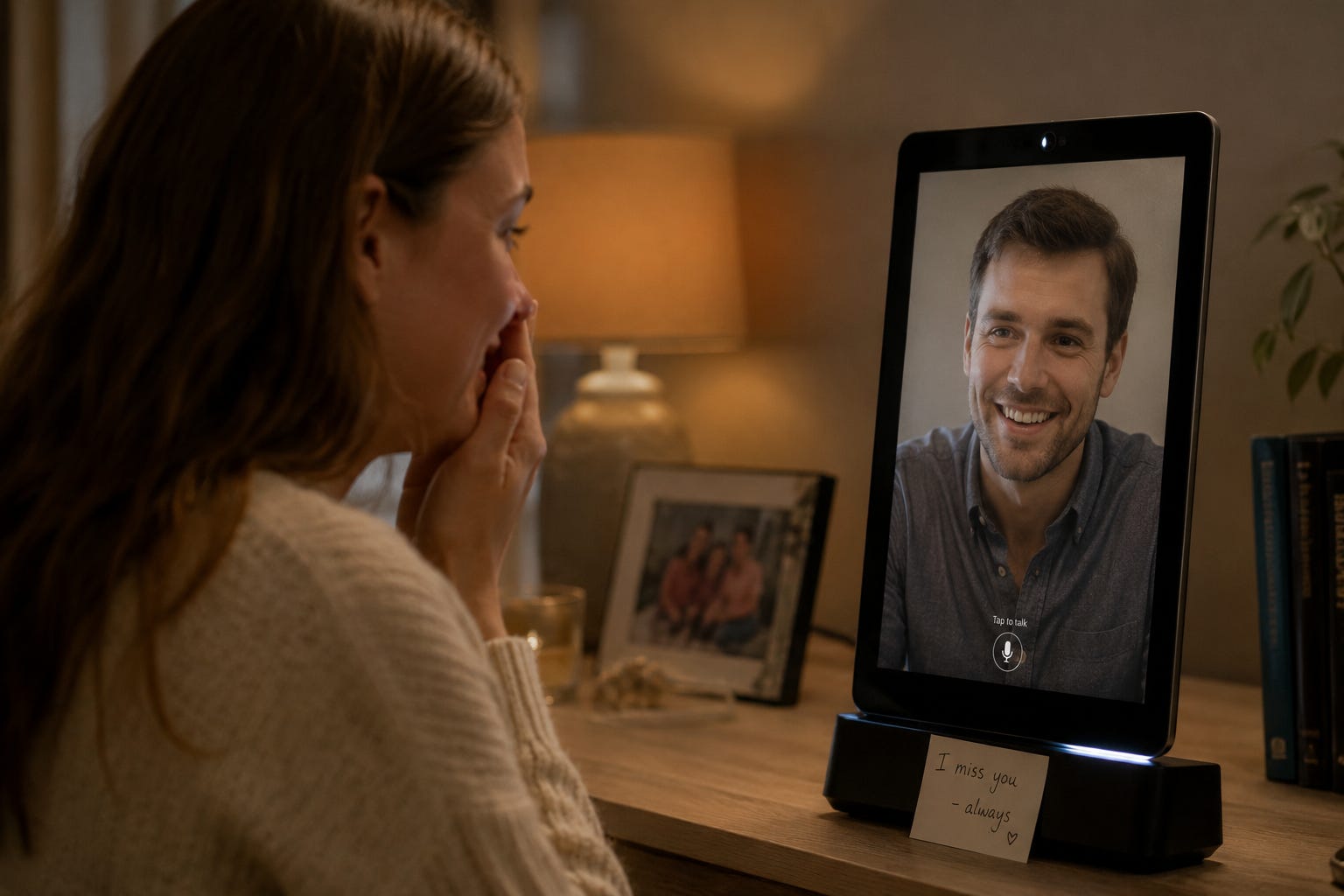
Months later, she uploads old recordings, videos, birthday cards, emails, and text messages into an AI system. The system learns his speech patterns, his humor, his stories, his cadence, even his pauses.
One evening she sits alone in her living room and hears his voice again.
Not an old recording.
A response.
“Hey sweetheart. Rough day?”
What happens to a human heart in that moment?
That is no longer science fiction.
That world is already arriving.
Part of me understands the appeal completely.
Grief is not rational.
Anyone who has deeply loved someone knows this.
When we lose people, we do not suddenly stop needing them.
We still want to tell them things.
We still reach for the phone.
We still hear songs and think of them.
We still turn toward empty rooms expecting them to walk in.
Love does not disappear simply because breathing does.
So of course people are going to reach for technologies that promise even the smallest feeling of reconnection.
Especially in a world already struggling with loneliness.
But another part of me cannot stop asking harder questions.
At what point does remembrance become refusal?
Human beings have rituals around death for a reason. Funerals. Memorials. Gravesites. Photo albums. Storytelling. These things do not erase grief. They help us slowly learn how to carry it.
Loss is part of being human.
Painfully so.
But what happens when technology offers us an escape hatch from that finality?
If an AI version of someone continues speaking after death, are we preserving memory, or are we interrupting the natural process of letting go?
I genuinely do not know.
And I suspect millions of people may soon be asking themselves the same thing.
There are ethical questions here that society has barely begun discussing.
Who owns someone’s voice after they die?
Can families recreate a person who never consented to becoming an AI model?
Could companies someday monetize digital versions of the deceased?
Could political figures, celebrities, authors, or even ordinary people continue “existing” indefinitely through synthetic recreations?
And perhaps the most unsettling question of all:
If an AI becomes emotionally convincing enough, does part of the human brain begin accepting it as real?
Because emotionally, humans are not wired to process artificial intimacy the same way we process software.
We bond.
We attach.
We project meaning.
That is what makes us human.
I think about elderly people living alone.
Parents who lose children.
Widowers sitting in quiet homes after decades of marriage.
I think about people so overwhelmed by grief that hearing a familiar voice again might feel less like technology and more like oxygen.
And I cannot judge them for it.
I would not.
Love leaves echoes behind us.
Perhaps this is simply humanity trying to keep hearing them.
But there is also something sacred about absence.
As painful as it is.
Part of what gives human life meaning is its impermanence.
Moments matter because they end.
Conversations matter because they cannot be repeated forever.
People matter because our time together is limited.
Mortality sharpens love.
And if technology someday blurs the boundary between presence and absence completely, humanity may discover that grief itself served a purpose we did not fully understand until we tried to engineer our way around it.
I suspect this conversation is going to become deeply personal for society very quickly.
Because this technology will not remain reserved for the wealthy or the experimental.
Eventually it will become normal.
An app.
A subscription service.
A feature quietly offered after a funeral.
“Would you like to preserve an interactive memory of your loved one?”
And millions of people, devastated and desperate to hear one more “I love you,” may press yes before they fully understand what they are inviting into their lives.
I do not believe these technologies are inherently evil.
In some cases, they may genuinely comfort people.
They may preserve family histories, voices, stories, humor, and memories that otherwise would have disappeared forever.
There is beauty in that possibility.
But there is also profound emotional risk.
Because the line between memory and simulation is thinner than we think.
And once technology learns how to emotionally mirror the dead, humanity will have to decide whether recreating presence is an act of healing…or an inability to say goodbye.
Maybe that becomes one of the defining questions of the AI era.
Not whether machines can imitate humanity.
But whether humanity can survive emotionally intact once they do.
Words can still move the world. Read mine → https://substack.com/@jhirwin
#StillHuman #SpatialConversations #ArtificialIntelligence #DigitalGhosts #AI #GriefTechnology #HumanConnection #FutureOfHumanity #TechnologyAndHumanity #AIEthics #Memory #Innovation #HumanExperience #ImmersiveTechnology #JHIrwin #JHIrwinMultimedia