


By J. H. Irwin
Author | Storyteller | Exploring the Human Experience Through Words
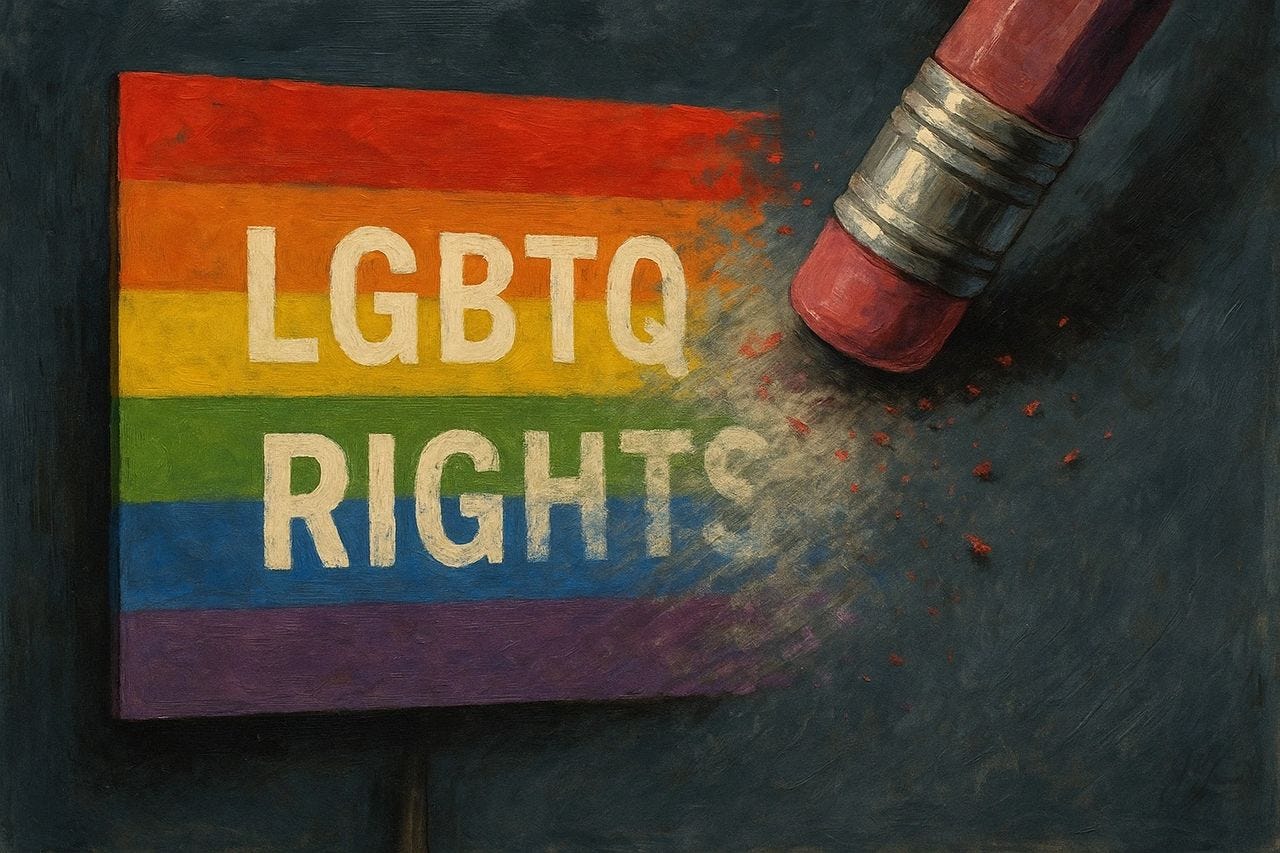
The rainbow crosswalk at the Pulse nightclub in Orlando was more than paint on pavement. It was a memorial, a promise, and a public declaration that love would triumph over hate. This summer, state officials quietly painted it over in the dead of night, citing a new rule banning “surface art” with “political or ideological messages.” For survivors and families of the 49 lives lost there, this was not about street maintenance. It was an act of erasure.
From crosswalks to courtrooms, LGBTQ+ communities are being told, in big and small ways, that they do not belong. The human cost is profound. Behind every new restriction is a family trying to stay intact, a child trying to feel safe, and a community fighting to breathe in an atmosphere thick with hostility.
The Rising Tide of Cruelty
Anti-LGBTQ legislation does not just alter laws. It alters lives. According to national surveys, more than 70 percent of LGBTQ adults report their mental health has been negatively impacted by the ongoing wave of restrictions. These are not abstract statistics. They represent hospital visits triggered by anxiety, relocations to safer states, families separated, and careers derailed.
The cruelty is often framed as “protecting children” or “restoring order,” but the true impact is destabilization. Communities are forced into survival mode. Symbols of pride are painted over. Books are banned. Teachers are gagged. Doctors are handcuffed. At the heart of it all, human dignity is diminished.
The Supreme Court Crossroads
The most alarming threat now comes from the Supreme Court. Former Kentucky clerk Kim Davis has petitioned the justices to overturn Obergefell v. Hodges, the 2015 ruling that established marriage equality nationwide. The Court has asked for responses, meaning the case is under serious consideration for the next term.
If Obergefell falls, the impact will be immediate and deeply personal. The 2022 Respect for Marriage Act ensures, for now, the federal government will continue to recognize marriages that were legally performed. Yet the law does not require every state to issue marriage licenses. This means that in more than two dozen states, bans currently sitting dormant could snap back into place. Couples might be forced to travel across state lines to marry, creating entire regions where love itself is locked out.
The consequences ripple far beyond wedding ceremonies:
Families with children could face renewed battles over parentage and custody, especially for non-biological parents.
Medical emergencies could become legal nightmares if spousal decision-making rights are not respected in states refusing licenses.
Taxes, insurance, and benefits hinge on marital status. The GAO has identified over one thousand federal laws tied to marriage. Federal recognition softens the blow, but access to marriage in your own state could still be denied.
Immigration and Social Security benefits remain linked to marriage validity. Couples living in hostile states may be forced into expensive, complicated workarounds.
Children of LGBTQ couples—nearly 300,000 nationwide, would be placed in a patchwork of protections and vulnerabilities depending on their ZIP code.
Even with the Respect for Marriage Act as a backstop, overturning Obergefell would reopen a chasm of inequality. Wealthier families may find ways around it. Families without resources will pay the steepest price.
State by State, Freedom is Shrinking
The rollback is not theoretical. Across the country, legislatures are advancing measures that roll back LGBTQ+ freedoms. Here is a snapshot of recent laws:
Alabama: SB 184 (2022) criminalizes gender-affirming care for minors. Signed by Gov. Kay Ivey.
Arkansas: Act 626 (2021) bans youth care, upheld in 2025 after federal appeals.
Florida: HB 1557 (2022), the “Don’t Say Gay” law, and HB 1069 (2023) which expanded restrictions. SB 254 (2023) limits gender-affirming care. All signed by Gov. Ron DeSantis.
Idaho: HB 71 (2023) bans youth gender-affirming care, upheld by the Supreme Court in 2024.
Indiana: SB 480 (2023) bans youth care. HEA 1608 (2023) forces schools to report pronoun changes.
Kansas: SB 180 (2023) defines sex by birth on IDs and in facilities. SB 63 (2025) bans gender-affirming care for minors, passed over a governor’s veto.
Kentucky: SB 150 (2023) restricts youth care and LGBTQ+ content in schools. Veto overridden.
Missouri: SB 49 (2023) bans youth care until 2027. SB 39 (2023) restricts sports participation.
Nebraska: LB 574 (2023) restricts care under “Let Them Grow Act.”
North Carolina: HB 808 and SB 49 (2023) passed over vetoes, banning youth care and censoring LGBTQ+ topics in schools.
Ohio: HB 68 (2024) combines a youth care ban with a sports ban.
Oklahoma: SB 613 (2023) bans youth care, upheld in 2025.
South Dakota: HB 1080 (2023) “Help Not Harm Act” bans youth care.
Tennessee: SB 1 (2023) bans youth care. Upheld by Supreme Court in U.S. v. Skrmetti.
Texas: SB 14 (2023) bans youth care. Courts have also struck down the state’s drag ban (SB 12).
Utah: SB 16 (2023) bans new access to hormones for minors.
The pattern is unmistakable. States are using legislation to shrink LGBTQ+ lives down to silence.
What Democracy Demands
This is more than a culture war. It is a democracy stress test. When governments decide which families count, which children deserve protection, and which communities are allowed visibility, they move from governing to authoritarian rule.
The stakes could not be higher. Every erased crosswalk, every censored book, every veto override is part of a larger story. It is a story of whether America chooses inclusion or exclusion, dignity or degradation, democracy or its undoing.
What We Must Do
Prepare legally: Families should update adoption papers, medical directives, and estate plans to withstand hostile states.
Document and report: Track acts of erasure and harassment with dates, names, and images. Local evidence fuels national accountability.
Vote and litigate: Use trackers from the ACLU and Movement Advancement Project to stay aware of what is happening in your state, then fight back with your vote, your donations, and your voice.
Takeaway
We cannot afford to look away. These attacks are not isolated or symbolic. They are calculated moves to roll back human rights. When crosswalks are painted over and marriage itself is put back on trial, silence becomes complicity.
To stand for democracy, we must stand for LGBTQ+ lives.