



By J. H. Irwin
Author | Storyteller | Capturing Life, Memory, and Meaning
Lately I find myself doing something I never used to do.
I brace myself before looking at prices.
Not on luxury items. Not on vacations or expensive electronics. I mean ordinary life. Gasoline. Groceries. Utility bills. A sandwich at lunch. A monthly subscription renewal. Things most of us once considered routine.
There is a different feeling in the air right now across this country. You hear it in conversations at grocery stores, in restaurants, online, and in quiet private discussions between couples trying to figure out where all the money keeps going.
People are tired. Not lazy tired. Financially exhausted tired.
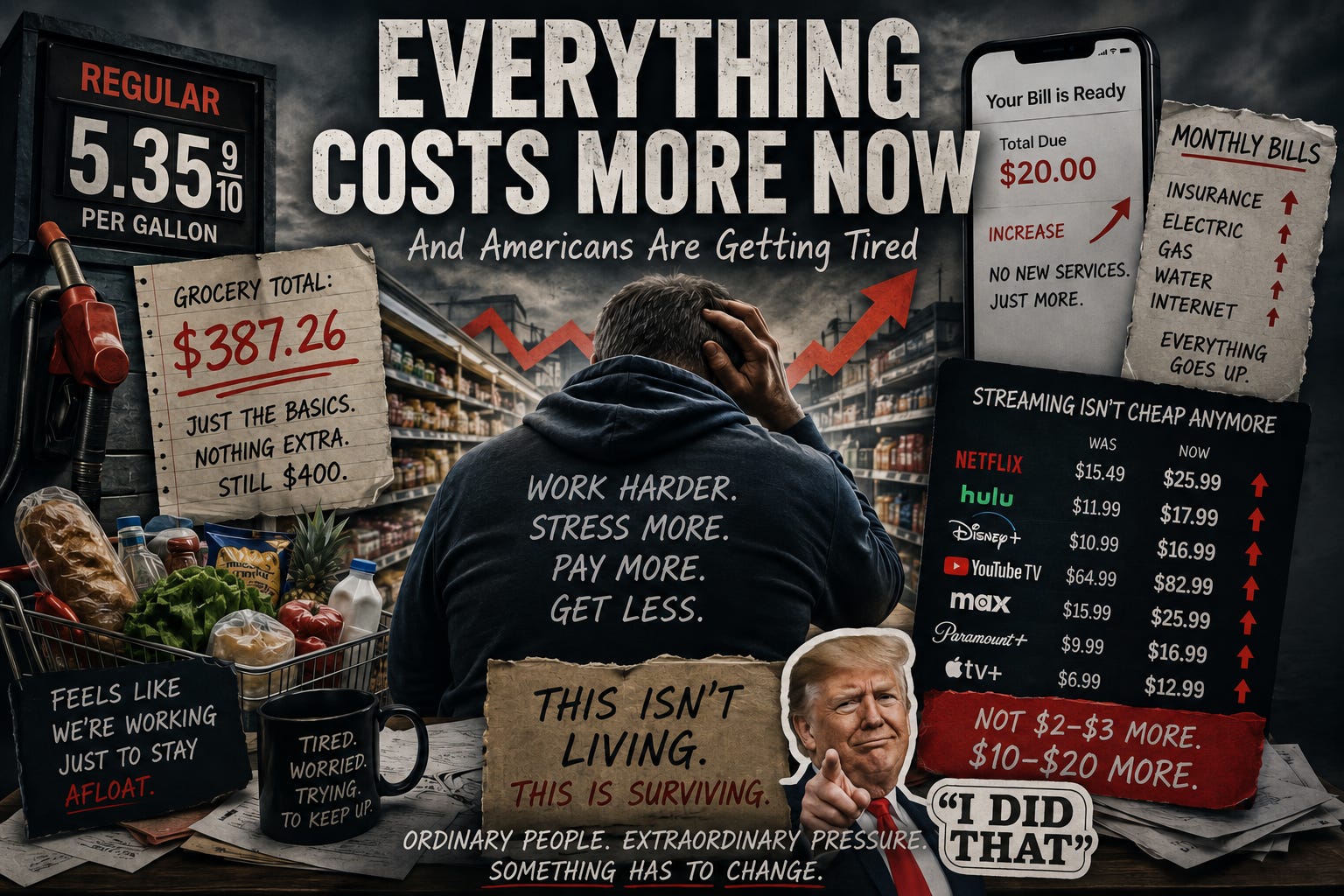
The other day my phone bill jumped another twenty dollars.
Not because I upgraded anything. Not because I added a new line. It just went up. Again.
Then I filled my gas tank…five dollars and thirty-five cents a gallon.
I stood there watching the numbers spin upward on the pump faster than I could even process them and thought to myself, when exactly did this become normal?
Then came the grocery store. Four bags. A few basics. Nothing extravagant. And somehow the total was pushing four hundred dollars. Again.
And here is the part nobody really talks about enough.
It is not just the big obvious expenses anymore.
It is death by a thousand smaller increases.
Streaming TV apps that used to creep up two or three dollars are now jumping ten, fifteen, sometimes twenty dollars at a time.
One service goes up.
Then another.
Then another.
Before long you look at your bank statement and realize watching television now costs almost as much as cable once did, the very thing streaming was supposed to replace.
Netflix climbs.
Hulu climbs.
Disney climbs.
YouTube TV climbs.
Paramount climbs.
Max climbs.
Apple TV climbs.
Everything climbs.
Every company sends the same carefully polished email explaining how the increase is necessary to “continue improving your experience.”
Meanwhile your experience is wondering how many subscriptions you now need to cancel just to feel financially comfortable again.
People feel nickel-and-dimed to death in America right now.
And it is not just entertainment.
Insurance premiums are exploding.
Electric bills are climbing.
Restaurant meals that used to cost thirty dollars somehow become seventy.
Fast food meals now cost what sit-down restaurants once charged.
Even simple comfort has become expensive.
And people notice.
They notice smaller product sizes for the same price.
They notice groceries disappearing from shelves faster because families are buying only what they absolutely need.
They notice older Americans quietly returning to work because retirement no longer feels secure enough.
They notice younger people wondering if home ownership is permanently out of reach.
What frustrates people most is not simply inflation itself.
It is the feeling that nobody in power seems to fully grasp what daily life now feels like for ordinary Americans.
Because this is not theory anymore.
This is not politics on television.
This is real life.
This is standing in a checkout line mentally calculating what can go back on the shelf.
This is couples quietly discussing whether they should cancel another streaming service, delay another repair, skip another dinner out, or put off another doctor appointment.
This is the emotional exhaustion of constantly adjusting. Constantly recalculating. Constantly absorbing increases from every direction.
Under Trump 2.0, Americans were promised relief.
What many are feeling instead is pressure. Relentless pressure.
And yes, economists can debate causes all day long. Supply chains. Energy markets. Tariffs. Corporate pricing. Global instability. Monetary policy.
Regular people are not living inside economic white papers.
They are living inside monthly bills.
That is the difference.
And eventually something happens psychologically to a country when ordinary life begins feeling financially out of reach.
People become angrier. Shorter with one another. More anxious. More divided.
You can feel it everywhere now.
The low-grade tension. The fatigue.
The sense that everyone is working harder simply to stand still.
Americans are resilient. We always have been.
But resilience should not require people to normalize constant financial anxiety just to survive ordinary life.
At some point we need leaders willing to stop speaking in slogans and start acknowledging what people are actually experiencing.
Because when a tank of gas feels stressful, groceries feel stressful, electricity feels stressful, and even sitting down at night to watch television feels stressful, this stops being about politics.
It becomes about quality of life.
And right now, for a lot of Americans, that quality of life feels like it is slipping further away month by month.
Words can still move the world. Read mine → https://substack.com/@jhirwin