


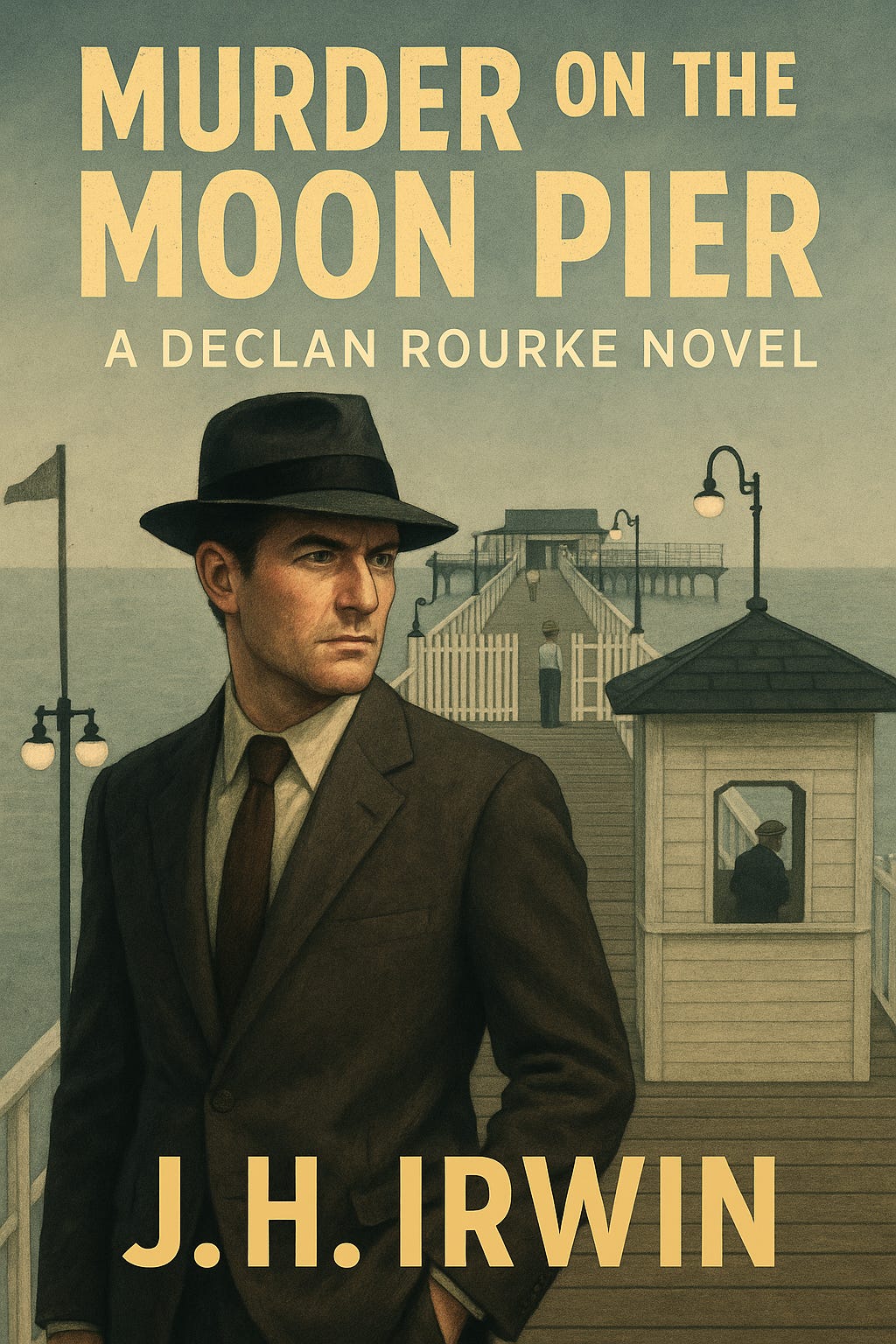
Murder On The Moon Pier
A Declan Rourke Novel
Book One
By J. H. Irwin
Copyright
Copyright © 2026 by J. H. Irwin Multimedia LLC
All rights reserved.
No part of this book may be reproduced or transmitted in any form or by any means, electronic or mechanical, including photocopying, recording, or by any information storage and retrieval system, without written permission from the publisher, except for brief quotations used in reviews.
Published by J. H. Irwin Multimedia LLC
Tampa, Florida
www.jhirwin.com
First Edition: 2026
Dedication
For the places that raise us,
the people who leave marks even when they leave quietly,
and the truths that refuse to stay buried.
Acknowledgments
This novel would not exist without the living memory of a place and its people.
I am grateful to the residents of Luna Pier and Allen’s Cove, past and present, whose stories, recollections, and quiet remembrances shaped the emotional truth of this book. To the voices of old-timers, neighbors, and family friends who spoke of moonlit dances, trolley bells, storms, and secrets with equal ease, thank you.
I also extend my appreciation to those who offered insight into Great Lakes history, Prohibition-era smuggling, and the lived reality of waterfront communities shaped by both beauty and danger.
Finally, thank you to every reader who understands that fiction often tells the truth more honestly than fact ever could.
Epigraph
“The lake remembers everything.
The pier hears it all.”
Declan Rourke
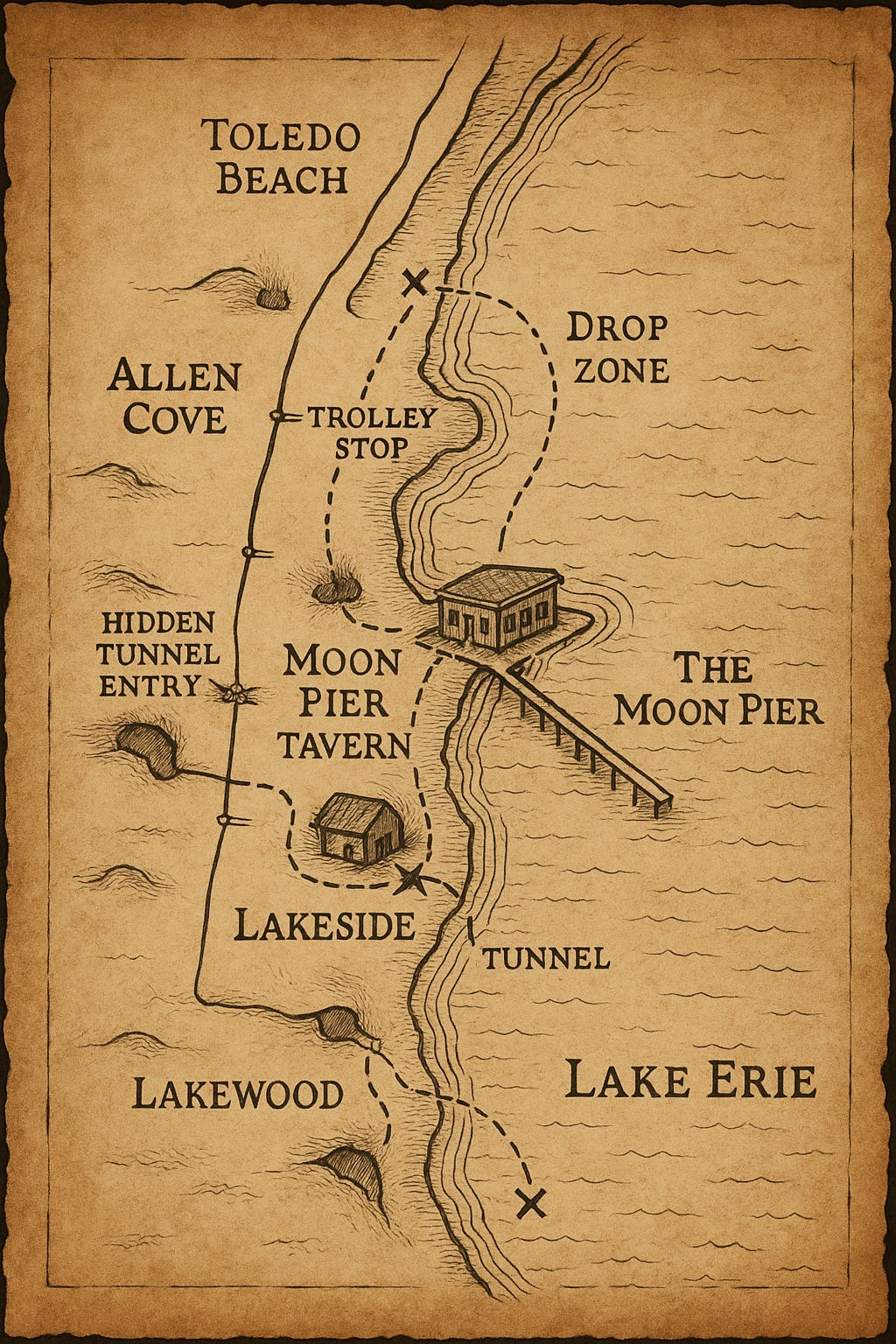
Smuggler’s Map
Author’s Note
This is a work of fiction, but it is rooted deeply in memory.
Allen’s Cove and Luna Pier are the heart of my childhood. Long before I understood history, crime, or the weight of unspoken things, I knew the rhythms of this place. Summer days that seemed endless. Neighbors who felt like extended family. Evenings filled with cicadas and lake air. Storms that reminded us the water could turn without warning.
I grew up hearing stories. Some were gentle. Some were joyful. Some were told with lowered voices and knowing looks. Stories of trolley cars bringing laughter from Toledo. Of music drifting over the lake. Of bootleggers, gamblers, and men who made fortunes quietly. Of storms that flooded homes and neighbors who helped each other rebuild without complaint.
This novel is not an attempt to document history. It is an attempt to honor its emotional truth.
Murder on the Moon Pier imagines what happens when the past refuses to remain nostalgic, when buried power resurfaces, and when the beauty of a place becomes the perfect cover for violence. The Luna Pier of this story is both real and imagined. Its spirit is authentic. Its crimes are fictional. Any resemblance to real persons is coincidental, though the echoes of history are intentional.
This book is the first in a series featuring Declan Rourke, a man shaped by the Great Lakes and haunted by the costs of survival. His journey begins here, in a town that looks peaceful by daylight and dangerous by moonlight.

Series Introduction: Declan Rourke
Declan Rourke understands places like Luna Pier because he understands what they hide.
A former bootlegger turned reluctant investigator, Rourke lives in the space between legitimacy and survival. He knows how power moves when it believes no one is watching. He knows how men justify violence when it protects legacy. And he knows that history is never finished with us, no matter how much time passes.
Each novel in the Declan Rourke series explores a different Great Lakes community, a different buried crime, and a different strand of an interconnected network that spans decades, cities, and fortunes.
Murder On The Moon Pier is where that journey begins.
The first body.
The first secret.
The first thread pulled from a web that was never meant to be seen.
A Brief History of Luna Pier and Allen’s Cove
(As Known to the Lake)
Before Luna Pier was a name spoken with affection or nostalgia, it was marshland and woodland pressed against the restless edge of Lake Erie.
In the late nineteenth century, a settler named Victor Dussia saw promise where others saw swamp. He and his son Paul cleared land near the water and carved a rough road toward the lake. A modest tavern and general store followed. Fishermen came. Traders passed through. A settlement began to take shape.
By the early 1900s, the shoreline had organized itself into three closely knit neighborhoods: Allen’s Cove, Lakewood, and Lakeside. Allen’s Cove, curved gently and protected from the lake’s worst moods, became a natural harbor. Cottages and boathouses rose directly at the water’s edge. Life revolved around fishing, porches, sunsets, and the quiet agreements neighbors make when the lake is both provider and threat.
Everything changed when the trolley arrived.
Electric interurban cars linked this quiet shore to Toledo, Ohio, carrying families, commuters, and thrill-seekers north to Toledo Beach. The shoreline transformed into a leisure corridor. Summers filled with laughter, music, and movement. Businessmen sent their families north for the season. Children grew up measuring time by swims and sunsets. The lake became both playground and pathway.
In 1920, Luna Pier reached its golden hour.
A long wooden pier extended boldly into Lake Erie, crowned with a grand dance pavilion built directly over the water. At night, strings of lights traced its outline. Music drifted across the lake. Couples danced while waves rolled beneath their feet. Big bands played. Guy Lombardo. Benny Goodman. Duke Ellington. The pier became the heart of the community and the symbol that gave the town its name.
But where music gathers, shadows follow.
Prohibition turned the Great Lakes into highways for contraband. Quiet coves like Allen’s Cove offered perfect landing points. Trolley stops provided cover. Dance halls provided anonymity. Rumors spread of speakeasies hidden behind respectable doors, of men from Detroit and Toledo mingling with crowds, of deals made while trumpets played and laughter rose.
Some of these stories were true. Some were embellished. All of them left residue.
By the 1940s, time and nature reclaimed the pier. Ice and storms destroyed the structure that had defined the town. The trolley disappeared. The crowds thinned. Luna Pier settled into a quieter life, carrying its memories like heirlooms.
Storms returned in later decades. Floods tested the shoreline. Neighbors rebuilt. The town incorporated. Break walls rose. The lake was respected again.
Today, Luna Pier remains a place of beauty and resilience. A town where history feels close enough to touch. Where moonlight on the water can still make you imagine music that is no longer there.
And where, beneath the surface, some things were never truly washed away.
Character Biographies
Declan Rourke
Declan Rourke is a former bootlegger who learned early that survival and morality rarely move in the same direction. He spent years inside the machinery of smuggling operations along the Great Lakes, long enough to understand how power hides behind respectability and how violence is often disguised as necessity.
He left that world, but it never released him. Rourke sees structure where others see coincidence. He recognizes patterns of control, silence, and inherited influence. What looks like tradition to most looks like protection to him.
Rourke’s defining trait is restraint. He listens more than he speaks, studies before he acts, and carries a personal code shaped by experience rather than law. He is not driven by justice in the traditional sense. He is driven by a refusal to ignore what he knows to be true.
His greatest vulnerability is connection. The more he allows himself to care, particularly for Catherine Leclair, the more exposed he becomes. In Murder On The Moon Pier, Rourke is pulled into a system that mirrors the world he escaped, forcing him to confront whether redemption is possible or simply another illusion men tell themselves to survive.
Catherine Leclair
Catherine Leclair is intelligent, perceptive, and far more dangerous than she first appears. Raised in the shadow of smuggling and silence, she learned early how to read people, control emotion, and recognize when truth is being buried.
She is not a passive observer of her brother’s death. She is an active force within the investigation.
Catherine’s defining drive is agency. She refuses to be reduced to grief or sidelined by men who underestimate her. She wants answers, not comfort, and she is willing to step into the same dangerous world that killed her brother to find them.
Her strength lies in duality. She balances emotional depth with calculated thinking, grief with discipline, and vulnerability with resolve. She understands the language of the underworld in ways Rourke respects and relies on.
Her greatest vulnerability is loyalty. Her love for Leo binds her to a path she cannot walk away from, even when she understands the cost. Her relationship with Rourke evolves from cautious alignment into something more complex, built on mutual recognition, shared risk, and a growing emotional tension neither fully trusts.
Catherine is not simply part of the story. She is one of its engines.
Detective Jack Bennett
Detective Jack Bennett is one of the last honest men working inside a compromised system. A lifelong resident of Lakeside, he understands the town’s rhythms, its silences, and the quiet ways cases disappear when they reach the wrong names.
Bennett’s defining trait is endurance. He stayed when others looked away. He learned how corruption functions without becoming part of it. He believes in the law, but he no longer believes the law is enough on its own.
His alliance with Rourke begins as necessity but evolves into trust. Rourke operates outside the system Bennett is bound to, and together they form a balance between structure and instinct.
His vulnerability is isolation. Integrity has cost him allies, advancement, and safety. He knows that standing clean in a compromised environment makes him a target.
Within the story, Bennett serves as both anchor and warning. He represents what it means to fight for justice from inside a system that was never designed to fully support it.
Madame Celeste
Madame Celeste is the architect and guardian of Lakeside’s hidden power structure. Cultured, controlled, and outwardly untouchable, she represents a lineage of influence built during Prohibition and sustained through adaptation rather than force.
She does not rely on visible violence. She relies on knowledge, leverage, and the certainty that most people will choose silence over disruption.
Celeste’s defining objective is preservation. To her, the past is not history. It is infrastructure. It is the foundation of wealth, control, and identity. She protects it with precision and without hesitation.
Her power lies in subtlety. She rarely acts directly, instead shaping outcomes through others, including figures like Vincent Rossi.
Her vulnerability is miscalculation. Celeste underestimates those who operate outside her controlled system, particularly Rourke, whose unpredictability disrupts her assumptions.
She is not simply an antagonist. She is a system embodied in a single individual.
Vincent Rossi
Vincent Rossi is an enforcer from Detroit’s organized crime network, brought in when problems require finality. He is disciplined, efficient, and emotionally detached, operating without ideology or sentiment.
Rossi does not create power. He protects it.
His defining trait is precision. He executes outcomes cleanly, without spectacle, and without personal investment. Violence, to him, is not emotional. It is procedural.
His presence in Lakeside signals escalation. When Rossi is involved, the situation has moved beyond control and into containment.
His vulnerability is conditional loyalty. Rossi’s allegiance is transactional. If the balance of power shifts, so can he.
Within the narrative, Rossi represents the physical enforcement arm of legacy crime, the necessary brutality behind otherwise refined systems of control.
Carl Mason
Carl Mason operates as a mid-level figure within Lakeside’s criminal hierarchy, managing gambling operations and collections. Unlike those above him, Mason is visible, loud, and reactive.
He is not power. He is proximity to power.
Mason’s defining motivation is survival. He aligns himself with whoever ensures his continued relevance and protection, even as he senses how easily he could be discarded.
His weakness is pressure. Under scrutiny, Mason becomes unstable. His usefulness lies in misdirection, and his expendability is understood by those who use him.
He represents the outer layer of the network, the part designed to be seen, blamed, and sacrificed if necessary.
Leo Leclair
Leo Leclair is the catalyst of the story. A smuggler driven by ambition, he believed the past held untapped power that could be claimed, controlled, and leveraged.
He was right.
Leo’s defining trait was hunger. Not just for money, but for status, influence, and independence from the hierarchy that confined him.
His fatal flaw was underestimation. He believed knowledge could protect him. He failed to understand that knowledge, in the wrong system, is the most dangerous liability of all.
In death, Leo becomes more powerful than he was in life. His actions expose the foundation of Lakeside’s hidden network and force others to confront truths long buried.
Alistair Thorne
Alistair Thorne exists beyond Lakeside, but his influence reaches into it. A financier with vast, abstracted power, he represents the evolution of legacy crime into modern systems of control.
Thorne does not operate in shadows.
He operates above them.
His defining objective is invisible control. He does not involve himself in the mechanics of violence. He ensures outcomes through distance, influence, and layered networks.
Where Celeste preserves the past, Thorne scales it.
As the series expands, Thorne becomes the larger threat. Proof that the systems built in places like Lakeside were never isolated. They were prototypes.
He is not the end of the story.
He is the expansion of it.
Chapter 1: The Moon Pier
The Moon Pier stretched into Lake Erie like a promise made in wood and light.
A long spine of timber and iron reached out from the Lakeside shoreline, daring the water to take it. Beneath it, the lake moved with slow patience, tapping against the pilings as if counting time.
It had been here before the music.
Before the crowds.
Before anyone believed they could build something beautiful on top of it and expect it to hold.
Tonight, the pier belonged to the living.
Strings of bulbs traced its length in soft arcs, each one glowing against the dark. Farther out, the dance pavilion burned brighter, open to the night, filled with motion and sound. Brass carried over the water. Drums followed. The music had weight to it, something steady enough to pull people into it whether they meant to move or not.
Laughter rose. Shoes struck the boards. Couples turned and returned, hands finding each other again and again.
The air held everything at once. Butter and salt. Smoke and perfume. The clean edge of the lake cutting through it all.
It was a stage built above water.
And water remembered.
Declan Rourke stood at the entrance where the pier met shore.
He didn’t move with the crowd. He let it pass him, bodies brushing close, voices rising and falling without consequence. He stood just outside the rhythm of it, as if he belonged to the structure more than the people.
His coat was right for the weather. Linen. Light. Respectable.
Nothing else about him was.
The brim of his fedora kept his eyes in shadow. That suited him. He watched without appearing to.
Crowds didn’t bother him.
Crowds lied.
They hid things in plain sight. Smoothed over edges. Turned sharp moments into forgettable ones. A man could do a great deal inside noise if he understood how attention worked.
Rourke understood.
He had once been the kind of man who depended on it.
The broken line of his nose told part of that story. The rest sat behind his eyes, dark and steady, moving without hurry.
He wasn’t here for the music.
He was here for what moved underneath it.
The Moon Pier had always carried more than what it showed. Even now, with the band playing and the crowd pressing close, there was something else running beneath it. Older. Quieter. Not gone.
Places like this didn’t forget what they were built on.
Lakeside had once been little more than marsh and shoreline. Then came the first houses. A road. A tavern. Enough to call it a town. Allen’s Cove curved along the water, protected just enough to make it useful. Boats could come in without drawing attention. Boats could leave the same way.
Then the trolley arrived.
Everything after that came faster.
Families. Music. Money.
A pier that reached out into the lake and refused to apologize for it.
At the shore end sat the Moon Pier Tavern. Low. Solid. Built to last longer than the stories told inside it. Its neon sign hummed in red and blue, casting tired light across the boardwalk.
The windows were fogged. The laughter that slipped through the door wasn’t the same as the laughter out on the pier.
It was rougher.
More honest.
Rourke let his gaze pass over it and move on.
Down the length of the pier, the night played out exactly as it was meant to. Dresses caught the light when women turned. Jackets hung loose over shoulders. The lake breeze moved through it all, touching skin, shifting fabric, reminding everyone where they were.
For most of them, that was enough.
For Rourke, it wasn’t.
The shift came quietly.
Flashing light, out of place against the warm glow.
A patrol car sat farther down the pier, its red and blue cutting through everything else. Not loud. Not dramatic.
Just wrong.
Some people pretended not to notice. Others looked too long, then looked away. The music didn’t stop. It never did.
It simply moved around the disruption.
Rourke adjusted his hat and started walking.
The crowd closed in as he moved through it. A shoulder brushed his arm. Someone laughed too close to his ear. Perfume lingered for a second, then disappeared into something else.
He moved through it all without resistance, like a shadow crossing light.
At the edge of the scene, uniformed officers held people back with more effort than authority. This wasn’t a fight. Not a drunk. Not something easy to explain.
This made people careful.
Detective Jack Bennett stood just inside the line.
“Rourke,” he said.
No surprise in his voice. Just acknowledgment.
“You came.”
“What happened?”
Bennett hesitated. Not long. Just enough.
“Leo Leclair,” he said. “Smuggler. Or he was.”
A beat.
“Ice pick to the back of the neck.”
Rourke stepped past him and crouched.
The body lay near a scatter of overturned chairs. Confetti clung to damp boards where blood had settled into the cracks. The music continued behind them, louder now, as if distance could make it irrelevant.
Rourke didn’t touch anything.
He didn’t need to.
The angle of the neck. The position of the hands. One curled tight, like it had been holding onto something that never made it out.
He saw the mark in the wood.
Faint.
Dragged.
This hadn’t happened here.
He shifted his gaze.
A crushed handbag. Sequins dulled by the floor. Something beneath it caught the light.
He reached carefully and lifted it.
A poker chip.
Red spade.
Turned once between his fingers, the letters showed through the smear.
“CM.”
He held it out.
Bennett’s jaw tightened. “Carl Mason.”
“Convenient.”
Bennett didn’t argue.
Rourke rose slowly, his eyes already moving past the body, past the officers, back into the crowd.
There were men who weren’t dancing.
Men who watched.
Men who stood near the tavern door like they had somewhere else to be but hadn’t decided when.
The pier felt different now.
Not because of the body.
Because of what had shifted around it.
“This is where you start,” Bennett said.
Rourke looked at him.
“This is where someone wants you to start.”
Bennett followed his gaze down the pier, then back again. “And you think that’s wrong.”
“I think it’s easy,” Rourke said.
“And you don’t like easy.”
Rourke glanced once more at the chip in Bennett’s hand.
“No,” he said. “I don’t.”
He turned toward the water.
The lake stretched out beyond the railing, dark and steady, the surface moving in ways that didn’t show themselves unless you stood still long enough to see them.
The Moon Pier carried music.
Carried laughter.
Carried light.
But beneath all of it, something else remained.
Rourke watched the water for a moment longer, then turned back toward the pier.
“Leclair didn’t die here,” he said.
Bennett looked at him. “Then where?”
Rourke’s gaze drifted north, past the lights, toward where the shoreline disappeared into something darker.
“Somewhere quieter,” he said.
The music swelled again behind them.
The crowd closed ranks.
And the night went on, exactly as if nothing had happened.
But the lake kept moving.
And it remembered.