


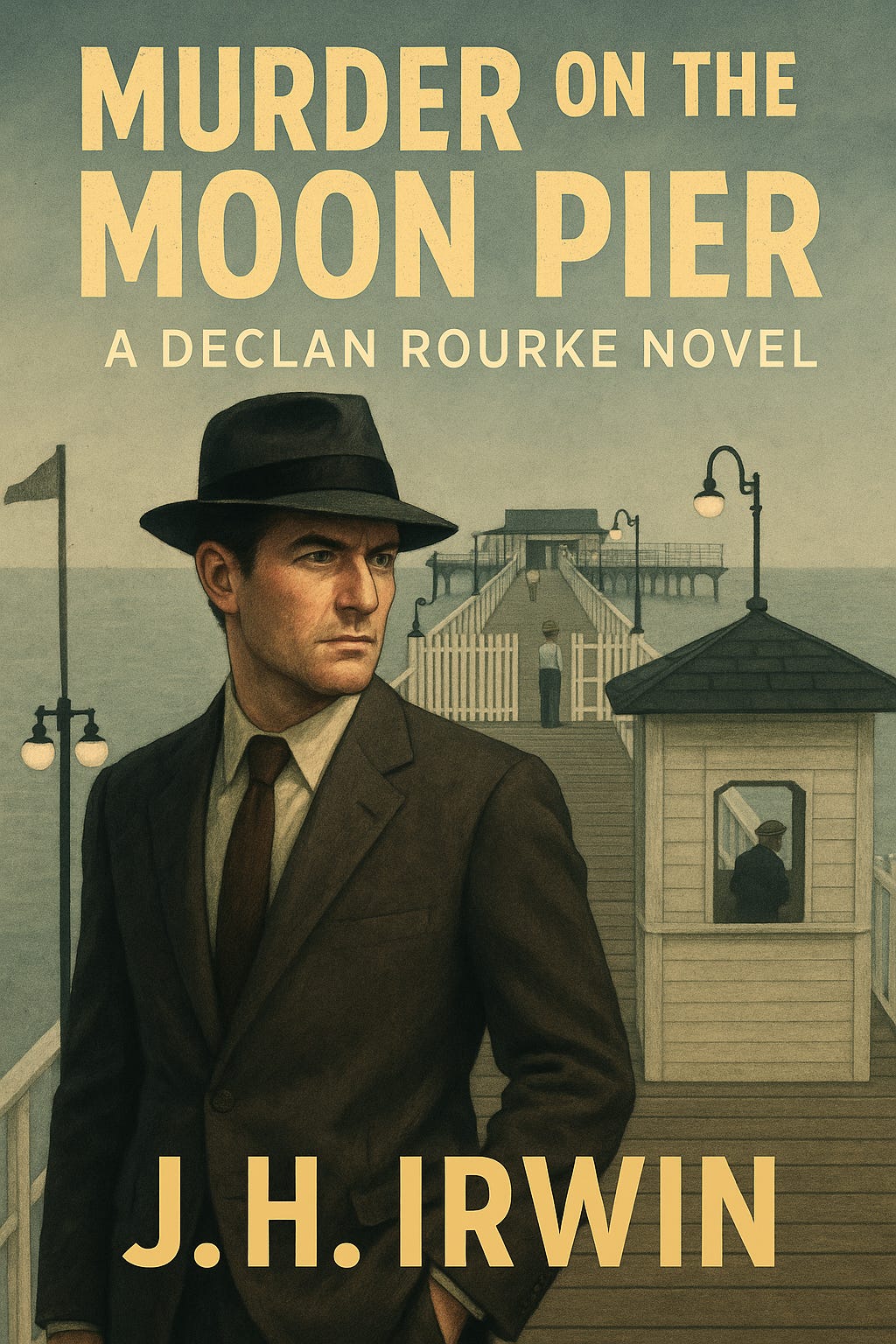

Murder On The Moon Pier
A Declan Rourke Novel
Book One
By J. H. Irwin
Copyright
Copyright © 2026 by J. H. Irwin Multimedia LLC
All rights reserved.
No part of this book may be reproduced or transmitted in any form or by any means, electronic or mechanical, including photocopying, recording, or by any information storage and retrieval system, without written permission from the publisher, except for brief quotations used in reviews.
Published by J. H. Irwin Multimedia LLC
Tampa, Florida
www.jhirwin.com
First Edition: 2026
Dedication
For the places that raise us,
the people who leave marks even when they leave quietly,
and the truths that refuse to stay buried.
Acknowledgments
This novel would not exist without the living memory of a place and its people.
I am grateful to the residents of Luna Pier and Allen’s Cove, past and present, whose stories, recollections, and quiet remembrances shaped the emotional truth of this book. To the voices of old-timers, neighbors, and family friends who spoke of moonlit dances, trolley bells, storms, and secrets with equal ease, thank you.
I also extend my appreciation to those who offered insight into Great Lakes history, Prohibition-era smuggling, and the lived reality of waterfront communities shaped by both beauty and danger.
Finally, thank you to every reader who understands that fiction often tells the truth more honestly than fact ever could.
Epigraph
“The lake remembers everything.
The pier hears it all.”
Declan Rourke
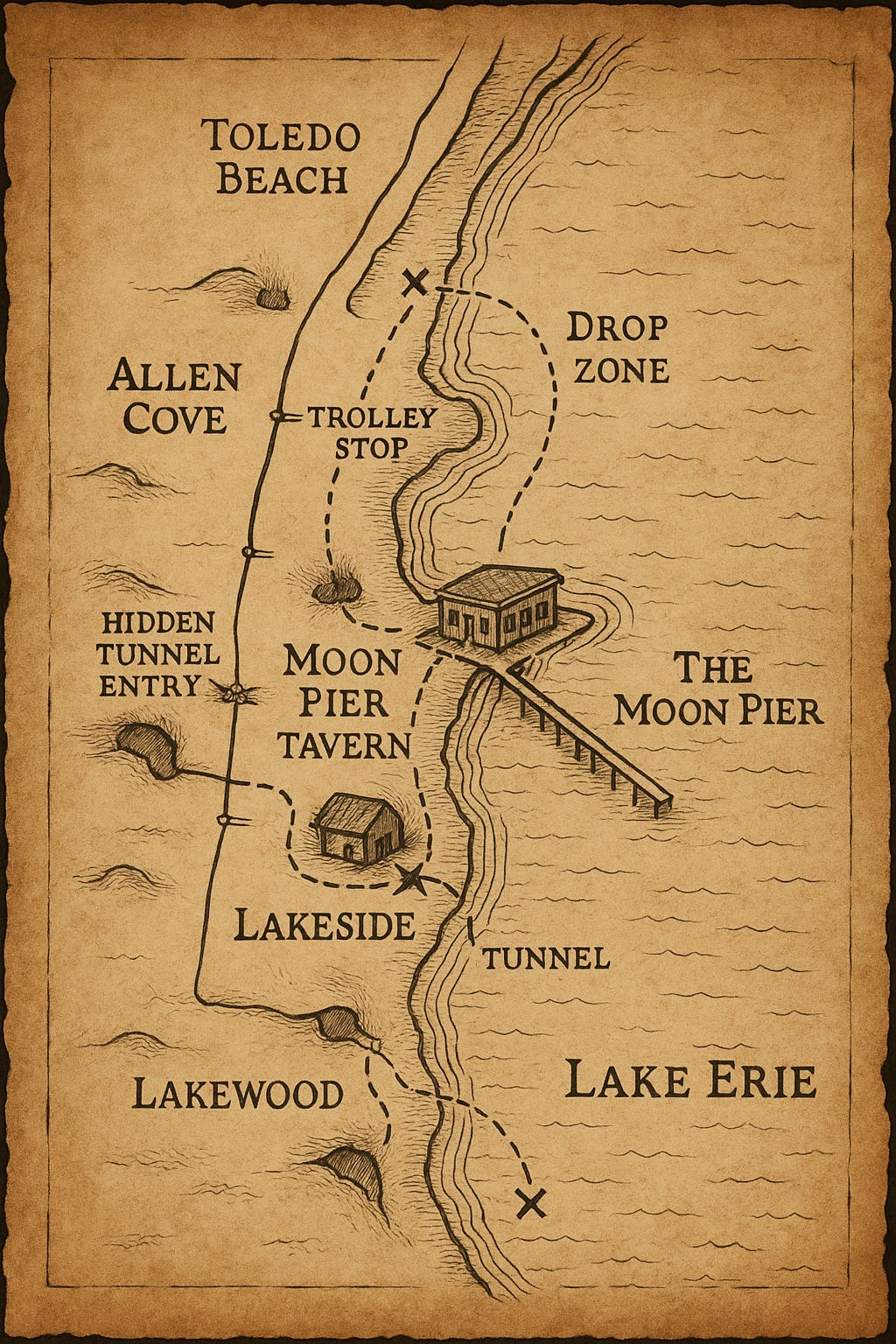
Smuggler’s Map
Author’s Note
This is a work of fiction, but it is rooted deeply in memory.
Allen’s Cove and Luna Pier are the heart of my childhood. Long before I understood history, crime, or the weight of unspoken things, I knew the rhythms of this place. Summer days that seemed endless. Neighbors who felt like extended family. Evenings filled with cicadas and lake air. Storms that reminded us the water could turn without warning.
I grew up hearing stories. Some were gentle. Some were joyful. Some were told with lowered voices and knowing looks. Stories of trolley cars bringing laughter from Toledo. Of music drifting over the lake. Of bootleggers, gamblers, and men who made fortunes quietly. Of storms that flooded homes and neighbors who helped each other rebuild without complaint.
This novel is not an attempt to document history. It is an attempt to honor its emotional truth.
Murder on the Moon Pier imagines what happens when the past refuses to remain nostalgic, when buried power resurfaces, and when the beauty of a place becomes the perfect cover for violence. The Luna Pier of this story is both real and imagined. Its spirit is authentic. Its crimes are fictional. Any resemblance to real persons is coincidental, though the echoes of history are intentional.
This book is the first in a series featuring Declan Rourke, a man shaped by the Great Lakes and haunted by the costs of survival. His journey begins here, in a town that looks peaceful by daylight and dangerous by moonlight.

Series Introduction: Declan Rourke
Declan Rourke understands places like Luna Pier because he understands what they hide.
A former bootlegger turned reluctant investigator, Rourke lives in the space between legitimacy and survival. He knows how power moves when it believes no one is watching. He knows how men justify violence when it protects legacy. And he knows that history is never finished with us, no matter how much time passes.
Each novel in the Declan Rourke series explores a different Great Lakes community, a different buried crime, and a different strand of an interconnected network that spans decades, cities, and fortunes.
Murder On The Moon Pier is where that journey begins.
The first body.
The first secret.
The first thread pulled from a web that was never meant to be seen.
A Brief History of Luna Pier and Allen’s Cove
(As Known to the Lake)
Before Luna Pier was a name spoken with affection or nostalgia, it was marshland and woodland pressed against the restless edge of Lake Erie.
In the late nineteenth century, a settler named Victor Dussia saw promise where others saw swamp. He and his son Paul cleared land near the water and carved a rough road toward the lake. A modest tavern and general store followed. Fishermen came. Traders passed through. A settlement began to take shape.
By the early 1900s, the shoreline had organized itself into three closely knit neighborhoods: Allen’s Cove, Lakewood, and Lakeside. Allen’s Cove, curved gently and protected from the lake’s worst moods, became a natural harbor. Cottages and boathouses rose directly at the water’s edge. Life revolved around fishing, porches, sunsets, and the quiet agreements neighbors make when the lake is both provider and threat.
Everything changed when the trolley arrived.
Electric interurban cars linked this quiet shore to Toledo, Ohio, carrying families, commuters, and thrill-seekers north to Toledo Beach. The shoreline transformed into a leisure corridor. Summers filled with laughter, music, and movement. Businessmen sent their families north for the season. Children grew up measuring time by swims and sunsets. The lake became both playground and pathway.
In 1920, Luna Pier reached its golden hour.
A long wooden pier extended boldly into Lake Erie, crowned with a grand dance pavilion built directly over the water. At night, strings of lights traced its outline. Music drifted across the lake. Couples danced while waves rolled beneath their feet. Big bands played. Guy Lombardo. Benny Goodman. Duke Ellington. The pier became the heart of the community and the symbol that gave the town its name.
But where music gathers, shadows follow.
Prohibition turned the Great Lakes into highways for contraband. Quiet coves like Allen’s Cove offered perfect landing points. Trolley stops provided cover. Dance halls provided anonymity. Rumors spread of speakeasies hidden behind respectable doors, of men from Detroit and Toledo mingling with crowds, of deals made while trumpets played and laughter rose.
Some of these stories were true. Some were embellished. All of them left residue.
By the 1940s, time and nature reclaimed the pier. Ice and storms destroyed the structure that had defined the town. The trolley disappeared. The crowds thinned. Luna Pier settled into a quieter life, carrying its memories like heirlooms.
Storms returned in later decades. Floods tested the shoreline. Neighbors rebuilt. The town incorporated. Break walls rose. The lake was respected again.
Today, Luna Pier remains a place of beauty and resilience. A town where history feels close enough to touch. Where moonlight on the water can still make you imagine music that is no longer there.
And where, beneath the surface, some things were never truly washed away.
The People of Lakeside
Declan Rourke
A man who watches. He came to the lakeshore from somewhere he does not discuss, carrying a past that shows mostly in what he notices and what he declines to say. He has the patience of someone who has learned that most things reveal themselves to a man willing to wait, and the wariness of someone who once had reasons to be careful. He is not a policeman. What he is instead is harder to name.
Catherine Leclair
Composed where grief is expected, precise where the men around her expect softness. She arrives asking the questions Lakeside would prefer went unasked, and she shows no inclination to stop. Those who mistake her quiet for fragility tend to make the mistake only once.
Detective Jack Bennett
A Lakeside man, born to the town and bound to it. A long career has taught him the difference between the cases a detective is allowed to solve and the ones he is not, and the weight of that knowledge sits on him like weather off the lake. He still believes in the law. He has simply stopped believing the law can do the work alone.
Madame Celeste
She moves through the lakeshore’s brighter rooms as though they had been built around her, and people defer to her without quite being able to say why. Elegant, unhurried, entirely self-possessed, she gives the impression of someone who knows a great deal and has decided, for the moment, to keep most of it to herself.
Carl Mason
Loud, local, and impossible to miss. He runs the kind of operations a small town pretends not to see, and when something goes wrong on the shoreline, his is the first name anyone says. Whether that is because he has earned it or because it is convenient is a question Mason himself would very much like answered.
Adelaide Voss
Keeper of the Lakeside Heritage Association and its records, and the town’s memory in human form. Small, courteous, and easy to overlook, she sits among the documents of a place that has outlived everyone in it. People assume the papers are the only things in her keeping. People assume a good deal about Adelaide Voss.
Leo Leclair
A smuggler of modest reputation and immodest ambition, known along the shoreline for moving things quietly and for wanting more than the life allowed him. His death is where this begins. Everything else is what his death disturbs.
And others, whose names are not yet spoken, and whose business in Lakeside is older than the pier.
Chapter 1: The Moon Pier
The Moon Pier reached into Lake Erie like a dare.
Not a promise. A dare. Long planks of timber and iron stretching out from the Lakeside shore into water that had been making and unmaking things long before anyone thought to build here. Beneath the pier the lake moved with its usual patience, tapping against the pilings in a slow irregular rhythm, the way a man taps a table when he already knows the answer and is simply waiting for you to catch up.
Tonight the pier belonged to the living, and the living had come in numbers.
Strings of electric bulbs traced the full length of the structure in soft arcs, each one throwing warm light across the boards below. Further out, where the pier widened into the dance pavilion, the brightness gathered and held. Open walls, open sky above, and inside it all a big band playing something with enough bottom to it that you felt it in your chest before you heard it with your ears. Brass carrying over the water. Drums following. The kind of music that reached into a crowd and turned strangers into partners before anyone had decided that was what they wanted.
Laughter rose above it. Shoes struck the boards. Couples turned and found each other again, hands reaching through the warm night air like it was the easiest thing in the world.
The air held everything at once: butter and salt from the concession stands, cigarette smoke cutting through perfume, and underneath it all that clean cold edge coming off the lake, reminding you the water was right there, that the whole beautiful spectacle was balanced on top of it, eight feet of open air between the dancers and the deep.
It was exactly the kind of place where things happened that were later difficult to explain.
Declan Rourke stood at the land end of the pier, just where the boards began, and let the crowd move past him the way a river moves around a stone it has learned to ignore.
He was not quite still. His eyes moved in slow, regular sweeps that took in faces and dismissed most of them and marked a few. His coat was linen, light for the evening heat, and it fit him well enough to pass without notice. That was the point of it. Nothing about the coat asked for a second look.
Other things about him might have. The line of his nose, for one. Broken twice in different decades and set imperfectly both times, so that it sat at a slight angle to the rest of his face, a small permanent reminder that he had once lived in a world where disagreements had physical consequences. The steadiness of his eyes, for another. Most people at a place like this were in motion even when they were standing still, tilting toward the music, toward a companion, toward whatever had drawn them out on a summer night. Rourke tilted toward nothing. He simply watched.
He had spent enough years inside crowds that moved things they were not supposed to move that he had learned their grammar. A crowd lied with confidence. It smoothed things over, absorbed disruptions, gave men cover to do what daylight wouldn’t permit. You could conduct a great deal of business inside noise if you understood the mechanics of it.
Rourke understood. He had once depended on that understanding for his continued survival.
He was not here for the music.
The Moon Pier had been built on a particular kind of faith, the faith that beauty, installed directly above danger, would make people forget the danger was there. And it had worked. It was still working.
Lakeside had been marsh and shoreline before anyone made it anything else. Then a road, a tavern, a handful of cottages pressed close to the water. Allen’s Cove curved naturally around a protected stretch of shore, deep enough for modest boats, sheltered enough from Lake Erie’s tempers to make it useful year-round. People had noticed that usefulness. Different kinds of people, for different kinds of purposes.
The trolley changed everything. Electric interurban cars threading up from Toledo, carrying families and businessmen and thrill-seekers north along the lakeshore. Money arriving with the summer crowds. Cottages becoming proper houses. A pier extending out over the water because the town could afford one now and because a pier was the kind of thing a town built when it wanted to declare itself.
The pavilion came after. The dance hall. The big bands.
And in their wake, like a tide that follows a tide, other things came too.
Rourke let his gaze travel the length of the pier. Couples at the railing with the lake below them and nothing in their eyes except the night. Men at the tavern door with too much in their eyes and nowhere particular to look. The lights were generous. The music was loud. The pavilion at the end swallowed all of it and asked for more.
Everything exactly as it should be.
Which was the first thing that was wrong.
He saw the patrol car before he heard anything.
The lights were wrong. Too blue, too urgent, cutting across the warm yellow of the pier’s string bulbs like a question nobody wanted answered. The car sat midway down the structure, near the place where the boards widened slightly before the main pavilion, and the knot of people around it was doing what crowds always do when something has gone wrong in a place built for pleasure: they were pressing close and pulling back at the same time, wanting to see and not wanting to be seen wanting to see.
The music hadn’t stopped. It wouldn’t.
Rourke adjusted the brim of his hat and moved.
He went through the crowd the way he had learned to go through most things, without friction, finding the gaps, not forcing anything. A shoulder here, a slight angle there. Bodies shifted around him without knowing they were doing it. In thirty seconds he was at the edge of the scene, close enough to see the overturned chairs and the dark stain that had settled into the cracks between boards, and the shape on the ground that had recently been a man.
Detective Jack Bennett stood just inside the police line, hat in hand. He was a large man running to gray at the temples, with the particular stillness of someone who had stood at too many scenes like this to be rattled by one more. He looked up when Rourke stepped close, and something in his expression said he had been expecting him, though not necessarily wanting him.
“Rourke.”
“Bennett. What happened?”
Bennett looked at the body. Then back at Rourke. He took a long breath before he spoke.
“Leo Leclair. Ran contraband up and down this shoreline for about four years. Small-time, mostly. Somebody put an ice pick in the back of his neck, then put him here.”
Rourke heard the last two words.
“Then,” he said.
“Then.”
He stepped past Bennett and crouched over the body. He did not touch anything. He didn’t need to. The position of the hands, one open, one curled tight, the knuckles still pale with a tension that hadn’t released when everything else did. The angle of the neck. The way the blood had settled, already dark and thickened, in patterns that didn’t match the overturned chairs, the scatter of confetti, the sequined handbag lying two feet away as though someone had knocked it off a table in a hurry.
He looked at the floorboards beneath the body. Then at the floorboards six inches to the left.
A faint drag mark. Nearly invisible in the artificial light, the kind of thing you only saw if you were crouching at exactly the right angle.
Rourke reached carefully and lifted the edge of the handbag.
A poker chip. Red, with a black spade stamped in the center.
He turned it once between his fingers. On the reverse, pressed into the clay in small neat letters: CM.
He stood and held it out to Bennett.
Bennett’s jaw tightened in a way that said he had already considered this and had not liked what he’d found.
“Carl Mason.”
“Convenient,” Rourke said.
“He had motive. Leclair owed him money. A lot of it.”
“A man who collects loudly.”
“He collects however he has to.”
Rourke glanced again at the chip, then at the body, then at the mark in the wood.
“Ice picks aren’t loud,” he said. “Moving a body to a busy pier in the middle of the evening isn’t loud. Leaving someone’s monogrammed chip at the scene.” He paused. “That’s the loudest thing here. Which means someone wanted it to be found.”
Bennett was quiet for a moment.
“So we’re not looking for Mason.”
“We’re looking at who wants us looking at Mason.”
The music swelled behind them. A trumpet taking the lead now, climbing above the rest of the band and hanging there in the warm night air.
Rourke looked toward the water.
The lake stretched out past the railing, dark, steady, the surface catching the pier’s light in long uneven ripples that moved away from them and didn’t come back.
“Leclair didn’t die here,” he said.
Bennett looked at the body. Then at the drag mark. Then at Rourke.
“Then where?”
Rourke’s gaze moved north, past the pavilion, past the last of the electric lights, toward where the shoreline curved away into something darker and quieter.
“Somewhere a man could be killed,” he said, “without the music stopping.”
Chapter 2: Echoes of Toledo Beach
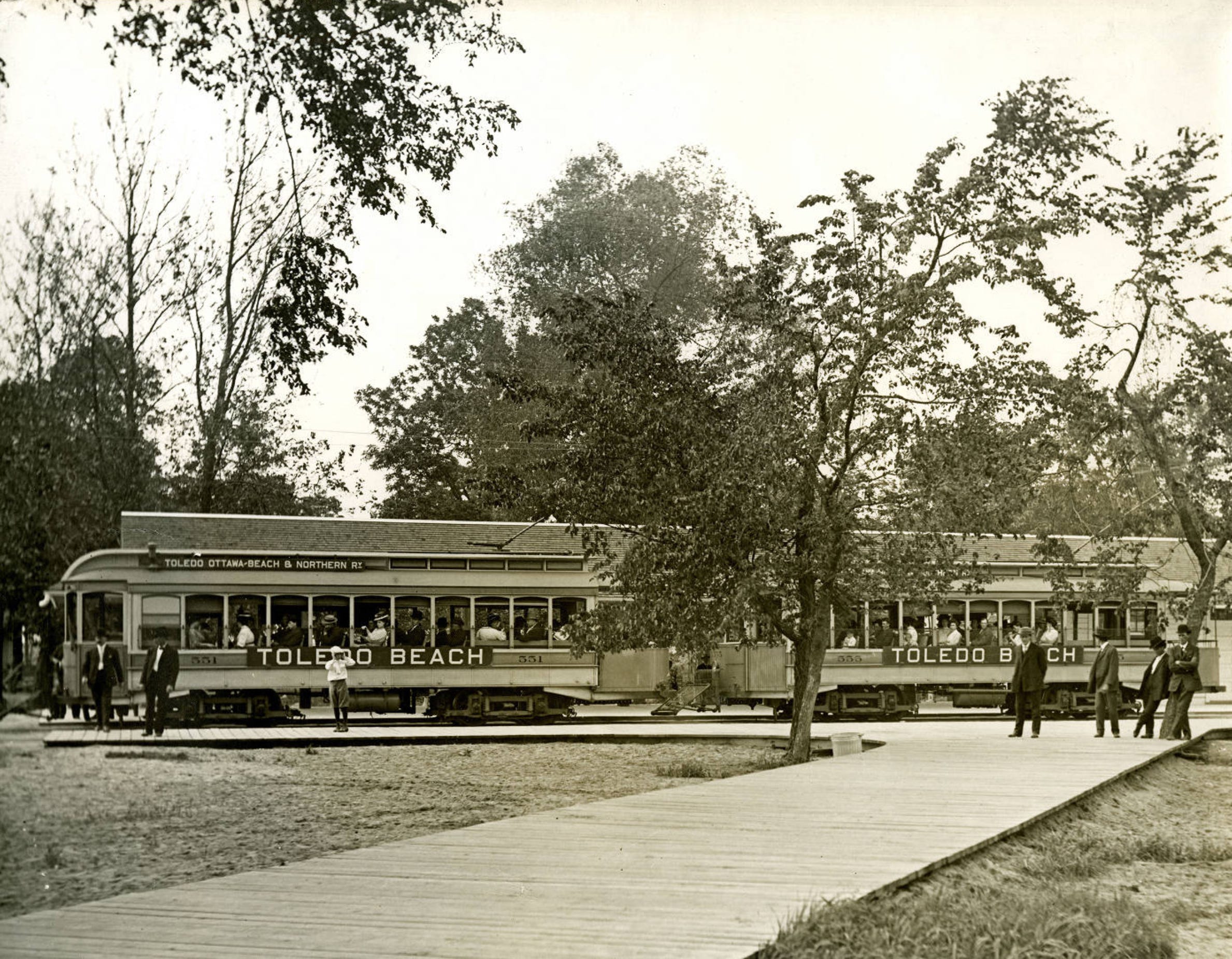
Toledo Beach Trolley Stop
They left the body to the uniformed men and walked north along the boardwalk, and the music followed them longer than it should have, stretching thin across the dark until it became something else, just sound, sourceless, the idea of a night that was still going somewhere even if they were not.
The Moon Pier Tavern sat at the shore end, squat and well-built, the kind of place constructed to outlast the people who drank in it. Its neon sign threw red and blue light across the boards without apology. Through the fogged windows, silhouettes moved. The door opened once and released a burst of laughter that had nothing of the pavilion’s brightness in it. Rougher, more honest, the laughter of men who were not pretending to be having the time of their lives.
Rourke marked who stood near the entrance without slowing. Two men, jackets open despite the warmth, watching the police lights with the specific quality of attention that meant they were trying not to appear to be paying attention.
He filed them and kept walking.
“Mason’s going to be the first name,” Bennett said. “Not just for us. For everyone.”
“He’s supposed to be.”
Bennett glanced sideways. “You think this was arranged.”
“I think the chip was arranged. I think the body’s location was arranged. Someone moved Leclair from wherever he was killed and put him somewhere he’d be found quickly, with a signpost pointing at a particular name.” Rourke kept his eyes on the road ahead. “That’s not passion. That’s planning.”
“Planning that implicates Mason.”
“Planning that uses Mason. There’s a difference.”
The night had thickened with the smell of the lake, that particular combination of iron and cold and organic depth that the lake gave off when the wind shifted. It cut through the lingering sweetness from the concessions and reminded you that the water had been here long before the music and would be here long after.
From the north, sound came down on the wind, high and intermittent, a mechanical scream rising and falling in waves. Rides. A midway.
“Toledo Beach,” Bennett said.
The horizon up that way pulsed with unsteady light. Not the warm steady glow of the pier. Something more aggressive. More hungry.
“The trolley conductor remembers Leclair,” Bennett continued. “Southbound, less than an hour before the body was found. Alone, he said. Or at least he arrived alone.”
“Which means he left something behind.”
“Or someone.”
The trolley platform sat ahead, lit just enough to function. A handful of people waited with the particular patience of those who had nowhere urgent to be or had decided to stop pretending they did. The car approached from the north with a low hum and a single sharp bell, too clean a sound for a night that already had a body in it.
Doors opened. People moved on and off without looking at each other.
Bennett stepped up onto the platform and paused. “I’m going north. You should come.”
Rourke looked at the waiting car. The windows threw back light instead of faces, the glass holding nothing useful.
“I’ll catch the next one,” he said.
Bennett studied him for a moment, reading something in the quality of his attention, then nodded and boarded. The doors closed. The trolley pulled north and took its bell with it.
Rourke stood where he was until the sound thinned out.
Then he turned toward the tavern.
Inside, the air was beer and smoke and old heat, the kind of warmth that buildings accumulate when they’ve been holding the same atmosphere for decades. The voices were low, not because anyone was being discreet but because this was not a place where anyone shouted. Shouting was for people who had something to prove.
Rourke moved past the bar without stopping. The bartender’s eyes came up, measured, and moved on. That was its own answer.
Carl Mason sat in the far corner with his back to the wall and money on the table. A heavy man with thick hands, moving through the bills with the practiced ease of someone who had done this particular accounting many times before. Two younger men flanked him, still learning how to sit still in a room where sitting still meant something.
Rourke stopped at the edge of the table.
Mason looked up. He had the kind of face that had stopped being surprised by things some years back. He looked at Rourke the way a man looks at weather, something to be assessed and prepared for, not particularly welcomed.
“You’re in my light,” Mason said.
Rourke reached into his coat and set the poker chip on the table between them.
The two younger men shifted. Mason didn’t. He looked at the chip with the unhurried consideration of someone deciding how much something was going to cost him.
“Found it by the body,” Rourke said.
“Then somebody put it there.”
“Your initials.”
“My chips move. That’s the point of chips.” Mason finally picked it up and turned it once, then set it back down. “Leclair owed me. I’m not going to pretend otherwise. But I collect with pressure, not with ice picks. Ice picks are permanent. You can’t collect from a dead man.”
Rourke let that sit. It was, as far as it went, true.
“So you’re being framed,” he said.
“I’m being pointed at. Whether it holds is somebody else’s problem.”
“Whose?”
Mason’s eyes moved briefly toward the bar, then came back. It was the smallest movement, barely a flicker, but it was the only involuntary thing Rourke had seen him do.
“There are people in this town,” Mason said, choosing his words with an uncharacteristic care, “who do not like their names to come up in conversations. People who’ve been here a long time. Long enough that they’ve stopped thinking of themselves as people who owe anybody anything.” He paused. “Leclair was digging into things that belonged to those people. Old things. Things that were supposed to stay old.”
“And they decided the problem needed to be resolved.”
“I didn’t say that.”
“You said enough.”
Mason stood. His men stood with him, fluid and automatic.
“Whatever you think you’re pulling at,” Mason said quietly, “pull carefully. People who protect history protect it hard.” He buttoned his jacket. “Get on the next trolley north. Stay on it. That’s free advice, and it’s the last free thing you’re going to get from this side of town.”
He walked out. His men followed. The door opened and closed and the rough laughter came and went with him.
Rourke stood at the empty table and looked at the chip.
Then he picked it up and put it in his pocket.
The platform was empty by the time he got back to it. The lake air had come in off the water with a cooler edge now, scrubbing away the last of the evening’s sweetness.
To the north, Toledo Beach pulsed against the dark sky like something that hadn’t learned to sleep. The rides he’d heard earlier were still turning. The music was different from the pier’s music, harder, louder, serving a different purpose. The pier’s music was meant to be beautiful. Whatever came from up that way was meant to pull.
The trolley arrived with its bell and its hum and its improbable cleanliness, and Rourke boarded it, and the shoreline of Lakeside fell away behind him as the car moved north.
He rested one hand against the rail and watched the dark water through the window.
Leclair had made this trip. Less than an hour before his body appeared on the pier.
Which meant he had gone north for something and came back with it, or had gone north for something and came back with the consequences of having found it.
The glow ahead grew larger.
Rourke watched it come.
Chapter 3: Toledo Beach
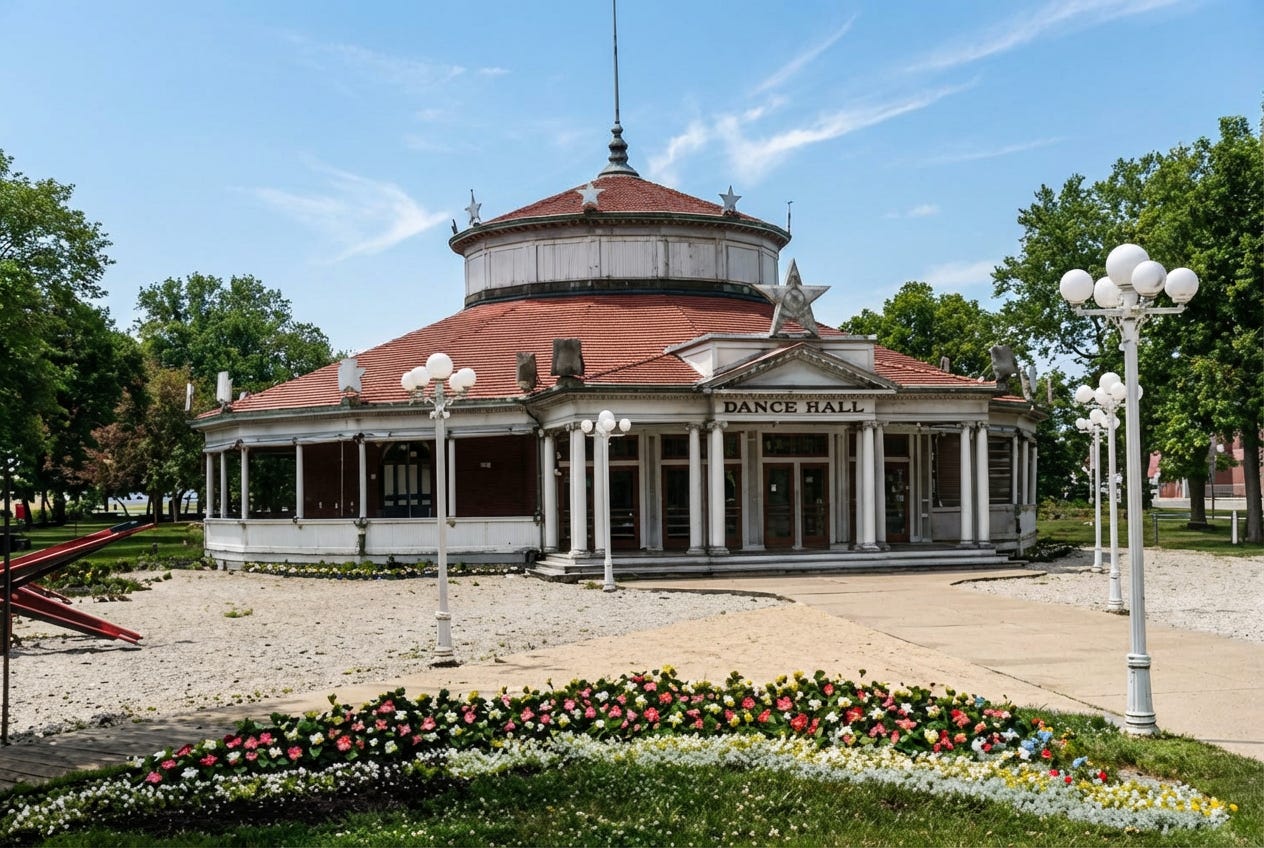
Toledo Beach Dance Hall
