


Political Satire based on documented events
By J. H. Irwin
Author | Storyteller | Satirist
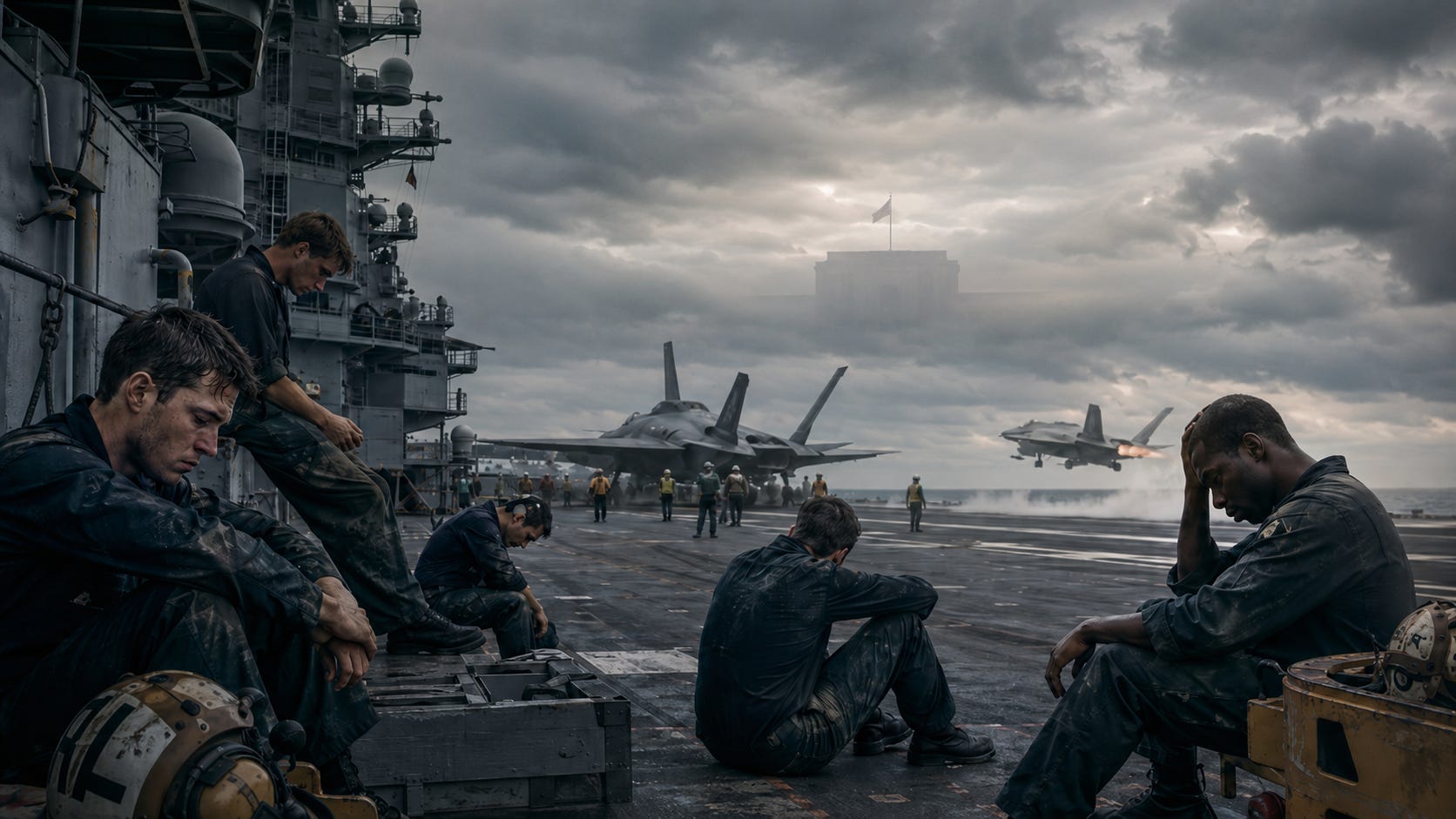
Welcome aboard the USS Abraham Lincoln, where approximately 5,000 sailors and Marines have enjoyed an extended all-inclusive cruise featuring breathtaking ocean views, occasional shortages of fresh food and basic supplies, plumbing adventures, disrupted mail service, combat operations, and the exciting possibility that nobody will tell you when you are coming home.
The Lincoln left San Diego last November. It was supposed to be a Pacific deployment. Then war intervened, the carrier was redirected to the Middle East, and by August its crew had spent more than 260 days at sea. According to U.S. Central Command, the strike group has conducted roughly 10,000 aircraft flights and expended 1.5 million pounds of ordnance. Sailors supported 40 days of continuous combat operations.
That is an extraordinary military accomplishment.
It is also an extraordinary thing to ask human beings to endure.
Fortunately, Washington has developed an innovative response to concerns about exhaustion, deteriorating morale and mental health.
Everything is fine.
The Freshies Have Abandoned Ship
One of the more strangely human details of this story involves something sailors call the “freshies.”
Fresh fruit. Fresh vegetables. Those extravagant delicacies commonly available at such exotic locations as Publix.
Because the war disrupted the Navy’s normal regional supply system, the Lincoln experienced periods when fresh produce disappeared. Sailors and families also reported food and water shortages, hygiene supply problems, laundry disruptions and mail delays. A brief Oman resupply stop in July finally brought fresh fruits and vegetables aboard after sailors said they had gone months without them. The Navy says many of those logistical problems have since been resolved.
Mission-critical supplies had to be prioritized.
Food first.
Hygiene supplies second.
Mail later.
Which makes sense.
Bombs before birthday cards.
Aircraft parts before Aunt Linda’s cookies.
Apparently the United States can move a multimillion-dollar missile halfway around the world with breathtaking precision, but getting a sailor an orange remains one of the more challenging aspects of modern warfare.
And yet the crew continued working.
Ten thousand flights.
Forty days of continuous combat.
One and a half million pounds of ordnance.
We know exactly how much weaponry left the ship.
What remains considerably harder to measure is what the deployment has taken out of the people launching it.
The Part That Isn’t Funny
Families and sailors have described exhaustion and declining morale. Stars and Stripes reported accounts of suicidal thoughts, including an incident in which sailors said a crew member was stopped from jumping overboard. The Navy confirmed that another sailor went overboard in early August, was quickly recovered and later transferred for additional care, although officials did not characterize the incident as a suicide attempt.
One parent described watching their sailor slowly lose hope.
That is where the satire stops being particularly funny.
The Navy disputes the suggestion that the Lincoln is experiencing a widespread mental health crisis. Officials say they have not observed an increase in suicidal ideation or attempts and point to the mental health professionals, medical personnel and chaplains available aboard the carrier. Defense Secretary Pete Hegseth said reports about conditions were “completely misrepresented” and insisted that ships are given everything the military can provide.
Those facts deserve to be included.
So does another one.
A ship can remain combat effective while the people aboard it are exhausted.
The crew can perform magnificently while individual sailors struggle.
Both statements can be true at the same time.
Nuance has not yet been banned by executive order.
Then Came Four Words
On August 14, Donald Trump was standing at Joint Base Andrews when a reporter raised the concerns of military families and asked whether the Lincoln’s deployment had gone on too long.
Trump first rejected the premise that families were concerned.
“No, they’re not.”
Then came the question about whether the deployment had lasted too long and whether he was worried about mental health concerns.
Trump responded:
“No, no, no. Not nearly long enough.”
Then he left to board Air Force One.
There are moments when satire requires imagination.
This is not one of them.
For sailors aboard the Abraham Lincoln, more than eight months away from home meant missed birthdays, anniversaries, holidays, family emergencies, long workdays, combat operations and endless stretches of ocean.
For the Commander in Chief standing beside his private presidential aircraft, it became four words.
Not nearly long enough.
There may be no better illustration of the distance between the flight deck and the podium.
One group gets on an aircraft carrier and wonders when it will see home again.
The other gets on Air Force One and is home for dinner.
And How Much Will That Be?
While the sailors were counting days, Washington was counting dollars.
The first six days of the Iran war cost an estimated $11.3 billion, according to figures provided by the Defense Department to Congress. The Center for Strategic and International Studies estimated the bill had reached roughly $16.5 billion by Day 12 and warned that the heavy use of munitions could create risks elsewhere, particularly in the western Pacific and Ukraine.
By May, the Pentagon was publicly citing $29 billion.
Harvard budget expert Linda Bilmes argues that figure dramatically understates the eventual expense because the government often values missiles at what they originally cost rather than what replacing them will cost now. She estimated upfront spending could reach roughly $200 billion. The Pentagon later sought another $80 billion connected to the conflict.
But don’t worry.
America has another highly sophisticated war-financing mechanism.
Your wallet.
Higher energy costs have rippled through gasoline prices, transportation and other household expenses. One economist estimated the typical American household could ultimately pay about $1,000 because of the conflict.
Consider it your patriotic participation fee.
Souvenir T-shirt not included.
Because Apparently One Strait Wasn’t Enough
The war began February 28 with massive U.S. and Israeli attacks on Iran that killed Supreme Leader Ali Khamenei and other senior officials. Iran responded in part by effectively shutting down normal traffic through the Strait of Hormuz, one of the most important energy corridors on Earth. Before the war, roughly one-fifth of global oil and LNG shipments moved through it.
By August, shipping had collapsed from more than 130 daily transits before the conflict to single digits on some days.
Then the Houthis declared a blockade affecting Bab el-Mandeb, another crucial shipping route, and attacked Saudi-linked vessels.
Because when you have one global energy chokepoint crisis, the obvious solution is apparently to collect the whole set.
Oil surged. Gasoline followed. Shipping became more dangerous and expensive. Iranian and American officials continued exchanging demands while global markets attempted to determine which strategically vital waterway might become unusable next.
Geopolitical Whac-A-Mole, now available in the Persian Gulf edition.
Good News, Someone Found Another Aircraft Carrier
There is finally some good news for the crew of the Abraham Lincoln.
The USS George Washington has now arrived in the Middle East to relieve it. The Lincoln can begin the long journey back toward San Diego and the families who have been waiting for most of a year.
There is, naturally, a small catch.
The George Washington was America’s forward-deployed carrier in Asia.
So while solving one overstretched-carrier problem, the United States has temporarily reduced its carrier presence in the Pacific.
Military strategists undoubtedly have a sophisticated term for this.
Here at The Gilded Toilet, we call it moving the lawn furniture around while the house is on fire.
Eventually the Lincoln will return home. Sailors will walk down the gangway. Families will hug people they have spent months worrying about. There will be speeches about courage, endurance, patriotism and sacrifice.
Those sailors will deserve every word.
But there is another phrase worth remembering.
Not nearly long enough.
Not because it was true.
Because four words spoken beside Air Force One revealed something 1.5 million pounds of ordnance cannot measure: the enormous distance that can exist between those who decide how long a war continues and those who are asked to live inside it.
And that, ladies and gentlemen, is precisely why we have The Gilded Toilet.
Sometimes the gold is merely tacky.
Sometimes what it reflects is far more serious.
Where the absurdity of this moment gets the satire it deserves, and all the gold in the world still can’t buy good taste.
Read The Gilded Toilet at Still Human → https://substack.com/@jhirwin