


By J. H. Irwin
Author | Storyteller | Capturing Life, Memory, and Meaning
A Human Moment
“Some phrases belong to the time that created them, not necessarily to the time we are living in now.
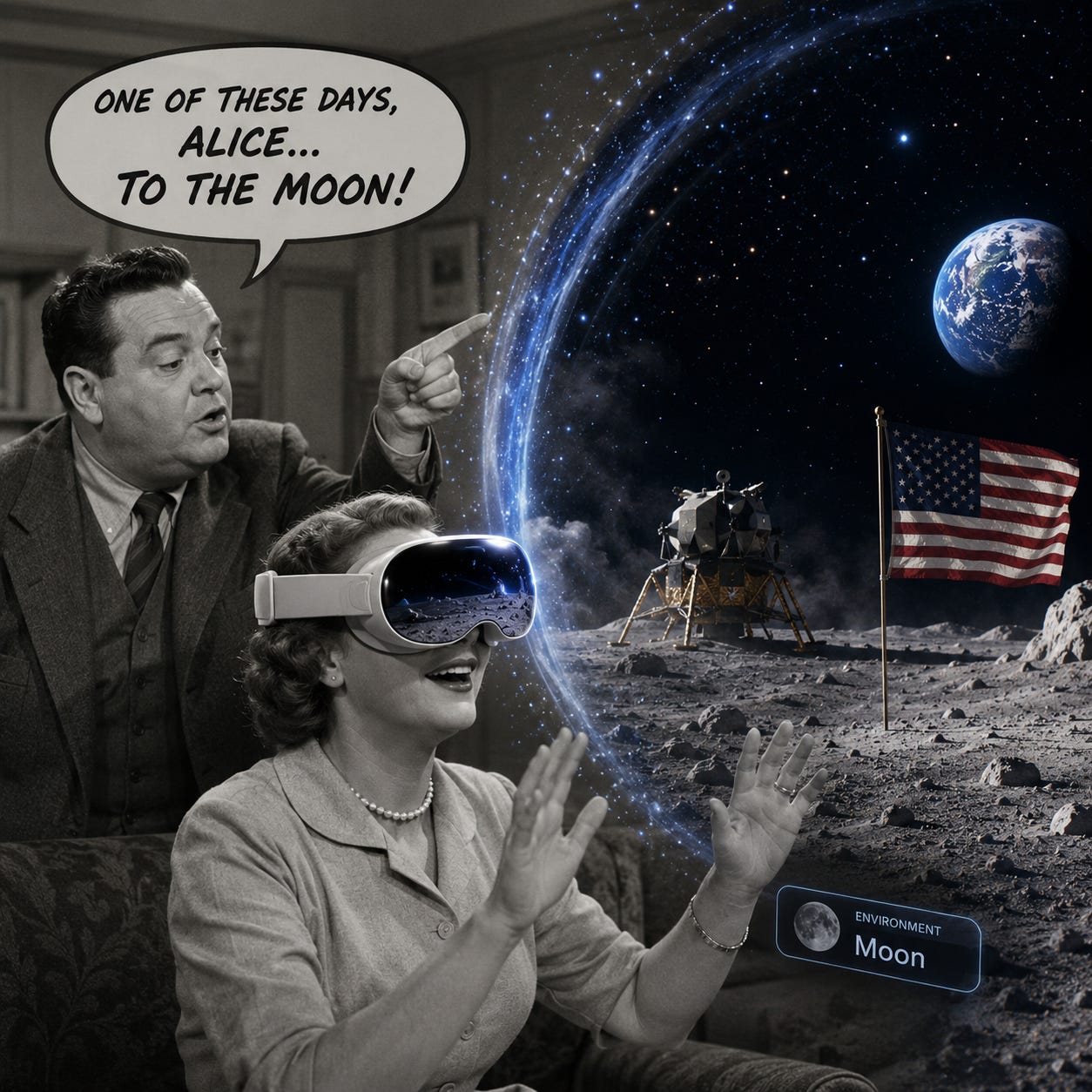
“One of these days, Alice… to the moon.”
For many, Jackie Gleason’s famous line from The Honeymooners still echoes as classic television comedy. It was oversized. It was theatrical. It was Ralph Kramden being Ralph Kramden, loud, frustrated, foolish, and ridiculous in the way sitcom characters were allowed to be in the 1950s.
But we hear things differently now. We should.
Words that once passed as harmless comic exaggeration can land differently in a world more aware of domestic abuse, emotional harm, and the power of language. That does not mean we erase the past. It means we understand it with more maturity. We can remember the context while also recognizing that some jokes do not travel cleanly into the present.
And yet, in the strange poetry of modern technology, Ralph Kramden could finally send Alice to the moon without menace, without insult, and without harm.
He would simply place an Apple Vision Pro on her head, select the moon environment, and let her go.
Not as punishment.
As wonder.”
To the Moon, This Time With Awe
That is the remarkable shift.
A phrase once used as comic bluster can now be reimagined through technology as an invitation. The moon is no longer just a punchline. It becomes a place of quiet escape. A digital landscape. A pause from the noise of the day.
With spatial computing, the world no longer has to remain confined to the walls around us. Apple Vision Pro does not simply put a screen in front of your eyes. At its best, it changes the emotional temperature of the room. It can dim the chaos, soften the edges, and place you somewhere your body is not, but your mind almost believes it is.
You can sit in your living room and feel the surface of the moon stretch out before you. You can look around and sense distance, depth, stillness, and scale. You are not watching the moon. You are, in some deeply convincing way, present with it.
That is the promise of spatial computing.
Not just entertainment.
Presence.
The World Beyond the Room
One of the most fascinating things about Apple Vision Pro is how quickly it changes the idea of where we are.
A long day can become a mountain top.
A cluttered room can become a tropical beach in Bora Bora.
A stressful afternoon can dissolve into a peaceful lakeside.
A restless evening can open into the white sands of a desert, so vivid that part of you expects to reach down and feel the heat of the sand between your fingers.
Of course, you know it is not real.
But the body is not always as logical as the mind. The mind says, “This is digital.” The senses whisper, “Maybe stay here a while.”
That is the strange, beautiful tension of immersive technology. It is artificial, but the feeling it creates can be genuinely human.
A calm breath is still a calm breath, even if the lake in front of you is rendered in pixels.
A moment of wonder is still wonder.
More Than a Headset
This is why Spatial Conversations matters as more than a tech topic.
We are not simply talking about devices. We are talking about the next layer of human experience.
Apple Vision Pro can take you skiing without leaving home. It can place you in the room while performers rehearse. It can bring you close enough to a concert stage that the old distance between audience and artist begins to blur. You can feel as though you are standing near Metallica as the music surrounds you, not just hearing a show, but being placed inside the energy of it.
You can watch a dinosaur move through a prehistoric world, hunting, breathing, turning its massive body through space in a way that makes childhood imagination feel suddenly adult and alive again.
You can hold out your hand and watch a butterfly land there, virtually, impossibly, tenderly.
And even though no butterfly has physically touched you, something in you responds.
That matters.
Because the future of technology will not be judged only by what it can calculate, display, or automate. It will be judged by what it does to our attention, our empathy, our nervous systems, our loneliness, our creativity, and our sense of being alive.
The Human Question
The question is not whether spatial computing is impressive.
It is.
The deeper question is what we will do with it.
Will we use it only to escape reality, or will we use it to better understand reality? Will we hide inside beautiful simulations, or will those simulations restore us enough to return to the world with more patience, imagination, and compassion?
That is where AI and spatial computing begin to overlap.
Artificial intelligence can become the guide. Spatial computing can become the room. Together, they may create experiences that feel conversational, responsive, and personal. Imagine sitting beside an AI historian while standing inside ancient Rome. Imagine walking through a memory with a digital narrator helping you understand the place, the people, and the feeling of it. Imagine a child learning about the solar system not by reading a paragraph, but by standing among the planets.
Imagine an aging person who can no longer travel returning, in some meaningful way, to a beach they loved.
Imagine grief softened by a place recreated with care.
Imagine education becoming less about memorization and more about presence.
There is power there.
There is danger there too.
That is why we have to keep the human conversation at the center.
From Punchline to Possibility
“One of these days, Alice… to the moon” belongs to another time.
But perhaps the phrase can be reclaimed in a gentler way.
Not as a threat.
Not as a joke at someone’s expense.
Not as the language of frustration.
But as a reminder of how far we have traveled.
We have moved from a world where the moon was a comic exaggeration to a world where someone can place a device over their eyes and feel, for a few extraordinary minutes, as if they are standing there.
That is astonishing.
And it should make us pause.
Because technology is no longer simply something we hold in our hands. It is becoming something we step into. Something that surrounds us. Something that can calm us, overwhelm us, teach us, distract us, move us, and perhaps even heal us in small, unexpected ways.
The future is not just on the screen anymore.
It is around us.
And if we are wise, if we remain grounded, if we refuse to surrender our humanity to the machinery of progress, then perhaps spatial computing can do something remarkable.
It can remind us that wonder still matters.
It can offer us a doorway out of the noise.
It can take us to the moon.
And this time, Alice gets to choose whether she wants to go.
Words can still move the world. Read mine → https://substack.com/@jhirwin
#JHIrwin #JHIrwinMultimedia #SpatialConversations #StillHuman #SpatialComputing #AppleVisionPro #ArtificialIntelligence #AI #FutureOfTechnology #HumanCenteredTechnology #DigitalLife #ImmersiveTechnology #Storytelling #Author #ContentCreator