


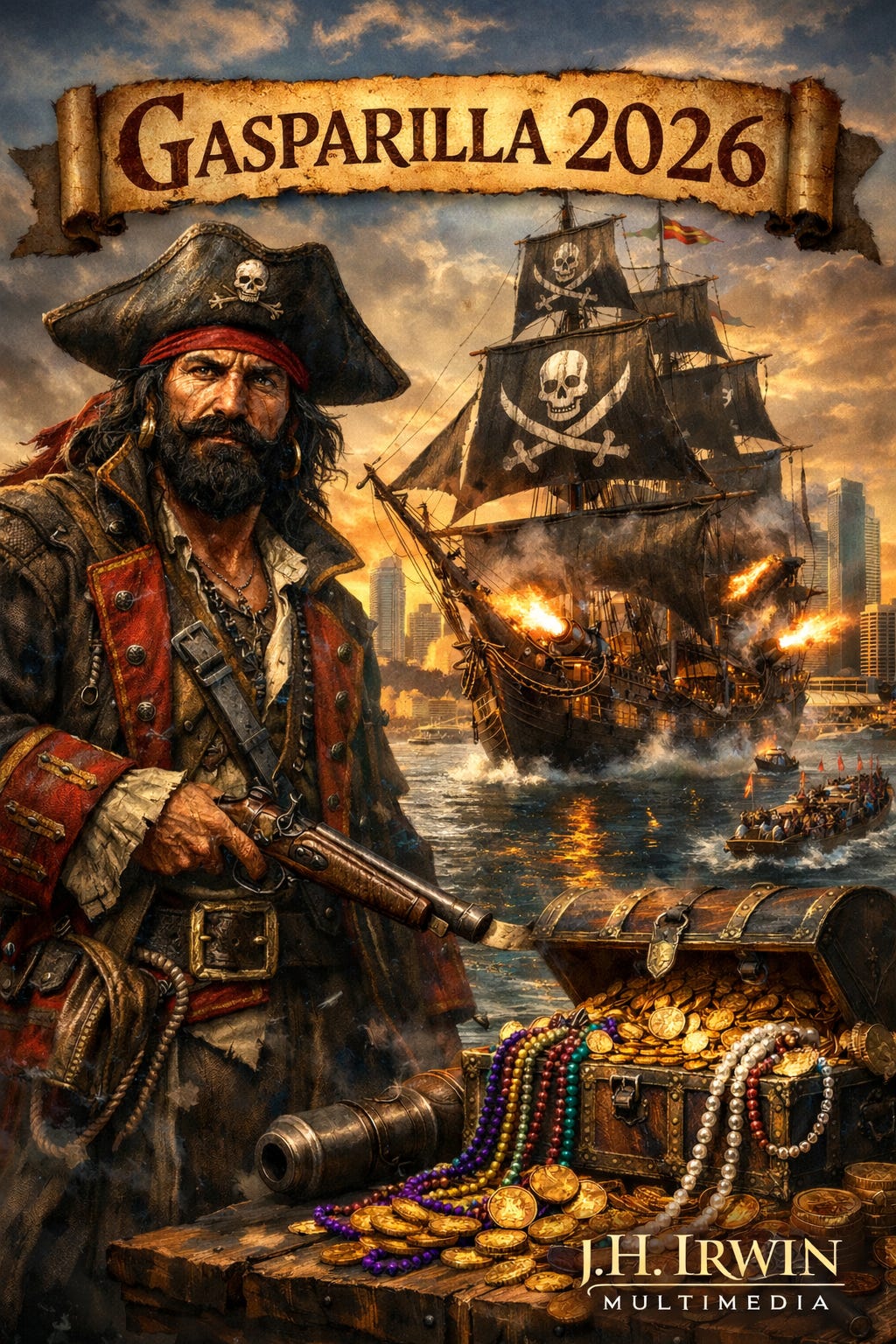
By J. H. Irwin
Author | Storyteller | Exploring the Human Experience Through Words
A Word from Jose Gaspar:
“Arrrghhh… ’tis I, José Gaspar, risen once more from salt and shadow. I return not for a single plunder nor a fleeting raid, but for a full campaign, drawn long and deliberate upon the tides.
Before the cannons speak and the beads fly, I’d best give ye a taste of the tale that forged this mischief, so ye know well what’s comin’ for ye… and why there’ll be no escape once the sails appear on the horizon.”
Long before Tampa was defined by skylines and waterfront towers, it was shaped by story. Like many port cities, it grew up around the tension between order and freedom, commerce and chaos, land and sea. Gasparilla sits squarely at the intersection of all four.
The festival’s roots reach back to the legend of José Gaspar, a figure said to have haunted Florida’s Gulf Coast in the late eighteenth and early nineteenth centuries. According to popular lore, Gaspar was a Spanish nobleman turned pirate who rejected empire and authority, choosing instead a life of defiance on the open water. Whether Gaspar truly existed matters less than what he came to represent. He became a symbol of rebellion, independence, and the romantic pull of the sea.
By the early 1900s, Tampa was a booming port city fueled by cigars, shipping, and immigration. In 1904, a group of local civic leaders known as Ye Mystic Krewe of Gasparilla decided to turn legend into spectacle. Inspired by Mardi Gras traditions in New Orleans, they staged a mock pirate invasion of the city. A ship sailed into the harbor. Cannons fired blanks. Pirates demanded surrender. Tampa obliged.
What began as theatrical fun quickly became tradition.
The early Gasparilla celebrations were as much about civic identity as entertainment. Tampa was announcing itself as a city with personality, humor, and a willingness to embrace myth alongside progress. Over time, the invasion became more elaborate. Parades expanded. Krewes formed. Costumes grew more detailed. What had once been a single event slowly evolved into a season of festivities.
Throughout the twentieth century, Gasparilla mirrored Tampa’s growth and struggles. It paused during wars, adapted during social change, and gradually opened to broader participation. The festival reflected shifting values, expanding from an elite civic pageant into a community-wide celebration that now includes family events, children’s parades, art festivals, and neighborhood gatherings.
Today, the Gasparilla Pirate Festival spans weeks rather than days. It is no longer just an invasion but a cultural season that blends history, humor, and belonging. Beads and coins may catch the eye, but what sustains Gasparilla is something deeper. It is the shared agreement to step outside routine, to play together, and to honor a story that has been passed down for more than a century.
Gasparilla endures because it is not about piracy at all. It is about permission. Permission to be loud. Permission to be joyful. Permission to remember that cities, like people, need rituals that loosen the grip of the everyday.
In that sense, José Gaspar never needed to be real. The idea of him was enough.