


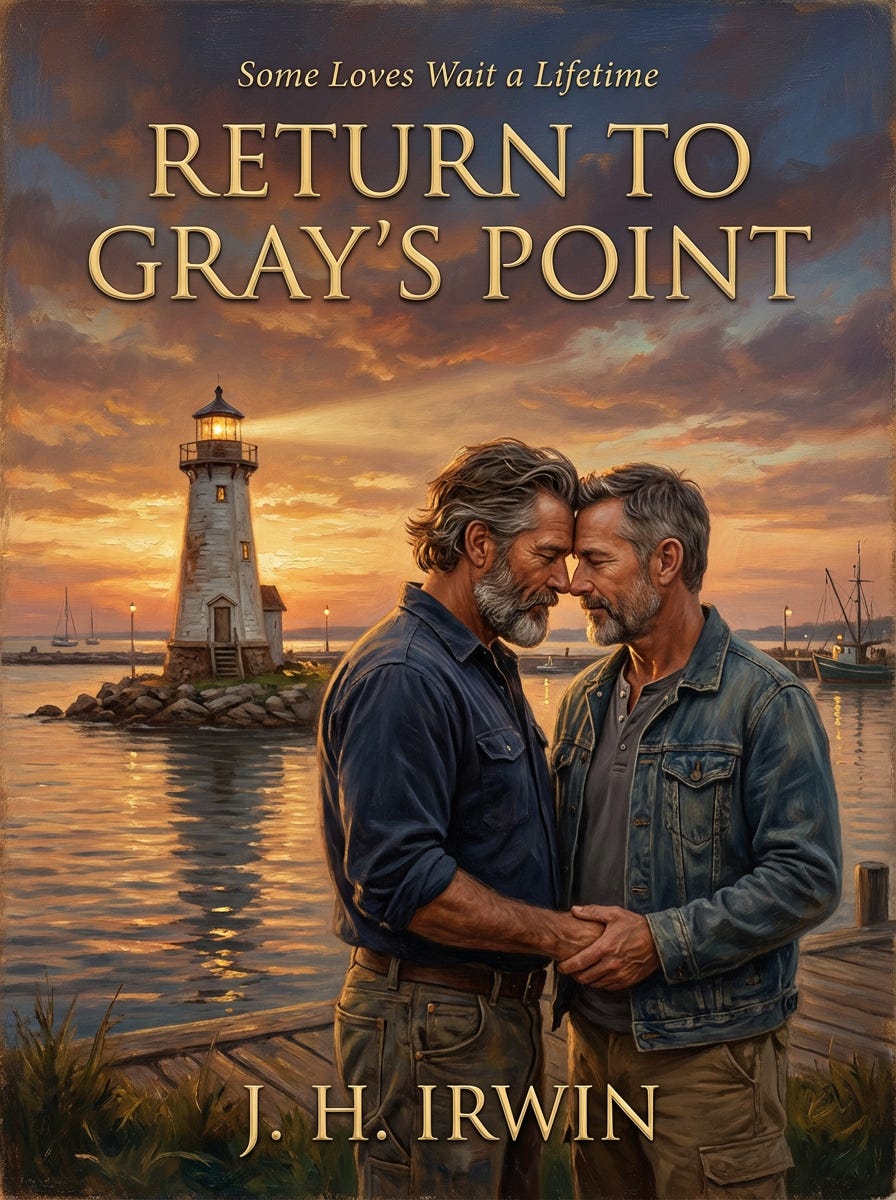


Return To Gray’s Point
Some Loves Wait A Lifetime
By J. H. Irwin
Copyright
Copyright © 2026 by J. H. Irwin Multimedia, LLC
All rights reserved.
No part of this book may be reproduced, distributed, or transmitted in any form or by any means, including photocopying, recording, or other electronic or mechanical methods, without the prior written permission of the author, except in the case of brief quotations embodied in reviews and certain other noncommercial uses permitted by copyright law.
This is a work of fiction. Names, characters, places, and incidents are either the product of the author’s imagination or used fictitiously. Any resemblance to actual persons, living or dead, events, or locales is entirely coincidental.
Published by J. H. Irwin Multimedia, LLC
First Edition
Dedication
For those who have loved in silence.
For those who have waited longer than they should have had to.
For those who were told their love was less, and chose to love anyway.
And for those who are still searching for the courage to return to what their heart never truly left behind.
Acknowledgments
No story is ever written alone, even when it feels that way in the quiet hours.
I am grateful for the lived experiences, both my own and those shared with me, that shaped the emotional truth of this novel. To the voices, past and present, who have insisted that stories like this deserve space, visibility, and care, your influence is woven into every page.
To the readers who believe in the power of independent authors and who support work rooted in authenticity, humanity, and truth, thank you. You make it possible for stories like this to exist outside the boundaries of expectation.
To those who have come before, who wrote, loved, and lived bravely when doing so carried far greater risk, this story stands on the ground you helped claim.
And finally, to anyone who has ever returned to a place, a person, or a version of themselves they thought was lost, this story is for you.
Author’s Note
“Stories have always been a way for us to understand ourselves, and perhaps more importantly, to understand one another.
Return to Gray’s Point is, at its heart, a story about love. Not a simplified or sanitized version of it, but the kind that lingers, fractures, heals, and waits. The kind that asks something of us. The kind that does not always arrive at the right time, but refuses to be forgotten.
Writing within the M/M romance space carries both responsibility and purpose. For far too long, stories of love between men were either hidden, misrepresented, or reduced to something less than whole. This novel exists, in part, to stand against that absence. It is an affirmation that these relationships are as layered, as enduring, and as deeply human as any other. They are not side stories. They are not exceptions. They are central to the broader human experience.
At a time when conversations around identity, equality, and human rights continue to shape our world, storytelling remains one of the most powerful tools we have. Through it, we build empathy. Through it, we challenge silence. Through it, we remind ourselves that love, in all its forms, deserves to be seen, respected, and understood.
This is not just a romance. It is a return. To memory. To truth. To the quiet places within us that still believe in connection, even after time and distance have done their work.
If you find something of yourself in these pages, then the story has done what it was meant to do.”
Chapter One
The Road Back
The sky over Lake Erie had the color of a tarnished spoon when Adrian Mercer crossed the state line, and the smell came through the cracked window before anything else did.
Cold water. Wet leaves. Wood smoke from somewhere past the tree line.
Forty years, and the air hadn’t changed a single note. That was the cruelty of scent: it didn’t knock. It walked straight in and started rearranging the furniture, and there was nothing a grown man could do but sit very still and let it.
Adrian put both hands back on the wheel.
Late October stripped the color out of everything along the southern edge of the lake. The trees that had burned gold and red a few weeks ago stood bare and dark now, their leaves shoved into ditches by the wind. The fields lay flat. Even the highway seemed to have lowered its voice, as if autumn had asked the whole county to show some respect.
On the passenger seat, the cedar box sat exactly where he’d set it that morning in Chicago. Small enough to carry. Heavy enough that he’d felt it beside him through every mile of Indiana and Ohio, the way you feel someone watching you.
His father had left instructions, in writing, because of course he had.
No funeral. No procession. No “public fussing,” as the note put it, by people who hadn’t visited in years and would suddenly go misty over ham salad and weak coffee. He wanted his ashes near the harbor. He wanted, and Adrian had read the line three times in the lawyer’s office before he trusted it, to see the lake.
He’d almost laughed, sitting in that office. Even dead, the old man knew how to make a wish sound like a directive.
“Well,” Adrian told the box now. “You’re getting your way. As usual.”
The box declined to gloat.
The highway curved west, and through a thin stand of trees the lake opened up, flat and dark and enormous, the far edge so faint it read less like a horizon than a rumor. Adrian’s chest did something complicated. He chose not to investigate.
Gray’s Point was another half hour up the road. He’d been born there. Learned to swim there, to argue there, to want there, to want things the town had no vocabulary for and even less patience with. By eighteen the place had stopped feeling like a hometown and started feeling like a room with the windows nailed shut. Every glance meant something. Every absence got tallied. Rumors outlived the people they were about.
He’d left for Chicago with two suitcases and the rock-solid conviction that survival sometimes required a clean exit.
He had not come back. Not really. One funeral for his mother. One catastrophic Thanksgiving in the early nineties, three hours of his father lecturing on boat permits and “the decline of standards.” Christmas cards mailed late. Visits measured in hours.
Now here he was, driving in with the man’s ashes riding shotgun and an overnight bag in the trunk, still not sure whether this counted as a visit or a sentence.
GRAY’S POINT Population 2,914 Home of Harbor Light
The same sign. Repainted, never redesigned. The town had never had much use for reinvention; it preferred durability, even in things that should have been retired decades ago.
He slowed past it, and the town reassembled itself in pieces he hadn’t asked for. Main Street. The diner with its neon coffee cup still buzzing in the window. The hardware store, somehow upright through a dozen recessions. The pharmacy, gone. The grocery, now a dollar market. A mural on the feed building that looked approved by optimism rather than taste.
Smaller than he remembered. Childhood does that to a place.
What hadn’t shrunk was the harbor.
He turned onto Harbor Road without deciding to, and his pulse answered before his brain did, a quick, traitorous knock against his ribs. There it was. The breakwall ran out into the lake in one long white line. The lighthouse at the end, weathered and entirely itself. The marina office near the docks, narrow and wind-bitten, with the same sloping porch roof he’d memorized over a summer he’d spent pretending he was there to work and not because one specific person usually was.
He tightened his grip and drove past.
Not yet.
He wasn’t ready to stand in the place where so many unfinished things had once gathered and called themselves possibility.
He turned onto Maple Street instead.
The house was where it had always been. White siding. Narrow porch. The maple leaning over the drive. The brass mailbox his father had polished more often than any mailbox on earth deserved. Adrian parked, killed the engine, and the silence dropped over the car like a sheet.
He sat a moment longer than he needed to.
Then he picked up the cedar box. “You wanted to come home,” he said quietly, and carried his father up the porch steps.
The key from the lawyer’s envelope turned easily. The smell of the house reached him first (dust, old coffee, laundry soap, cedar polish, furnace heat), and for a second he couldn’t make himself move.
The front room was almost unchanged. The recliner aimed at the television. A folded blanket on one arm. The lamp with the yellowed shade his mother had bought at a church sale. On the mantel, a photograph of her in a cream blouse, smiling at someone just out of frame.
He set the box on the dining table and went to the picture.
“Hi, Mom.” His voice was too loud for the room.
She’d been gone long enough that she came back to him in flashes now instead of scenes. Ivory soap. Her voice calling him to supper. The way she’d stood at the sink and stared out the window when his father was in one of his weathers, as if stillness were a kind of armor.
He set the frame down carefully and went to look in the refrigerator, because grief makes you do useless practical things.
Mustard. Pickles. Eggs. Half a loaf. A package of ham. And on the top shelf, a pie tin under foil. He lifted the corner: half a peach pie.
He smiled before he could stop it. “Someone was taking care of you.”
That was the part nobody warned you about. Not the paperwork or the lawyers or the empty rooms. It was the ordinary evidence that a life had run right up until the second it didn’t. Coffee made. Pie eaten. Mail opened. And then the whole machine just stopped.
By late afternoon the light had gone gray and the sky over the lake had begun to bruise. A storm, coming in.
He should have started on the paperwork. Bills, utilities, the legal things waiting to turn urgent the moment he ignored them long enough.
Instead he reached for his coat. Some habits came back faster than others.
The walk to the harbor took ten minutes. The air had sharpened, carrying that metal edge that always arrived ahead of lake weather. The marina sat mostly empty for the season, the summer crowd long gone, leaving the practical people who actually kept the place running once romance packed up and left.
He was nearly at the foot of the breakwall when he saw the man at the railing.
Tall. Broad through the shoulders. Still in the particular way some men go still after a lifetime around water, one hand on the rail, eyes on the lake, as if he were keeping it company.
Recognition arrived before the face did. It came up through Adrian’s body like cold water, fast and total.
The man turned at the sound of his footsteps.
Older, obviously. Gray at the temples. Lines cut around the eyes by sun and weather and a life spent outdoors. But the jaw was the same. The mouth was the same. The way he held his weight was the same, and that was the detail that undid Adrian: that the body remembered the body.
Elias Thorne.
For a moment neither of them spoke. The wind came across the harbor and lifted the front of Adrian’s coat. Then Elias gave the smallest nod, the way a man nods at something surprising but not impossible.
“Adrian.”
His name in that voice. Forty years collapsed into the space of two syllables, and Adrian felt the present and the past slam together somewhere behind his sternum.
“Hello, Elias.”
Out over the water, the first low rumble of thunder turned over and went quiet.
And just like that, the past stepped forward and stood beside him.
Chapter Two
The Harbor
The wind carried the smell of rain off the water, and Adrian stood on the breakwall with his hands jammed in his pockets, trying to make the man in front of him agree with the one he’d carried in his head for most of his life.
The boy he remembered had been eighteen and sun-browned, all rangy strength and quiet certainty, moving through the world like he belonged wherever his boots happened to land: a dock, a grocery aisle, a room full of older men talking over him. Adrian had once found that maddening and irresistible in roughly equal measure, which, in hindsight, should have told him everything.
The man in front of him had the same steadiness. Time had only deepened it, the way it deepens the grain in good wood.
“You look surprised,” Elias said.
Adrian realized he’d been staring. “Not surprised. Recalibrating.”
The corner of Elias’s mouth lifted, slow, and Adrian felt the pull of it low in his stomach, absurd and immediate.
“That sounds like something a professor would say.”
“Old habits.”
Neither of them spoke for a second. The lake worked against the outer wall. Out past the lighthouse the clouds had stacked into long dark bands.
It should have been awkward. Forty years was more than enough to turn two people into strangers. Instead Adrian felt the far more dangerous thing, recognition, not just of Elias but of some younger self that had sat up and opened its eyes the moment he’d turned onto Harbor Road.
“So,” Elias said at last. “You’re back.”
“For a little while.”
“Your father.”
Adrian nodded. In a town like this, death traveled faster than the mail.
“I heard,” Elias said, quieter now. “I’m sorry.”
“Thank you.” And he meant it, not because he and his father had been close in any clean way, but because the grief was real anyway, and there was relief in standing next to someone who didn’t need that complication explained.
“He left instructions,” Adrian said. “For the ashes.”
Elias leaned his forearms on the rail. “Near the harbor?”
“That obvious?”
“Gray’s Point doesn’t get many mysterious cedar boxes.”
“Feels like a missed opportunity for the town, honestly.”
Elias smiled, and the old ease of it landed harder than Adrian was ready for. “Sounds like him. He wanted to see the lake.”
“He did.”
The sentence settled between them with the quiet authority of something true.
The lighthouse stood at the far end of the wall, paint flaking, the rail gone soft with rust. Adrian had spent half his childhood watching its beam sweep across his bedroom ceiling and telling himself it pointed outward, toward escape. Standing here now, he wasn’t sure that had ever been the truth.
“You still work here?” he asked.
“Most days. I run marina operations now.”
“That sounds official.”
“Docking permits. Repairs. Winter storage. Whatever needs doing.” Elias shrugged. “Someone had to become responsible.”
“And it was you.”
“It was me.”
Adrian laughed, and then the laugh thinned out, because they’d started walking and walking beside Elias was its own quiet disaster. The man still moved with that unhurried balance, like there was no point rushing just to prove you could, and Adrian’s whole body had begun cataloguing him without permission. The width of his shoulders under the canvas jacket. The thick, sure hands when they came to rest on the rail. The low, even weight of his voice riding under the wind.
It wasn’t lust, not the crude, easy kind. It was worse than that. It was awareness. The particular ache of being near a man your body had decided about a long time ago and never properly un-decided.
Adrian had spent decades getting good at composure. Chicago demanded it. Academia rewarded it. His desire had learned to wear good manners and leave no fingerprints.
Gray’s Point had never been any good for restraint.
“And you never left,” he said.
“No.”
“Why?”
Elias looked out at the water. “Someone had to keep an eye on the lake.”
“That’s not an answer.”
“No,” Elias agreed. “It isn’t.”
They came to a rough seam in the concrete, and Elias’s hand found Adrian’s elbow, just for half a second, just to steady him over it. Just the press of a palm through wool.
Adrian felt it travel the whole length of his arm. Felt the heat of it sit there after the hand was gone, like a print left on glass. He kept his eyes hard on the horizon and prayed that forty years had bought him at least the dignity of a still face.
“I’m beginning to think,” he said, going for dry, “that this town is determined to humiliate me.”
Elias glanced over. “How’s that?”
“It appears to have kept my entire adolescence dissolved in the lake air. For just this occasion.”
“Sounds inconvenient.”
“You have no idea.”
By the time they reached the lighthouse, the first rain had begun to pock the water in dark scattered rings. Adrian stopped and looked out.
“I used to stand right here all the time,” he said.
“I remember.”
He turned. “You do?”
“Yes.” No hesitation at all, and somehow that unsettled him more than if Elias had needed a moment to find it.
“You never said much, back then,” Adrian said.
“You never gave me much of a chance.”
The words landed and sat there with weight, and a memory came up sharp and whole, like it had been waiting just under the surface for forty years for exactly this cue. Late August. The marina shed after closing. Engine oil and warm wood. Adrian standing too close on purpose. Elias against the doorframe, watching him in a way that made the air feel charged enough to spark, the kind of charge you only feel at eighteen, when you’ve never yet survived your own wanting and have no idea it can be survived at all.
Adrian looked away first. Then and now.
“We were idiots,” he said.
“We were eighteen.”
“That’s the same thing.”
Elias laughed out loud at that, and the sound of it went through Adrian like the first warmth after coming in from the cold.
The rain strengthened. A gray sheet of it dragged itself across the lake toward them.
“Storm’s coming in fast,” Elias said. “You should head back.”
Adrian nodded. He should.
Neither of them moved.
The lighthouse stood at their backs and the harbor opened ahead and Adrian understood, with an annoyance that was mostly fear, that something had already shifted, simply because he had stood here beside this man again and found the old current not gone but live, humming under everything, exactly where he’d left it.
“Well,” he managed. “This has been unexpectedly pleasant.”
Elias raised an eyebrow. “Pleasant.“
“I had low expectations.”
“Flattering.”
“Honest.”
They walked back toward the docks together, and when Adrian reached the parking lot and turned for one last look, Elias was already at the lighthouse again, one hand on the rail, facing the water like he’d merely picked a conversation back up with the lake.
Adrian got in the car and sat there without starting it, rain ticking on the windshield, thinking the exact impossible thought he’d once punished himself for thinking at eighteen.
What if the moment didn’t disappear? What if it only waited?
When he finally turned the key, the lighthouse beam flickered on behind him, and for the first time in decades Adrian Mercer wondered whether coming back to Gray’s Point was going to cost him a great deal more than he’d budgeted for.
Chapter Three
The Things We Never Said
