


By J. H. Irwin
Author | Storyteller | Exploring the Human Experience Through Words
I first became familiar with the name “Silas Dent” not long after I moved to Florida in 1981. I enjoyed driving around, getting to know the Tampa Bay area. One day I was near St. Petersburg Beach and happened upon Silas Dent’s Steakhouse on Gulf Boulevard, and decided it would be my dinner destination that evening. Inside was a rich history about the man, the myth. Since that moment his life has intrigued me, and with that, I introduce you to
“Silas Dent, the Eccentric Resident of St. Petersburg”...
Early Life and a Journey to Seclusion
Silas Dent was born in the late 19th century (around 1875–1881, sources vary) and grew up with an adventurous, independent spirit. Little is recorded about his early years, but by the turn of the 20th century he had drifted down to Florida’s Gulf Coast, drawn perhaps by the promise of open land and bountiful waters. He arrived in the St. Petersburg area when it was still a raw frontier and found his way to a tiny mangrove-speckled isle known as Cabbage Key, near the mouth of Tampa Bay. This uninhabited island, reachable only by boat, would become his lifelong home. In 1912, Silas Dent staked his claim on Cabbage Key (then part of the undeveloped coastal islands) and began a most unusual life of self-sufficient seclusion. He was not entirely alone in the beginning – Silas and his brother started a small dairy homestead on the island, bringing a few head of cattle to graze the sparse scrub. In those days Pinellas County’s barrier islands were wild and isolated, and the Dent brothers were true pioneers living off the land and sea.
Even as a young man, Silas was drawn to the natural abundance around Cabbage Key. He learned to fish the teeming waters and tame the semi-tropical wilderness of his island. In nearby Pass-a-Grille (a small beach community across the channel), Silas quickly became known as an expert outdoorsman. In fact, in his younger years he sometimes worked as a fishing guide for visiting sportsmen – a 1910s-era postcard proudly described the “young, barefoot Silas Dent” as a “popular guide in Pass-a-Grille Beach,” even then noting that he was better known as the hermit of Cabbage Key. This early venture as a guide showed that while Silas chose to live apart from modern society, he was never entirely cut off from it. He was gregarious and generous with his knowledge of the local waters. Guiding fishermen by day and returning to his solitary island by night, Silas lived at the boundary between civilization and wilderness.
Life on Cabbage Key: Dairy Farmer and Hermit Fisherman
By the 1920s, Silas Dent had fully settled into his unique existence on Cabbage Key. He built himself a simple thatched hut – a cottage of palmetto fronds and local wood that blended into the island foliage. This humble shack, often described as a “thatched cottage,” was his home for decades. Around his hut, Silas cleared a bit of high ground for a makeshift farm. He kept a small herd of cattle that provided him with fresh milk, and he cultivated a garden patch for vegetables when he could. Each dawn, the island hermit turned dairyman would rise with the sun to milk his cows by hand. Then, displaying a work ethic as sturdy as any farmer on the mainland, Silas would haul his gleaming milk pails down to the shore and load them into his rowboat. Braving currents and weather, he rowed fresh milk to Pass-a-Grille every day, supplying local hotels and restaurants with dairy in an era before bridges connected the islands. Residents and tourists on Pass-a-Grille grew accustomed to the sight of the “Happy Hermit of Cabbage Key” paddling into their docks each morning with milk cans in tow. His reliable service made him something of a local folk hero long before his legend spread wider.
As the years went on, Silas devised creative ways to support his isolated lifestyle. In addition to milk, he realized the surrounding Gulf waters could provide a livelihood. He became adept at catching fish and crabs, which he would sell or trade to his neighbors on the mainland. Barefoot and sure-footed, Silas would wade into the shallow grass flats to harvest Florida stone crabs in a manner few would dare attempt. According to local lore, the wily hermit had a special technique: he would dangle his toes as bait in the water to lure the crabs, letting them clamp on before snatching them up with a hearty laugh. It was a dangerous stunt – stone crabs have powerful pincers – but Silas treated it as good fun. Neighbors marveled at his fearless touch with wild creatures. He was even known to capture poisonous rattlesnakes with his bare hands, removing unwelcome serpents from his island or showing off his bush skills. These eccentric habits – fishing with toes, grabbing rattlers by hand – only cemented his reputation as an almost legendary outdoorsman.
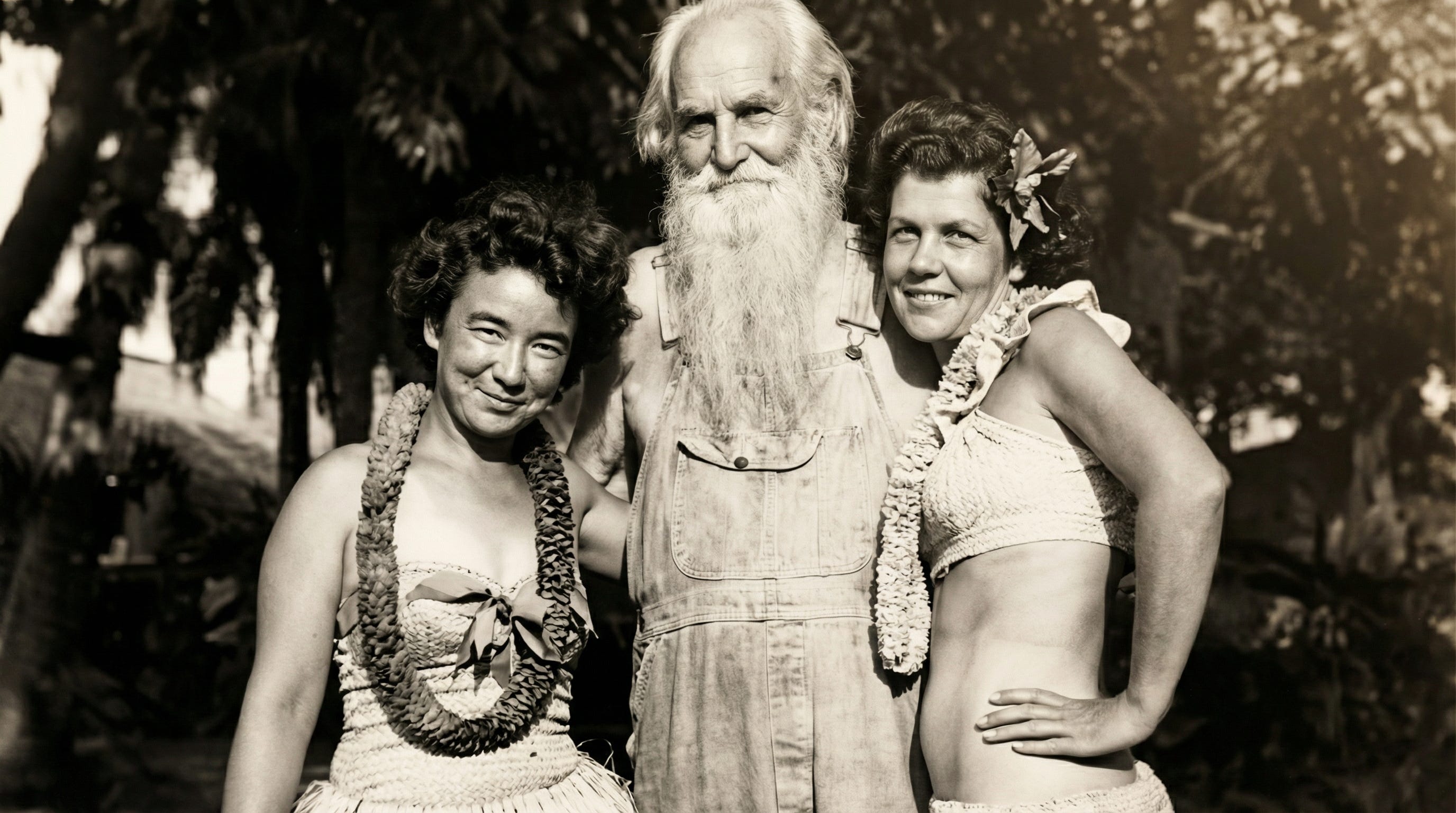
Despite living alone on a scrubby island, Silas was far from a recluse in personality. People who met him invariably described him as friendly, talkative, and hospitable – hence the nickname the “Hospitable Hermit” or “Happy Hermit.”He welcomed visitors who boated over to see him, whether they were curious locals, weekend adventurers, or boys out exploring. Children were especially fond of Silas. On at least one Christmas Eve in the late 1940s, the white-bearded hermit donned a Santa Claus costume and hosted local kids, handing out little gifts to the eleven wide-eyed children gathered around his palm-frond Christmas tree. A sepia-toned photograph from that night shows Silas with a jolly grin beneath his Santa beard, surrounded by delighted youngsters – a heartwarming scene that captures how this supposed loner was very much a beloved figure in the community.
When not entertaining guests or tending his cows, Silas spent his days much as one might imagine a self-reliant hermit of old Florida would. He patrolled his island domain in simple clothes (often just shorts and a shabby shirt, and usually barefoot), accompanied at times by a trusty dog. He hand-crafted tools and even wove grass skirts from palmetto fibers, which he would trade or humorously gift to visitors. (Local beachgoers chuckled to find the hermit of Cabbage Key peddling homemade grass skirts – perhaps Florida tourists in the 1930s and ’40s took them home as curious souvenirs of their encounter with the island hermit.) In the evenings, Silas might light a kerosene lamp in his thatched hut, the golden glow visible offshore as one of the only lights in that wild darkness. He cooked whatever he had on hand – maybe a fresh fish he’d caught or a bit of beef or milk from his herd. On special occasions when he went to town in St. Petersburg for supplies, he surely cut a memorable figure: a sun-weathered, barefoot man with twinkling eyes, striding through the city’s streets as nonchalantly as any paying customer, before retreating once more to his mangrove kingdom across the bay.
Eccentric Tales and Local Legend
Over time, Silas Dent’s eccentric lifestyle yielded countless colorful anecdotes that locals loved to recount. Many an evening in St. Petersburg or Pass-a-Grille, one might hear fishermen swapping stories about “Old Silas” and his latest antics on Cabbage Key. One popular tale described how Silas would casually sit on a dock with his feet in the water to gather stone crabs – letting the crabs latch onto his toes before plucking them off for the dinner pot. Another story had Silas stalking through the palmetto thickets after a venomous snake, emerging triumphantly with the writhing reptile held safely in his bare hands, as if it were no more bothersome than a wriggling garden hose. These almost folkloric images – the gentle hermit who could charm or subdue wild creatures – made Silas Dent something of a mythic character around South Pinellas.
Yet those who knew him stress that Silas truly was as kind-hearted and gentle as the stories suggest. He had a genial nature and a broad smile. If a boater got lost or stuck near Cabbage Key, Silas would gladly help, towing them to safety or offering a cup of strong coffee by his campfire to warm them up. His hospitality was genuine. In fact, the very moniker “Happy Hermit of Cabbage Key” originated from the press recognizing how content and welcoming he was in his solitude. The name first gained wide exposure in 1948, when Life magazine – a major national magazine of the day – featured Silas Dent in a human-interest piece and dubbed him “the happy hermit of Cabbage Key”. The Life magazine blurb (accompanied by photographs of Silas at his thatched hut, smiling in his element) introduced the nation to this cheerful Floridian hermit living in quasi-paradise. After that, Silas received occasional sightseers and reporters, all eager to glimpse the man who thrived alone on an island yet seemed perfectly jolly. He never disappointed them. Silas would share wry wisdom about living off the land, perhaps cracking a joke about preferring the company of gators to people, before sending his visitors on their way with a wave.
One legendary episode from Silas’s later years highlights both his ingenuity and the Old Florida pioneer spirit he embodied. As his dairy operation grew a bit, transporting multiple cans of milk by rowboat became arduous. Always resourceful, Silas and his brother rigged up a solution worthy of a Hollywood movie: they loaded an old Cadillac automobile onto a barge, effectively creating a makeshift ferry powered by the car’s engine. Using this contraption, they could carry larger quantities of milk (and maybe even a cow or two) across the bay to market. Locals were astonished to see the sight – an antiquated Cadillac lashed atop a barge chugging across Boca Ciega Bay, piloted by the Dent brothers. It must have been an unforgettable mix of frontier practicality and quirky inventiveness. The image of Silas steering a car-on-a-raft to make his deliveries only added to his legend. Decades later, old-timers would swear these stories were true (and indeed contemporary accounts confirm the Cadillac-ferry tale). Such was the resourceful life of Silas Dent: if a problem needed solving, he solved it, convention be damned.
Through the 1930s and 1940s, Silas Dent remained a fixture of local lore. He weathered numerous storms on his island, including the great hurricane of 1921 which sent a tidal surge over the low-lying keys. While others fled or perished in that storm, Silas and his animals somehow survived. Neighbors recalled seeing him soon after, calmly paddling over to Pass-a-Grille with his usual milk delivery as if nothing had happened – though one imagines he likely had to rebuild his hut and corral in the aftermath. This stoic resilience in the face of nature’s fury bolstered his nearly superhuman reputation. By the time World War II ended, the world around Silas was changing fast – army airfields and coastal forts had popped up on nearby Mullet Key (Fort De Soto) during the war, and after 1945, developers and tourists began eyeing the pristine islands for new projects. Through it all, Silas carried on his simple life, an old man by now, still tending his cows, fishing for his supper, and strolling bare-foot along the sands of Cabbage Key with the same easy smile.
Later Years, Legacy, and the End of an Era
In the early 1950s, Silas Dent was in his seventies and had spent the majority of his life on Cabbage Key, largely untouched by modern amenities. He had lived “in a thatched cottage there for half a century,” as one historian noted. To younger residents of Pinellas County, he was something out of a storybook – a living link to the pioneer days. Despite his age, Silas remained active and self-sufficient nearly to the end. His later years were marked by a continued joy in the routine he had created. Neighbors would still spot him poling his canoe through the mangroves or see smoke rising from his cookfire at dusk. He never did abandon Cabbage Key for “civilization”; the island was his beloved sanctuary, and he stayed true to it. In 1952, Silas Dent passed away at the age of 76, peacefully ending his extraordinary chapter of Tampa Bay history. Fittingly, he died in the place he loved – presumably on Cabbage Key itself – surrounded by the whispering pines, the salt breeze, and the calling gulls that had been his companions for so long.
Silas’s death marked the end of an era. Not long after he was gone, the rapid development he had long eluded finally overtook Cabbage Key. In the late 1950s, developers dredged and filled the surrounding bays to build modern roads and upscale communities. In fact, the dredging of channels and causeways literally wiped Cabbage Key off the map, merging and reshaping the islands into the new sprawling Tierra Verde development. The wild little paradise that Silas Dent had known – palmetto flats, shady pine groves, and sandy cow pastures – was transformed into a landscape of pavement and canals he “would never recognize”. Conservationists mourned the loss of the natural island, even noting that places which had once known pirates, soldiers, and Silas Dent himself were now buried under dredged soil. But such was the march of progress in Florida.
Yet, Silas Dent’s legacy lives on in many ways. His name and story became enshrined in local folklore and written histories as a symbol of the hardy individualism of early Pinellas County settlers. The St. Petersburg Times (now Tampa Bay Times) and other papers periodically retold his tale, ensuring new generations learned about the cheerful hermit of the Gulf beaches. In 1948 Life magazine had already secured his national fame, but it was the local community that truly remembered him. A popular restaurant on St. Pete Beach later took on the name “Silas Dent’s Steakhouse,” honoring the old hermit’s memory in the very civilization he once avoided. (Diners who asked about the name would hear stories of the milk-toting, snake-wrangling hermit of Cabbage Key while cracking stone crab claws – a proper tribute in spirit and cuisine.) The Gulf Beaches Historical Museum in Pass-a-Grille today features an exhibit about Silas Dent, complete with photographs and even personal items, keeping his story alive for history buffs and beachgoers alike. And in local schools and libraries, Silas is sometimes brought up as a colorful character from the region’s past – a true-life “Florida Cracker” hermit who demonstrated both self-reliance and kindness.
Above all, the legend of Silas Dent endures because his life strikes a chord of romance and nostalgia. He lived nearly half a century on his own terms, embracing the solitude of nature without ever becoming bitter or truly lonely. Instead, he found joy in it – earning him the nickname “Happy Hermit.” He showed that one could be self-sufficient yet generous, independent yet connected to community. Whether rowing his skiff through pre-dawn mists to deliver fresh milk, or regaling wide-eyed children with gifts and tall tales by a driftwood Christmas tree, Silas Dent lived a life that was both unconventional and richly human. In the narrative of Florida’s Suncoast, his biography reads almost like a tall tale – except it’s all true, every bit of it, from the toe-caught crabs to the thatched hut and the Cadillac-barge ferry. Silas Dent’s story reminds us of a time not so long ago when an individual could disappear into the mangroves and make a home, becoming a legend simply by being himself. And though Cabbage Key is gone and the world around Tampa Bay has vastly changed, the memory of the Happy Hermit of Cabbage Key remains, irrepressible as the Florida sunshine.