



By J. H. Irwin
Author | Storyteller | Capturing Life, Memory, and Meaning
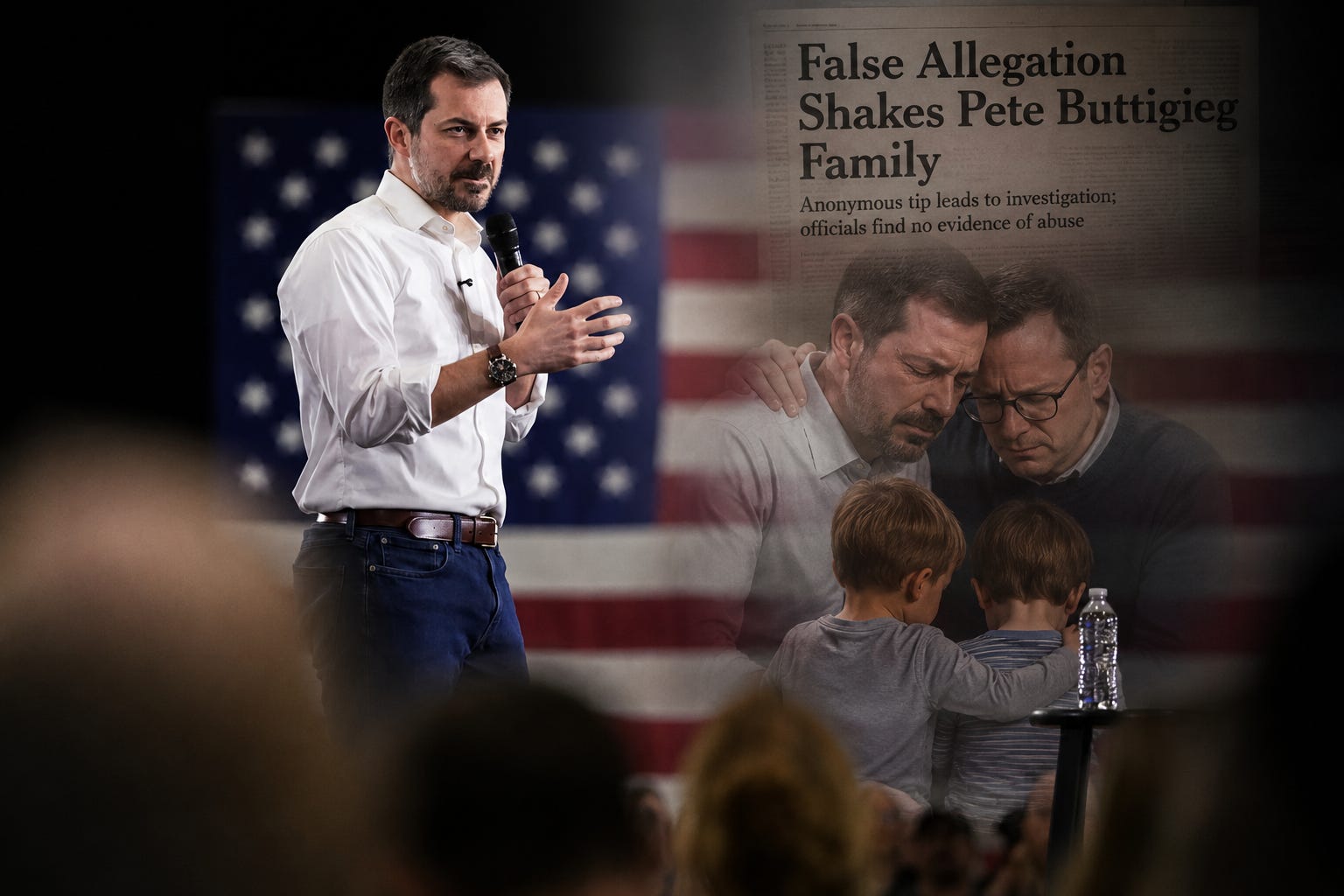
When news broke that Pete Buttigieg and his husband, Chasten, had become the targets of a false child abuse allegation, I felt what I suspect many gay men felt before I even finished reading the story
Not anger.
Fear.
According to reports, an anonymous caller made fabricated allegations involving the couple’s young children, prompting Child Protective Services and law enforcement to investigate. The claims were quickly determined to be baseless, and authorities concluded there was no evidence of abuse. The investigation ended, but the emotional impact of such an accusation is not something that simply disappears once the paperwork is closed.
For many readers, this was another story about a public figure caught in today’s increasingly toxic political climate.
For many gay men, it was something much more personal.
It reminded us of a fear we have carried quietly for most of our lives.
Long before same-sex marriage became legal, long before gay couples could openly adopt children or become foster parents, one of the oldest weapons used against gay people was the accusation that we somehow posed a danger to children. The stereotype was repeated in whispers, shouted from pulpits, written into discriminatory laws, and reinforced by politicians seeking an easy target. It became so deeply embedded in parts of our culture that many people accepted it without ever asking whether it was actually true.
It wasn’t.
It never was.
Yet a lie repeated often enough has a way of becoming something people stop questioning.
As a result, many gay men learned to live differently than everyone around them. We became cautious in situations that our straight friends never had to think twice about. We learned to be aware of how we interacted with children, how long we remained alone with them, and even how affection might be perceived by someone watching from across the room.
Most heterosexual men have probably never had to wonder whether giving a frightened child a comforting hug might later be misunderstood. Many gay men have.
Most straight fathers never worry that volunteering to coach a youth team, mentor a teenager, or babysit a niece or nephew might invite suspicion based solely on who they love. Many gay men have considered those possibilities more carefully than anyone should ever have to.
These aren’t conversations we often have publicly because discussing them can sound defensive, as though merely acknowledging the stereotype somehow validates it.
It doesn’t.
It simply acknowledges the emotional reality of living beneath it.
Perhaps that is why Pete Buttigieg’s experience resonated so deeply within the LGBTQ+ community. It wasn’t simply that someone made a false accusation. False accusations can happen to anyone. What struck a nerve was the specific nature of the accusation and how easily it tapped into a prejudice that many believed had faded into history.
The truth, however, is that history tells a very different story than the stereotype.
Decades of research have consistently found no evidence that gay men are more likely to sexually abuse children than heterosexual men. In fact, researchers who specialize in child sexual abuse have repeatedly emphasized that adult sexual orientation and child sexual abuse are entirely separate issues. Sexual abuse of children is not an extension of homosexuality or heterosexuality. It is a distinct form of criminal behavior with its own psychological motivations.
One frequently cited study examining hundreds of substantiated child sexual abuse cases found that only two of the identified offenders were reported to be gay or lesbian. The overwhelming majority of offenders were heterosexual men connected to the child’s family or immediate circle. Other research has consistently shown that most children are abused not by strangers, but by someone they already know and trust, often within their own family or social network.
These findings matter because they expose just how disconnected the stereotype has always been from reality.
The myth survives not because the evidence supports it, but because prejudice has never required evidence to survive.
Throughout history, gay teachers lost their careers because parents feared they would somehow “recruit” children. Gay fathers lost custody battles despite being loving parents. Gay men were barred from volunteering with youth organizations or coaching children’s sports because people confused sexual orientation with predatory behavior.
Even today, despite enormous progress in LGBTQ+ equality, echoes of those assumptions remain. Sometimes they appear in legislation. Sometimes they surface on social media. Sometimes they emerge in casual conversations where harmful jokes are dismissed as harmless opinions. And sometimes they are weaponized against public figures precisely because those making the accusation understand the emotional damage such lies can inflict.
The greatest tragedy is that these accusations don’t merely attack an individual’s reputation. They force an entire community to relive decades of suspicion that many hoped had been left behind.
As a gay man, I don’t move through the world believing people are judging me this way. Most people are kind, accepting, and capable of seeing individuals for who they truly are. Society has changed enormously during my lifetime, and I am profoundly grateful for that progress.
But progress does not erase memory.
Many of us still carry the habits that prejudice taught us. We remain conscious of situations others rarely notice. We think about appearances. We avoid circumstances that could be misunderstood. We instinctively protect ourselves from accusations that have haunted generations of gay men before us.
That vigilance becomes part of who you are.
It is difficult to explain to someone who has never had to live with it because it often operates quietly beneath the surface. It isn’t paranoia. It isn’t shame. It is simply the accumulated experience of belonging to a group that has spent decades defending itself against an accusation it never deserved.
None of this should ever diminish the importance of protecting children. Every credible allegation involving a child’s safety deserves to be investigated thoroughly, professionally, and without hesitation. Children must always come first.
At the same time, we should recognize the profound damage caused by knowingly false accusations. They traumatize innocent families, consume resources that should be devoted to children who genuinely need protection, and erode public confidence in systems that exist to safeguard the most vulnerable among us.
Perhaps most importantly, they breathe life back into prejudices that responsible people have spent decades trying to overcome.
Pete Buttigieg’s experience reminded me that equality is not measured solely by laws or court decisions. It is also measured by whether people can live their lives without carrying the burden of stereotypes they did nothing to earn.
Most Americans today understand that being gay says nothing about a person’s character, integrity, or ability to love and raise children. Millions of LGBTQ+ parents are proving that every single day, raising families filled with the same laughter, sleepless nights, scraped knees, homework battles, birthday parties, and unconditional love that define families everywhere.
That is the reality.
The stereotype never was.
If there is one lesson to take from this story, it is not simply that false accusations are cruel. It is that they reveal how easily old prejudices can still be exploited when people know exactly where to aim.
We protect children by following evidence, not stereotypes.
We protect families by rejecting assumptions that have been disproven for decades.
And we protect our shared humanity when we remember that every accusation carries consequences, not only for the person being accused, but for every innocent person who sees themselves reflected in that accusation.
Perhaps the greatest measure of progress will come when a story like Pete Buttigieg’s is seen for exactly what it is: not a reflection of a person’s identity, but the malicious act of someone willing to weaponize one of society’s oldest lies.
Until then, many gay men will continue doing what we have always done. We will love our families, contribute to our communities, and live our lives with the quiet hope that one day we will be judged not by myths that were invented about us, but by the character we demonstrate every single day.
Words can still move the world. Read mine → https://substack.com/@jhirwin