


By J. H. Irwin
Author | Storyteller | Capturing Life, Memory, and Meaning
My husband and I celebrated twenty-nine years together this week. What began as an anniversary trip to New York City became something far more profound on the flight home to Tampa yesterday. I witnessed a moment that distilled the meaning of love, commitment, and the vow we all speak but rarely fully grasp. This article is my attempt to honor what I saw and what it awakened in me.
Till Death Do Us Part
We changed our flight because of a pending blizzard.
We had just spent several days in New York City celebrating twenty-nine years together. Twenty-nine years of shared love, shared grief, shared joy, shared ordinary mornings that quietly become extraordinary in retrospect.
Because of the last-minute change, my husband and I were not seated together. He was across the aisle and back one row. I had the window seat. An elderly man sat beside me on the aisle. Across from him, also in an aisle seat, sat his wife.
They appeared to be in their mid to late eighties. Fragile, yes. But unmistakably connected.
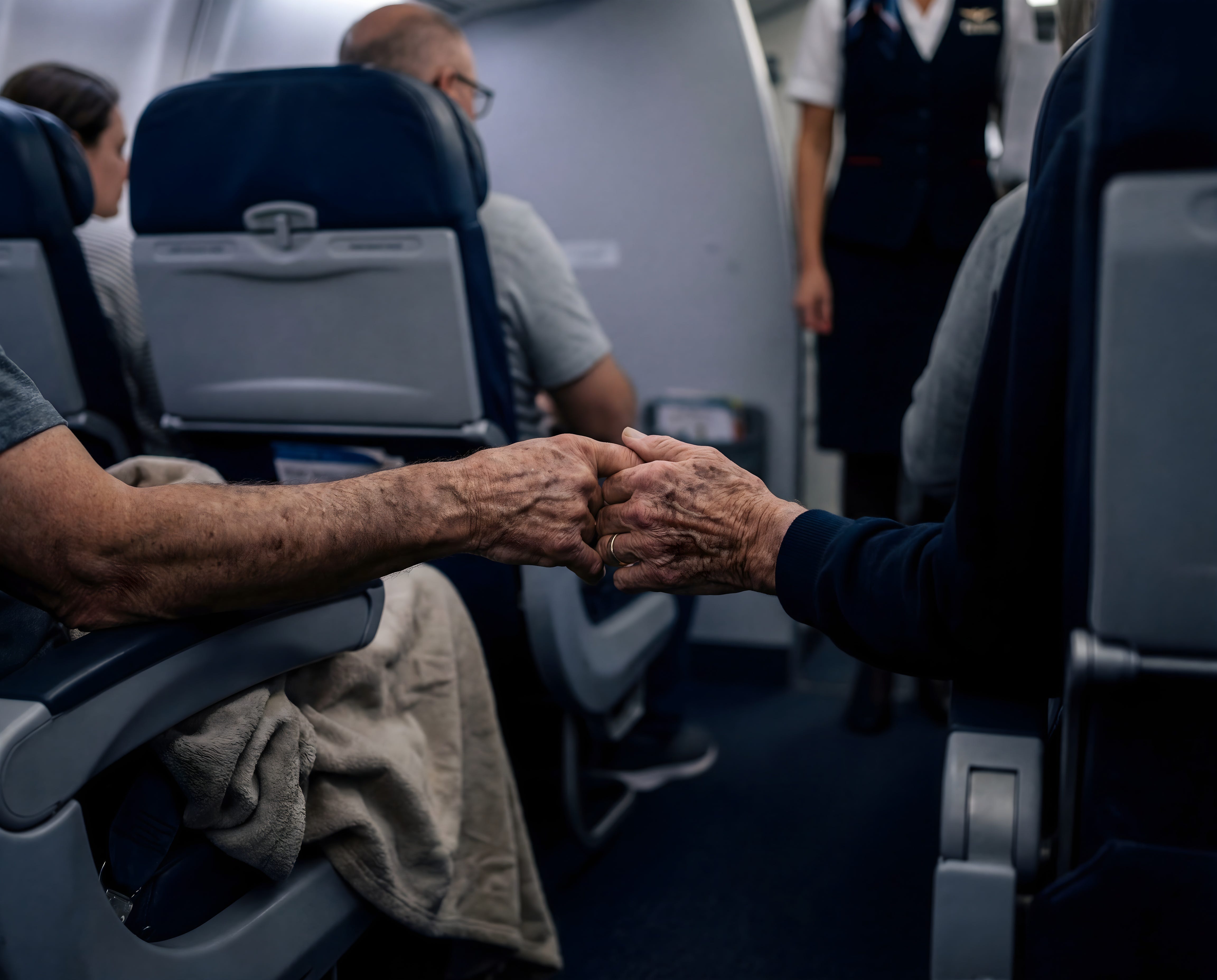
From time to time they reached across the aisle and held hands. Not theatrically. Not for attention. Just instinctively, the way two people do after decades of loving each other. They used their phones to playfully take pictures of one another across the aisle, smiling gently, almost shyly. Even now, at their age, they still wanted images of each other.
It was tender. It was real.
He struggled to find the headphone plug for his headset. I helped him. He could not figure out how to select his movie. I helped again. He thanked me with the politeness of a man who had likely spent a lifetime being the helper himself.
About halfway through the two-and-a-half-hour flight, something shifted.
At first, he seemed tired. Then unsettled. His head dropped forward toward his knees as we began descending. I thought perhaps he was clearing his ears.
Then he said quietly, “I can’t breathe.”
The air in the cabin changed instantly.
The flight attendants moved quickly. An oxygen canister appeared. A mask was placed over his nose and mouth. For a moment he seemed unresponsive. Across the aisle, his wife watched, unable to reach him.
That look on her face will stay with me.
My empathy took over before my thoughts did. I placed my hand on his back. Not dramatically. Just gently, steadily. I kept it there. I spoke to him. I wanted him to know he was not alone.
He began to improve slightly. I asked if he was okay.
He told me they had not traveled in four years. He said this trip was probably not a good idea. He told me he was diabetic and undergoing dialysis.
It was clear he was not in good health.
And in that moment a quiet realization formed in my mind. Perhaps this was not simply a trip. Perhaps it was a farewell. Perhaps they were visiting someone, or someplace, for the last time.
I looked back at my husband across the aisle. Our eyes met. I then looked at the man’s wife. She looked at me.
There was a shared understanding in that silent exchange.
I imagined the life they had built. The house. The arguments that once felt urgent. The careers that once felt central. The children they may have raised. The holidays. The ordinary evenings that seemed endless at the time.
All of it narrowing now to one airplane aisle.
When we landed in Tampa, the crew asked all passengers to remain seated while paramedics were called. I was in the front row and helped hold the oxygen canister as he tried to steady his breathing. I kept my hand on his back. I kept talking to him.
Across the aisle, his wife waited.
Eventually, the decision was made for all passengers to deplane except the two of them.
As I stood to leave, I reached across and placed my hand on her back. I offered quiet words of comfort. They felt small compared to the weight of what she was carrying.
When my husband and I reached our car, I could no longer contain the emotion. The tears came without restraint.
I was not only grieving for that man.
I was grieving the inevitability of the vow.
“Till death do us part” is spoken in youth with limited comprehension. It sounds ceremonial. Romantic. Almost poetic.
But it is neither abstract nor poetic.
It is literal.
Yesterday I saw what that vow looks like in its final chapters. It looks like reaching across an aisle to hold hands even when mobility is limited. It looks like taking pictures of each other when time feels fragile. It looks like oxygen masks and trembling breaths. It looks like a wife who cannot physically cross the aisle but refuses to look away.
It looks like love that remains when everything else begins to fail.
Twenty-nine years suddenly felt both long and impossibly brief.
We spend so much of our lives believing there will always be another trip, another anniversary, another Tuesday morning coffee. We argue over small things. We stress over careers. We guard grudges. We assume time will continue its generous pace.
And then one day, whether in a hospital room or on a descending airplane, the circle closes.
I never learned their names.
But I witnessed their love.
And that is enough.
It changed me.
Because love is not proven in wedding photos or anniversary dinners. It is proven in the quiet endurance of decades. It is proven in the hand that still reaches. It is proven in the vow that becomes real when breath becomes difficult.
We are all moving toward that aisle. Every couple. Every family. Every one of us.
The only question is not whether the final chapter will come.
It is whether, when it does, a hand will still reach across.