


By J. H. Irwin
Author | Storyteller | Capturing Life, Memory, and Meaning
If you had not visited Washington, D.C., since 2008 and returned today, I suspect your first reaction would not be to admire the monuments. It would be to notice what stands between you and them. The change is immediate. It is physical. More importantly, it is emotional. Something about the nation’s capital feels different.
I recently read an account from someone making that very return after nearly two decades away. Their description stayed with me because it echoed something I have been hearing from others. They spoke of a city with a noticeably heavier security presence around its most recognizable landmarks, of barriers where open views once existed, and of an atmosphere that felt less welcoming than they remembered. Whether every visitor leaves with the same impression is beside the point. The question worth asking is why so many are beginning to describe America’s capital in similar terms.
To be clear, Washington has never been without security. The White House has always been protected. Federal buildings have always had police officers nearby. The nation’s capital is home to the government of the United States, and protecting that government is both necessary and expected. The issue is not whether security should exist. It is how dramatically the public experience has changed.
The White House itself remains open to the public through guided tours arranged by members of Congress. Americans can still walk through the historic residence that has welcomed visitors for generations, and that is something worth celebrating. Yet approaching the White House today is a different experience than it once was. Expanded security zones, reinforced fencing, restricted access, and a much more visible law enforcement presence shape the journey long before anyone reaches the gates. The People’s House is still there, but it feels farther away.
The same is true at the National Mall. The Lincoln Memorial Reflecting Pool, one of the most recognizable public spaces in America, has spent much of this year hidden behind fencing and construction barriers following problems with a major renovation project. Visitors expecting the iconic view made famous in photographs, documentaries, and history books instead encountered blocked sightlines and detours. Temporary projects eventually end, but they contribute to a broader feeling that the nation’s civic spaces have become increasingly inaccessible.
Then there are the images.
Washington has always displayed symbols of the republic. American flags fly proudly above public buildings. Statues honor presidents, civil rights leaders, veterans, scientists, and explorers. Museums preserve the nation’s story without asking citizens to pledge loyalty to any one individual. That balance has long reflected one of America’s greatest strengths. Our institutions were meant to endure beyond the people elected to lead them.
In recent months, however, visitors have remarked on the growing presence of oversized banners featuring President Donald Trump displayed on federal buildings. Supporters view them as expressions of patriotism and strong leadership. Critics see something else entirely. They see a shift away from celebrating democratic institutions toward elevating a single political figure. Whether one agrees with that interpretation or not, it represents a noticeable change in the visual identity of the nation’s capital.
Symbols matter.
The spaces we build communicate our values just as surely as the laws we pass. A courthouse conveys justice. A memorial conveys remembrance. A public square conveys openness. When barriers become more prominent than the landmarks themselves, people naturally begin asking what message is being sent.
This is not merely a discussion about fencing, barricades, or banners. It is about confidence.
I have to be honest. I hesitate to even write about what is happening in our country anymore because it depresses me.
There was a time when it was almost all I wrote about. Every executive order, every attack on democratic norms, every assault on the rights of others seemed to demand a response. Those articles reached more people than much of what I write today. They generated more discussion, more shares, and more engagement. They also took something from me. Living inside that outrage every day became emotionally exhausting, and eventually I realized I was carrying more of the country’s pain than I could bear. I stepped away because I needed to rediscover hope, kindness, and the humanity that still exists around us.
Then I read the account of someone returning to Washington after nearly twenty years away.
It was not written by a political strategist or a television commentator. It was written by an ordinary traveler describing what they saw with their own eyes. Barricades. Restricted views. A heavier security presence. Monumental banners celebrating one political leader. Whether every observation was identical to another visitor’s experience almost seemed beside the point. What struck me was the overwhelming feeling they described, because it echoed something I had been been hearing from others.
When our nation’s capital begins reminding visitors of Red Square more than the open democracy it has long symbolized, there is reason to pause and ask difficult questions.
That thought saddens me more than it angers me.
It is not simply because I disagree with a president or his policies. Elections are won and lost. Administrations come and go. America has endured profound disagreements before. What troubles me is the growing sense that the visual language of our democracy is changing in ways that feel unfamiliar to many of its own citizens.
There is another loss that is harder for me to explain.
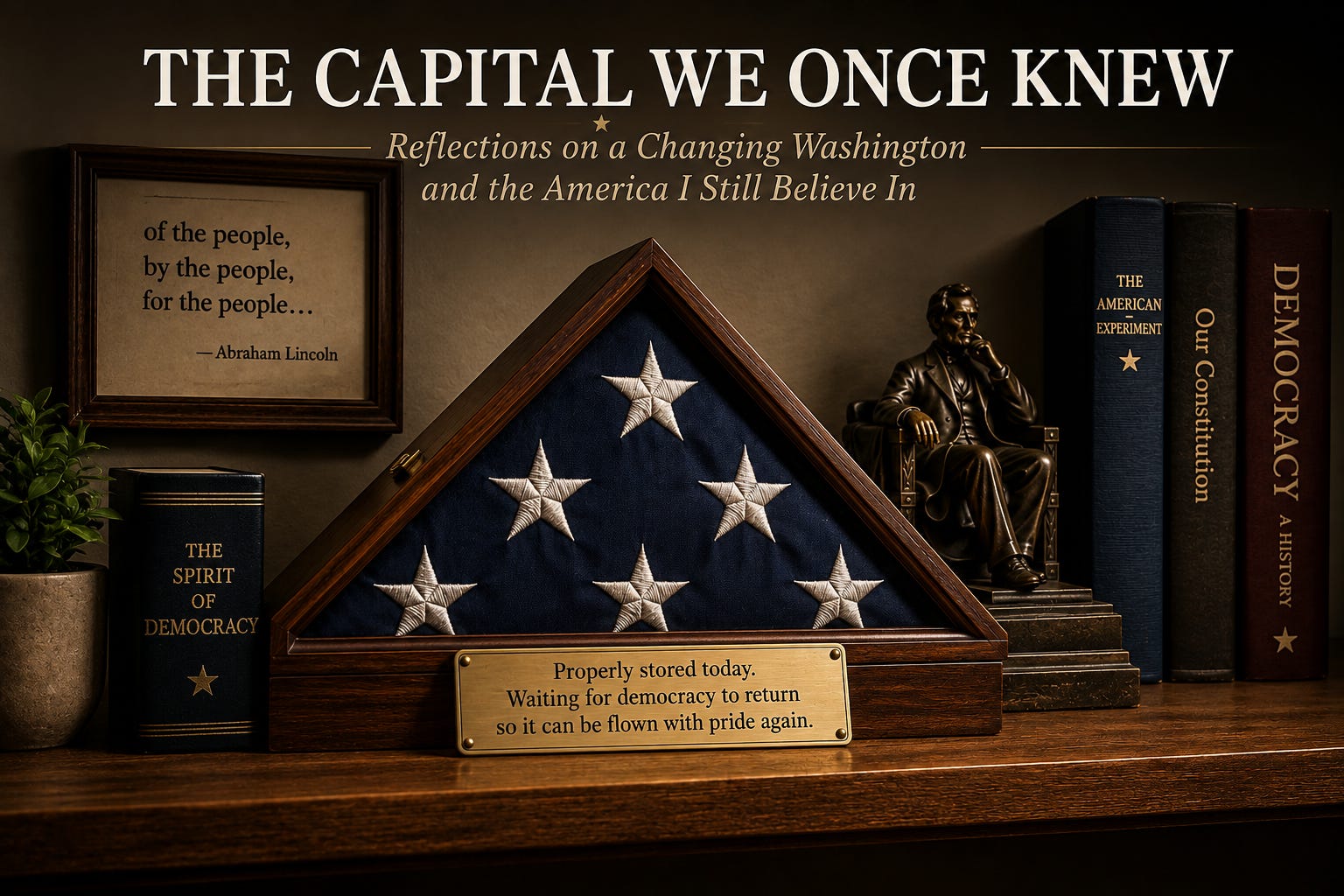
Since the last election, I no longer feel comfortable flying an American flag in my own front yard. For most of my life that flag represented constitutional freedoms, equality under the law, and the promise that America, while imperfect, always aspired to become more inclusive than it had been before. Today, I struggle to see it the same way. As a gay man, as someone who has spent his life believing that every person deserves equal dignity, I find myself mourning what that symbol once meant to me. That is not because the flag has changed. It is because my relationship with it has.
That realization breaks my heart.
I love this country. I always will. Perhaps that is why these changes affect me so deeply. Criticism born from love is not disloyalty. Sometimes it is the highest form of patriotism, because it refuses to stop believing that America can once again become the nation its founding ideals promised it could be.
Confident democracies generally seek to remind citizens that government belongs to them. The buildings may require protection, but they also invite participation. The Capitol, the White House, the Smithsonian museums, and the monuments have historically represented a shared inheritance. They belong equally to Republicans, Democrats, independents, and those who have never voted at all. They belong to every American.
When those places begin to feel less accessible, whether because of necessary security measures, changing political culture, or the cumulative effect of both, something subtle changes in the relationship between citizens and their government. Trust is not measured only by opinion polls. Sometimes it is measured by whether ordinary people feel welcome in the spaces built to represent them.
Some will read this and conclude that these changes are simply the reality of modern security. They are not entirely wrong. The threats facing public officials today are real, and no reasonable person would argue that the White House or other federal buildings should be left vulnerable.
Security protects democracy. Openness reminds us it still belongs to us.
Every nation tells a story about itself through its capital city. Paris tells a story of culture. London tells a story of continuity. Rome tells a story of civilization stretching back thousands of years. Washington has traditionally told a story about a constitutional republic that belongs to its citizens, where power changes hands peacefully and public institutions matter more than public personalities.
That story feels less certain today.
The greatest change may not be something that appears in photographs at all. It is a feeling. Visitors describe a city that feels more guarded, more politically branded, and less open than they remember. Feelings, by themselves, do not prove decline. They do, however, reveal something important about how people experience the country.
A democracy should inspire confidence without requiring spectacle. It should command respect without demanding reverence for any one leader. It should protect its institutions while remaining visibly connected to the people those institutions serve.
America deserves a capital that reflects those ideals.
I hope that one day, when someone returns after twenty years away, the first thing they notice is not another barricade or another political banner. I hope they notice the monuments again. I hope they feel what generations before them felt standing beside the Reflecting Pool, walking the National Mall, or looking toward the White House.
Not because nothing has changed.
But because the spirit of an open democracy is still unmistakably present.
Words can still move the world. Read mine → https://substack.com/@jhirwin