


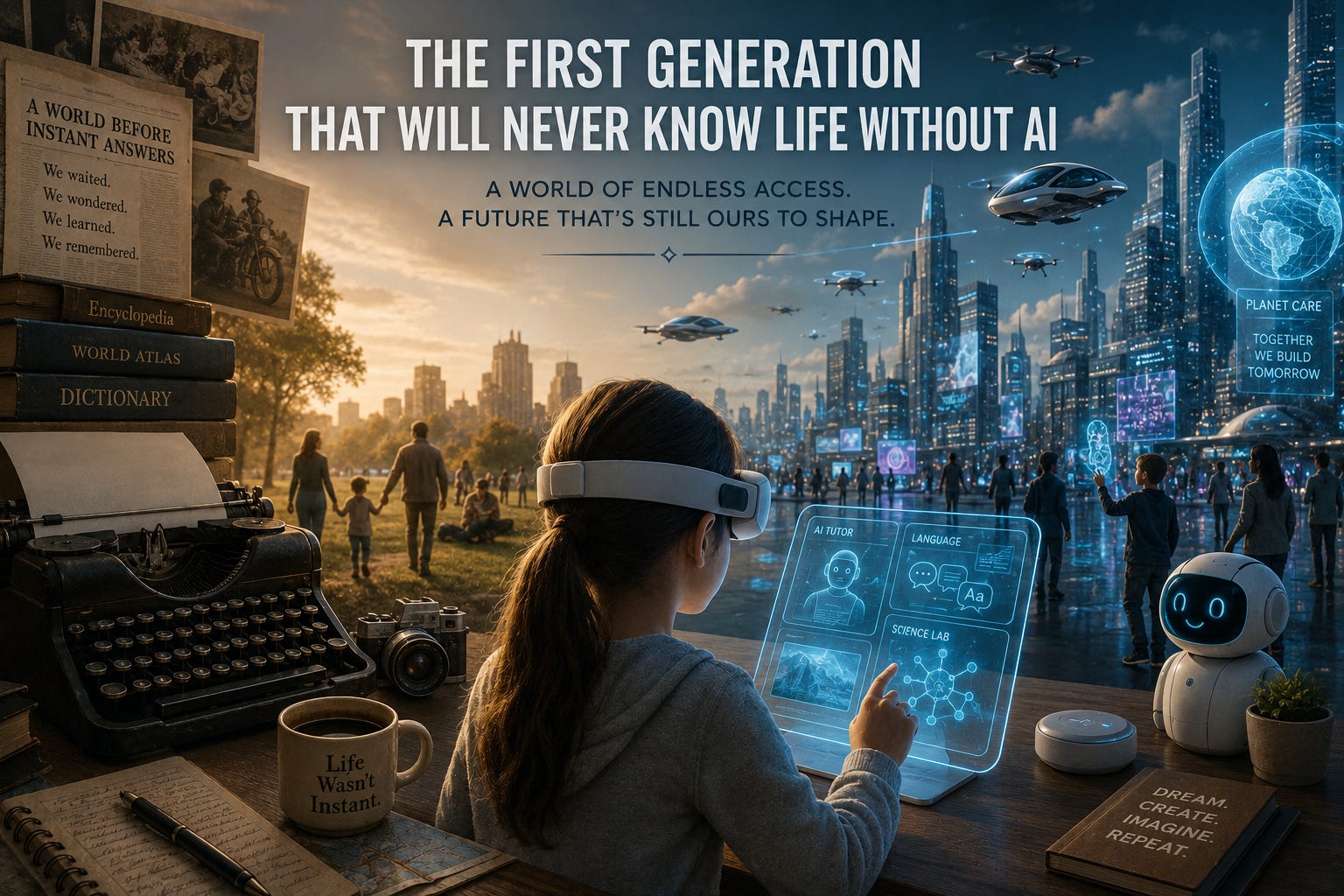
By J. H. Irwin
Author | Storyteller | Capturing Life, Memory, and Meaning
Author’s Note
“I am 65 years old. I grew up in a world where information was something you searched for, not something that followed you around waiting to answer every question you asked. We memorized phone numbers. We unfolded paper maps. We sat with uncertainty longer because there was no machine sitting in our pocket ready to explain everything instantly.
Now, within the span of a single lifetime, humanity has entered something entirely different.
Artificial intelligence is no longer science fiction. It is not some distant possibility waiting decades to arrive. It is here, embedded into our phones, our workplaces, our search engines, our hospitals, our schools, and increasingly, our personal lives.
And for the first time in human history, there will be generations who never experience a world without it.
That realization stopped me cold.”
The End of “Before”
People my age remember “before.”
Before the internet.
Before social media.
Before smartphones.
Before algorithms shaped what we saw, believed, and paid attention to.
And now, before AI.
The generations being born today will never know what it felt like to struggle through a research paper without instant answers. They may never understand the silence of a disconnected world. They may never experience being truly lost without GPS guiding every movement or AI helping solve every problem.
To them, artificial intelligence will feel as ordinary as electricity.
That changes something fundamental about human development.
When you grow up with intelligence constantly available beside you, your relationship with learning changes. Your relationship with memory changes. Even your relationship with yourself may change.
A child today may grow up with an AI tutor helping with homework, an AI assistant organizing their life, an AI companion answering emotional questions, and AI systems creating art, music, and stories personalized specifically for them.
That is extraordinary.
It is also unsettling.
Mr. Data Wanted What We Already Had
Years ago, while watching Star Trek: The Next Generation, I remember being fascinated by the character Data. Data was an android, a machine powered by artificial intelligence, capable of calculations and analysis beyond human ability. He could process information instantly, remember everything, and outperform humans intellectually in countless ways.
And yet, that was never enough for him.
What Data wanted more than anything was not greater intelligence. He wanted humanity.
He studied humor because he did not naturally understand laughter. He practiced human interaction because emotion was foreign to him. He searched constantly for meaning, friendship, loyalty, compassion, and belonging. In many ways, some of the most emotional moments in the series came not from the humans aboard the Enterprise, but from the machine trying desperately to understand what it meant to be one.
That irony feels deeply relevant now.
For decades, science fiction imagined machines struggling to become more human. But today, as AI advances at breathtaking speed, there are moments where it almost feels like human beings are drifting in the opposite direction, becoming more machine-like themselves. Faster. More optimized. More algorithmically guided. More dependent on systems that tell us what to think, watch, buy, and believe.
Data reminded us that intelligence alone is not humanity.
Humanity lives in imperfection.
In empathy.
In memory.
In grief.
In humor.
In conscience.
In love.
The very things the android longed for are the things we risk undervaluing in ourselves.
Convenience Has a Cost
Human beings are remarkably adaptable, but there is something we should not ignore.
Some of the most important parts of being human were forged in difficulty.
Patience.
Resilience.
Independent thought.
Imagination.
Reflection.
Problem solving.
For most of human history, struggle forced us inward. We learned to sit with confusion, boredom, loneliness, and uncertainty long enough for creativity and identity to emerge.
AI threatens to remove friction from life.
At first glance, that sounds wonderful. Who wants unnecessary struggle? But friction is often where growth occurs. A generation raised in a world where answers appear instantly may become incredibly informed while simultaneously becoming less practiced at wrestling with uncertainty itself.
And uncertainty is part of life.
No machine can eliminate grief.
No algorithm can prevent heartbreak.
No chatbot can fully substitute for human connection.
The danger is not simply that AI may make life easier. The danger is that people may slowly lose confidence in their own ability to think, create, and navigate life without technological mediation.
The Workplace Is Already Changing
There is another reality we need to speak honestly about.
AI is not only changing technology. It is changing labor itself.
For years people assumed automation would mostly threaten physical jobs. Instead, we are watching AI move aggressively into cognitive work.
Writing.
Coding.
Research.
Customer service.
Marketing.
Design.
Finance.
Legal analysis.
Media production.
Even medicine and engineering are beginning to shift.
Entire industries are being quietly restructured while much of the public still treats AI like a novelty app that creates funny images.
The truth is larger than that.
Future generations may have careers that barely resemble the careers most of us knew. Many routine intellectual tasks will likely become AI-assisted or AI-managed entirely. The value of a worker may increasingly depend less on information recall and more on judgment, emotional intelligence, creativity, ethics, leadership, and the ability to interpret complex human situations.
Ironically, the more intelligent machines become, the more valuable authentic humanity may become.
People may crave real voices more than synthetic perfection.
Real experiences more than generated content.
Real trust more than automated interaction.
A machine can generate words endlessly, but it cannot live a human life.
It cannot carry memory.
It cannot age.
It cannot understand loss.
It cannot know what it means to survive decades of living.
That still belongs to us.
The Loneliness Question
One of my deepest concerns is not technological. It is emotional.
We are already living through a loneliness epidemic despite being more digitally connected than any civilization in history. AI may intensify that contradiction.
Imagine future generations growing up with personalized AI companions that understand their moods, adapt to their personalities, and tell them exactly what they want to hear. Some people may eventually prefer artificial interaction because it is easier, safer, and less emotionally demanding than real human relationships.
But human relationships are supposed to be messy sometimes.
Growth often comes through disagreement, vulnerability, compromise, sacrifice, and emotional risk. If AI begins replacing too much of that human friction, we may create societies that are hyper-connected technologically while emotionally disconnected from one another.
That possibility worries me far more than robots.
The Battle for Reality
There is another danger emerging in plain sight.
Truth itself.
AI can create photographs that never happened, voices that never spoke, videos of events that never occurred, and articles designed to manipulate public opinion at industrial scale.
We are entering an era where seeing may no longer mean believing.
Future generations may have to develop entirely new survival instincts around information itself. Critical thinking may become one of the most essential human skills of the next century because the line between authentic and artificial will become increasingly difficult to detect.
And that raises enormous ethical questions.
Who controls these systems?
Who benefits from them?
Who gets left behind?
Who decides what information is true?
Who protects democracy, privacy, and human dignity when intelligence itself becomes commodified?
These are not science fiction questions anymore.
They are now political, economic, and humanitarian questions.
Remaining Human in the Age of AI
I do not believe the answer is fear.
Nor do I believe the answer is surrender.
Artificial intelligence can help humanity in extraordinary ways. It may revolutionize medicine, education, accessibility, scientific discovery, and countless aspects of daily life. It already assists people with disabilities, accelerates research, and opens creative possibilities that were unimaginable only a few years ago.
I use AI myself.
I use it for research, guidance, editorial support, and imagery creation that once required searching endlessly through outside sources trying to match the vision in my mind.
But I will never hand my voice over to it.
My stories still come from my life.
My perspective.
My experiences.
My emotions.
My convictions.
My humanity.
That distinction matters.
Because the future may not belong to those who reject AI entirely, nor to those who blindly merge themselves into it without question.
The future may belong to the people who learn how to use these tools while fiercely protecting the irreplaceable parts of being human.
Empathy.
Conscience.
Memory.
Love.
Moral courage.
Authentic creativity.
Those things still matter.
And perhaps they always will.
Words can still move the world. Read mine → https://substack.com/@jhirwin
#ArtificialIntelligence #AI #StillHuman #StarTrek #Data #Technology #Humanity #FutureOfWork #DigitalAge #Creativity #HumanRights #ProDemocracy #Author #ContentCreator #JHIrwin #JHIrwinMultimedia