

The Future Arrived Quietly
No flying cars. No silver jumpsuits. Just invisible technology changing everything.


By J. H. Irwin
Author | Storyteller | Capturing Life, Memory, and Meaning
A Human Moment
“When I was a child, the future seemed easy to imagine.
Television and movies painted vivid pictures of what was waiting for us. There would be flying cars gliding above gleaming cities, robot servants handling household chores, and people dressed in metallic clothing navigating worlds that looked impossibly advanced. The year 2000 felt unimaginably distant, and anything beyond that seemed to belong to the realm of fantasy.
Yet here we are.
Most of us are not commuting through the skies or vacationing on Mars. We do not have robotic butlers preparing breakfast each morning, but they are coming soon. Instead, the future arrived in a way that almost nobody predicted. It arrived quietly, slipping into our daily routines so gradually that many of us barely noticed the transformation taking place around us.
That may be the most remarkable part of all.”
Consider a typical day.
You wake up and ask a digital assistant about the weather. Your phone recognizes your face before you touch it. Navigation software calculates the fastest route to your destination while streaming services predict what you may want to watch later that evening. Online retailers anticipate purchases before you make them, and artificial intelligence can now draft emails, summarize meetings, answer questions, create artwork, and generate content in seconds.
None of these activities feel extraordinary anymore. They have become part of the background of modern life. Yet if you described these capabilities to someone living fifty years ago, they would sound every bit as astonishing as the science fiction fantasies that once filled movie screens.
The future did not arrive with a dramatic announcement. It simply became normal.
Perhaps no device illustrates this better than the smartphone.
The phone sitting in your pocket contains more computing power than the systems that guided astronauts to the moon. What once required rooms filled with equipment now fits comfortably into the palm of your hand. It functions as a camera, map, encyclopedia, communication center, television, banking terminal, music player, and gateway to nearly all the world’s information.
We carry this technological marvel everywhere, often taking it so completely for granted that we become irritated when the battery drops below twenty percent.
That is how thoroughly the future has blended into everyday life.
Another transformation is now underway, and it may prove even more significant than the smartphone revolution.
Artificial intelligence is rapidly moving from novelty to necessity. While many people still think of AI as an interesting tool used occasionally for entertainment or productivity, its integration into daily life is accelerating. Increasingly, AI systems are beginning to operate in the background, quietly assisting before we even realize assistance is needed.
Appointments will be coordinated automatically. Information will be summarized before we request it. Travel plans, scheduling conflicts, research tasks, and routine decisions will increasingly be handled by systems designed to reduce friction and save time. You might even notice AI is taking your order at Checkers now.
Convenience has always been one of technology’s greatest selling points. Human beings naturally embrace tools that make life easier. The challenge, however, is ensuring that convenience does not come at the expense of awareness, critical thinking, or personal agency. History has shown that every technological leap creates opportunities as well as unintended consequences.
Artificial intelligence will be no different.
At the same time, spatial computing is beginning to reshape our relationship with digital information.
For decades, computing occurred through screens. Desktops evolved into laptops. Laptops became tablets. Tablets shrank into phones. Now the screen itself is beginning to disappear.
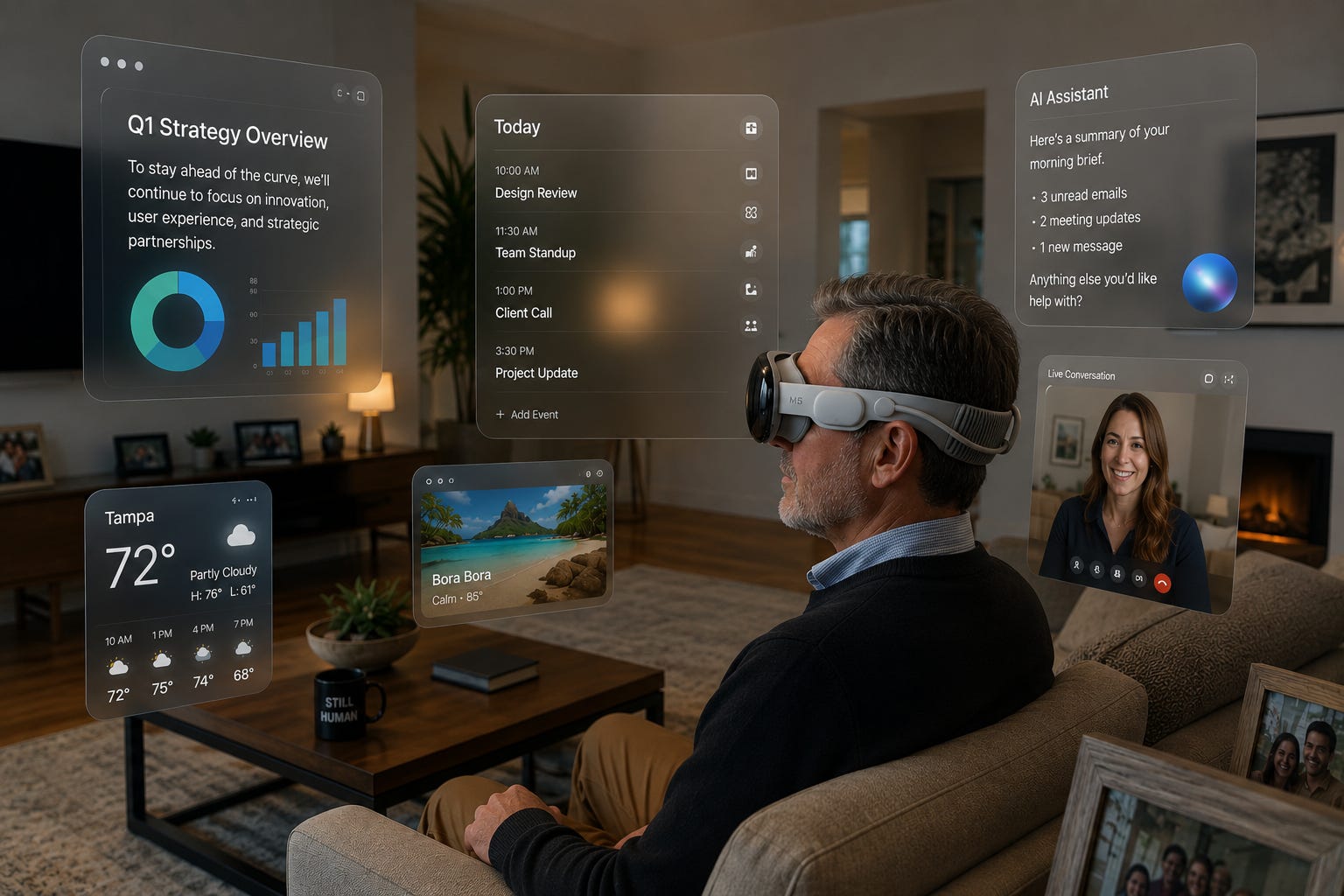
Devices such as Apple Vision Pro are introducing a new model in which digital content exists within the physical spaces around us. Rather than looking through a window into technology, we are increasingly stepping inside it. A cluttered office can become a mountaintop retreat. A living room can transform into a lakeside cabin. Multiple virtual displays can surround a user without requiring a single physical monitor.
The shift may seem subtle today, but many technological revolutions look small at the beginning. The first personal computers appeared to be little more than hobbyist curiosities. Early smartphones were often dismissed as unnecessary luxuries. Social media platforms initially seemed like harmless ways to stay connected with friends.
Only later did we recognize how profoundly these innovations would reshape society.
Yet the most important aspect of this story is not technological.
It is human.
Every major technological advancement changes more than the tools we use. It changes the way we behave, communicate, learn, work, and understand ourselves. Television transformed family life. The internet altered how we access information. Social media reshaped communication, relationships, and public discourse.
Artificial intelligence and spatial computing may ultimately influence something even deeper: how we think.
Future generations may find it difficult to imagine a world where information was not instantly available. They may struggle to understand why people once memorized phone numbers, unfolded paper maps, or spent hours searching through libraries to answer a single question. What feels ordinary to us today will eventually become history.
That realization should encourage a certain degree of humility. We are living through changes that future historians may view as every bit as significant as the arrival of electricity, television, or the internet itself.
This raises an important question.
If machines continue becoming faster, smarter, and more capable, what remains uniquely human?
The answer is unlikely to be intelligence alone. Machines are increasingly capable of processing information at extraordinary speed. Nor is it efficiency, where technology already outperforms us in countless ways.
The qualities that may matter most in the decades ahead are empathy, wisdom, creativity, moral judgment, compassion, and emotional understanding. These traits emerge from lived experience rather than computation. They are shaped by relationships, failures, joys, losses, and the countless moments that teach us how to navigate life as imperfect human beings.
Technology may help us solve problems. It may even help us create. But understanding the emotional weight of a goodbye, the complexity of forgiveness, or the meaning found in a lifetime of memories remains deeply human territory.
At least for now.
The future has always been portrayed as a destination, something waiting somewhere ahead of us. But perhaps that was never entirely true.
Perhaps the future is not a place we arrive.
Perhaps it is something we gradually become.
Each new innovation subtly changes the way we live. Each technological breakthrough influences the choices we make, the habits we form, and the society we create together. Over time, those small changes accumulate into something much larger.
The real story of the future is not about machines.
It is about us.
It is about how we adapt, how we preserve our humanity, and how we choose to use the remarkable tools we continue to invent. While the future may have arrived quietly, the decisions we make today will determine whether it becomes a force that deepens our connection to one another or slowly distances us from the very qualities that make us human.
That, more than any flying car or science fiction fantasy, may be the most important technological question of our time.
Words can still move the world. Read mine → https://substack.com/@jhirwin
#StillHuman #SpatialConversations #ArtificialIntelligence #SpatialComputing #FutureOfTechnology #AppleVisionPro #Innovation #TechnologyAndHumanity #DigitalTransformation #FutureOfWork #HumanConnection #AI #ExtendedReality #MixedReality #JHIrwin #JHIrwinMultimedia