



By J. H. Irwin
Author | Storyteller | Capturing Life, Memory, and Meaning
History has a troubling habit of asking the same question in different languages. How do ordinary people surrender their conscience to extraordinary lies?
It is tempting to believe the answer is ignorance. It is comforting to imagine that only the uneducated, the hateful, or the morally bankrupt could become followers of authoritarian movements. If that were true, history would have been a much kinder place. The reality is far more unsettling. The people who become part of these movements are often neighbors, coworkers, family members, professionals, clergy, veterans, teachers, and community leaders. They are not born without empathy. They slowly learn to set it aside.
This pattern has repeated itself throughout history, but perhaps nowhere more clearly than during the rise of Nazi Germany.
Adolf Hitler did not seize power by beginning with concentration camps or genocide. He first gave people an explanation for their fears. Germany had suffered economic collapse, national humiliation, and political instability. Rather than asking citizens to wrestle with complicated realities, he offered them something much simpler. He gave them enemies.
The Jews became the primary scapegoat. Gay people, political opponents, Roma, disabled individuals, intellectuals, and others soon followed. Each group was portrayed not as fellow human beings, but as obstacles to national greatness. Once people could be convinced that their neighbors were responsible for society’s problems, empathy became easier to discard. Dehumanization always precedes persecution because it allows people to stop seeing another person’s humanity before they begin accepting the removal of their rights.
The frightening truth is that millions of Germans were not monsters. Many were ordinary citizens who gradually adapted to a changing moral landscape. Some actively participated. Others remained silent because speaking carried risk. Many simply convinced themselves that someone else would intervene if things became truly unbearable.
By the time many realized the full consequences, the machinery was already in motion.
History never repeats itself in exactly the same form, but it often repeats its methods.
Today we are witnessing many of the same psychological mechanisms at work. The names have changed. The circumstances are different. The outcomes are still being written. Yet the process is remarkably familiar.
Again, a charismatic leader tells people that their struggles are not the result of complicated economic, political, or social forces. Instead, they are told that someone else is to blame. Immigrants become the threat. LGBTQ+ people become the threat. Political opponents become the threat. Universities, journalists, scientists, judges, and anyone questioning the movement become enemies of the people rather than fellow citizens participating in democracy.
Every authoritarian movement requires an enemy because fear is one of the most effective tools of control. A frightened population spends less time questioning those in power and more time fearing those identified as the source of their problems. While public attention remains fixed on manufactured enemies, power quietly consolidates behind the scenes.
This is not simply politics. It is psychology.
Human beings crave certainty, especially during periods of rapid change. We want simple answers to complex problems. We want someone who appears confident enough to promise that only they can fix what is broken. Once that emotional bond is formed, evidence becomes less important than identity. Facts that challenge the movement are dismissed. Contradictions are rationalized. Corruption is excused. Broken promises are forgotten because protecting the leader becomes synonymous with protecting the self.
Psychologists have studied this phenomenon for decades. People naturally seek information that confirms what they already believe. They place enormous value on belonging to a group. They often obey authority figures even when doing so conflicts with their own moral instincts. None of these tendencies make us evil. They simply make us vulnerable.
The danger comes when someone understands how to exploit those vulnerabilities.
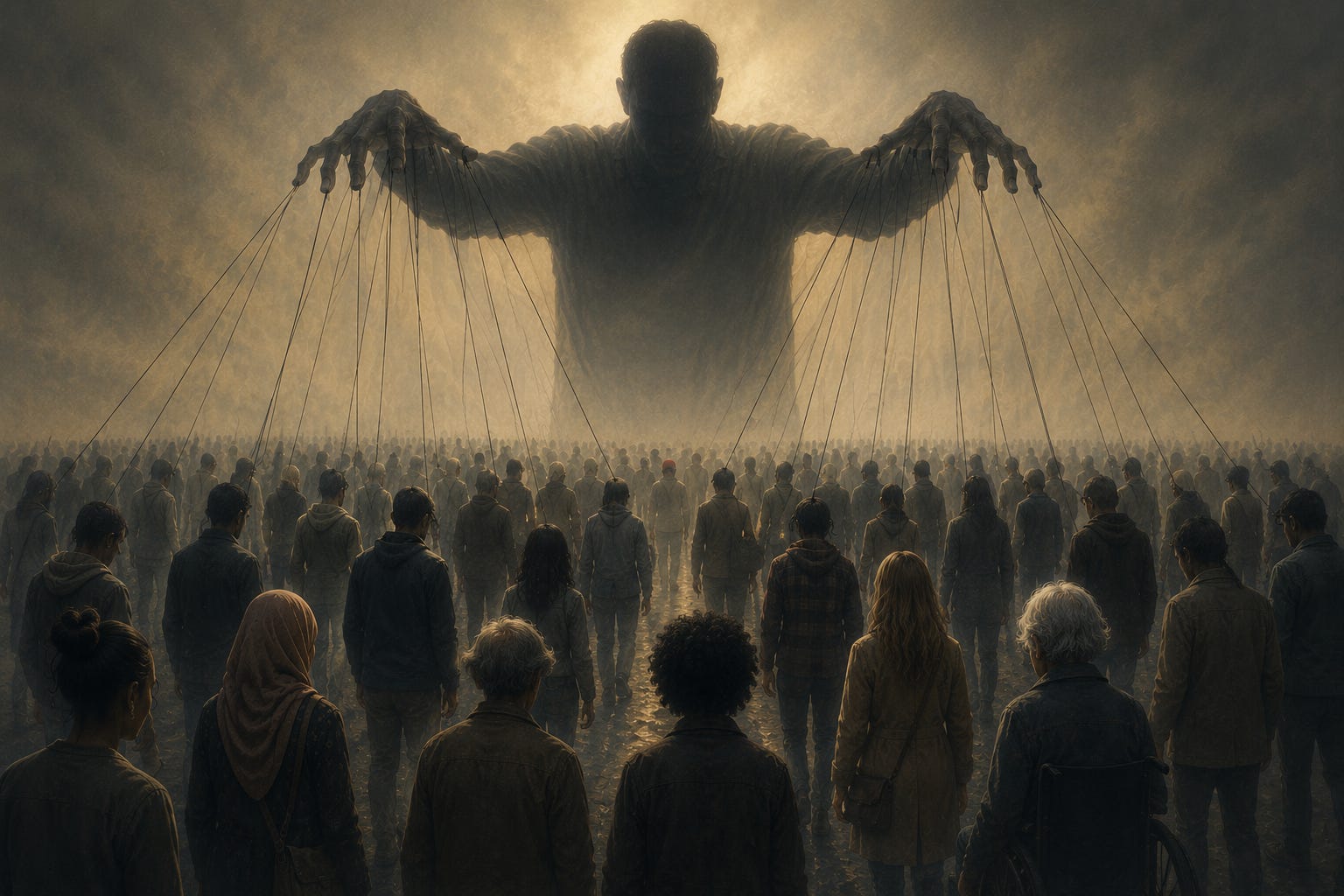
The most successful authoritarian leaders do not merely gain followers. They create identity. Supporting the movement becomes part of how people define themselves. Any criticism of the leader feels like a personal attack. Any evidence that contradicts the movement is rejected before it is even considered. Reality itself becomes divided into two categories: information that strengthens the cause and information that must therefore be false.
It begins to resemble a trance.
Not because people are hypnotized, but because they have become emotionally invested in protecting a version of reality that gives them purpose, belonging, and certainty. Breaking that trance becomes extraordinarily difficult because accepting the truth requires admitting they were deceived. For many people, that feels more painful than continuing the deception.
This is why history repeats itself.
It is not because human beings fail to remember the past. It is because each generation convinces itself that it is somehow different. We imagine that if we had lived during darker periods of history, we would certainly have been among those who resisted. Yet history suggests that resistance has always been the exception rather than the rule.
The question is never whether another authoritarian movement can arise.
The question is whether enough people will recognize it before it becomes too powerful to challenge.
Those who have not fallen into this pattern carry a profound responsibility. Remaining silent because the conversation is uncomfortable has never protected democracy. Looking away because the fight feels exhausting has never preserved human rights. Every advance in justice has required ordinary people deciding that comfort was no longer an acceptable substitute for conscience.
Resistance does not require hatred. In fact, hatred often strengthens authoritarian movements because it reinforces the idea that society consists only of competing tribes. What resistance requires is moral clarity. It requires refusing to dehumanize even those who have abandoned empathy themselves. It requires defending truth even when lies are more popular. It requires standing beside those who are targeted even when doing so carries personal or professional consequences.
Most importantly, it requires refusing to surrender our own humanity in response to theirs.
History teaches us that civilizations are rarely destroyed all at once. They are weakened one compromise at a time, one silence at a time, one rationalization at a time. The same is true of individuals. We lose ourselves gradually, often without realizing it, until one day we look back and wonder how we became someone we never intended to be.
The battle before us is not simply political. It is moral. It is a battle over whether empathy will continue to matter, whether truth will remain worth defending, and whether we will recognize the humanity of people whom others insist we should fear.
Every generation inherits this test.
Every generation believes it will recognize the warning signs.
Only some generations prove that they did.
The outcome has never depended solely on those who sought power. It has always depended on whether enough ordinary people found the courage to interrupt the machinery before it could consume the conscience of a nation.
Words can still move the world. Read mine → https://substack.com/@jhirwin