



By J. H. Irwin
Author | Storyteller | Capturing Life, Memory, and Meaning
Bob Mackie Gave the World Permission to Sparkle
This week, we lost more than a legendary designer. We lost an architect of memories. Bob Mackie spent more than six decades creating images so powerful, glamorous, outrageous, and joyful that they became permanently woven into our cultural history. Mackie died from pneumonia on September 14, 2026, in Palm Springs, California. He was 87.
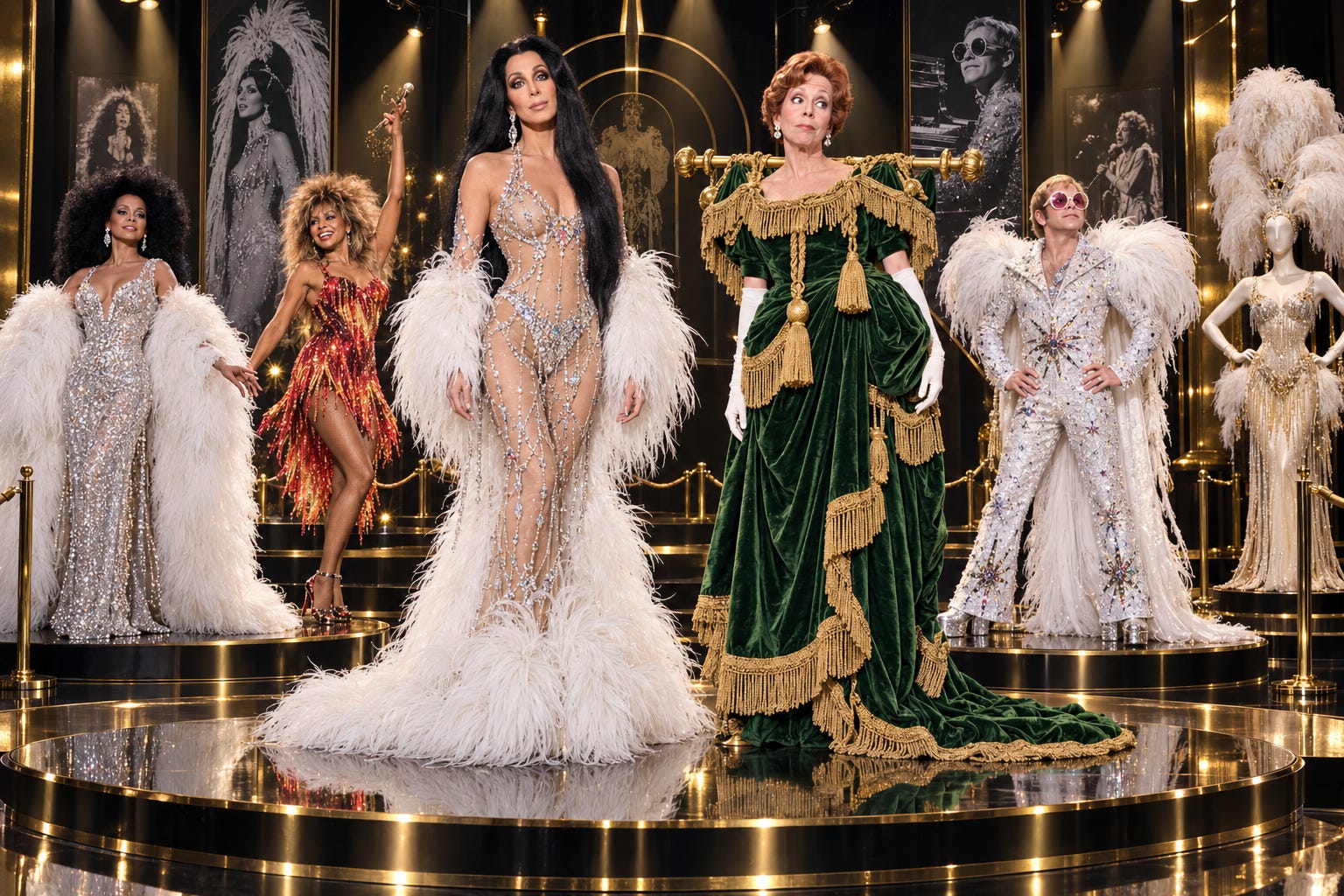
Most of us never met Bob Mackie, but millions of us knew his work. We knew it the moment Cher walked onto a stage shimmering in beads and feathers. We knew it when Elton John appeared at Dodger Stadium dressed in a sparkling baseball uniform. We knew it when Tina Turner moved across a stage in flames, fringe, and wings. We especially knew it when Carol Burnett descended a staircase wearing an elegant green velvet gown with the curtain rod still stretched across her shoulders.
Those were not simply costumes. They were moments, and Bob Mackie understood the difference.
Robert Gordon Mackie was born on March 24, 1939, in Monterey Park, California. His parents divorced when he was young, and he was largely raised by his paternal grandmother in Alhambra. He spent a great deal of time alone, drawing to entertain himself and escaping into the Technicolor musicals he saw at the movies with his mother and older sister. The color, movement, spectacle, and fantasy of those films showed him a world far removed from the quiet surroundings of his childhood.
When the credits rolled after one of those musicals, Mackie discovered that costume design was an actual profession. Suddenly, the world he had been imagining with crayons and sketches could become a life.
He studied at Pasadena City College and the Chouinard Art Institute before leaving school to begin working in Hollywood. He sketched for some of the most respected costume designers in the business, including Edith Head and Jean Louis. While working for Jean Louis, the young Mackie drew the original sketch for the sheer, crystal-covered gown Marilyn Monroe wore when she sang “Happy Birthday” to President John F. Kennedy in 1962. It was an extraordinary contribution from a young artist who had only begun to find his place in Hollywood.
In 1963, Mackie was hired by costume designer Ray Aghayan to work on Judy Garland’s television variety show. Their connection became both professional and deeply personal. Mackie and Aghayan became creative collaborators and life partners, sharing the first Emmy ever awarded for costume design in 1967 for the television production Alice Through the Looking Glass. Their relationship endured until Aghayan’s death in 2011.
Television ultimately made Bob Mackie a household name. When The Carol Burnett Show premiered in 1967, Mackie was chosen to design its costumes. During the show’s eleven seasons, he created an astonishing average of approximately sixty costumes each week for Burnett, Harvey Korman, Vicki Lawrence, Tim Conway, Lyle Waggoner, the guest stars, and the supporting performers.
Mackie did not merely dress Carol Burnett. He helped her discover her characters. The awkward shape of a skirt could create a walk. A wig, a padded figure, or an exaggerated neckline could reveal a personality before a single word was spoken. His costumes became an essential part of the comedy because he understood that clothing could deliver a punchline just as powerfully as dialogue.
Nothing demonstrated that genius more perfectly than the 1976 sketch Went with the Wind!, a parody of Gone with the Wind. In the original film, Scarlett O’Hara famously turns green curtains into a dress. Mackie took that idea one gloriously ridiculous step further. Carol Burnett descended the staircase as Starlet O’Hara wearing the green velvet curtains, complete with gold fringe, a valance across her head, and the brass curtain rod still attached.
When Harvey Korman’s character complimented her gown, Burnett delivered the immortal response: “I saw it in the window, and I just couldn’t resist it.”
The audience exploded. Mackie had created one of the greatest visual jokes in television history. Nearly fifty years later, people still remember exactly where they were when they first saw it. The costume now resides in the permanent collection of the Smithsonian’s National Museum of American History, where it belongs, because it is more than a dress. It is part of America’s shared cultural memory.
Then there was Cher.
Few creative relationships in entertainment history have been as enduring or transformative as the one between Bob Mackie and Cher. Their partnership began in television, including The Sonny & Cher Comedy Hour, but quickly evolved into something much greater. Mackie recognized that Cher possessed a rare combination of beauty, confidence, mystery, humor, and fearlessness. He did not try to make her look like anyone else. He helped the world see who she already was.
Together, they challenged nearly every convention governing how a woman was supposed to dress on television. Mackie used sheer fabrics, feathers, crystals, strategically placed beads, towering headdresses, and silhouettes that celebrated Cher’s body rather than concealing it. His designs could be provocative, but they were never accidental. Every bead and feather contributed to the character and the moment.
The sheer, feathered “naked dress” Cher wore to the 1974 Met Gala became one of the most recognizable gowns in fashion history. Her black beaded ensemble and enormous feathered headdress at the 1986 Academy Awards was not simply clothing. It was defiance made visible, worn after Cher’s acclaimed performance in Mask was ignored by the Academy. Two years later, Cher accepted the Oscar for Moonstruck in another unforgettable Mackie creation, a barely there black beaded gown that allowed her to appear glamorous, powerful, and completely herself.
Mackie’s imagination stretched far beyond Cher. He designed Diana Ross’s costumes for Lady Sings the Blues, earning an Academy Award nomination alongside Ray Aghayan. He placed Tina Turner in winged bodysuits, shimmering fringe, and a fiery sequined costume that moved with the same explosive energy she brought to the stage. He dressed Barbra Streisand, Liza Minnelli, Bette Midler, Bernadette Peters, Mitzi Gaynor, Dolly Parton, Whitney Houston, Madonna, Diana Ross, and RuPaul.
For Elton John’s historic 1975 concerts at Dodger Stadium, Mackie transformed a baseball uniform into pure spectacle, covering it in crystals and sequins and topping it with an equally dazzling cap. Elton did not simply enter the stadium wearing that costume. He became a living, sparkling monument to show business, and the image remains inseparable from his career.
Behind the glamour was a man whose personal life also held love and profound loss. Mackie was briefly married to actress and singer Marianne Nicholson, professionally known as Lulu Porter, from 1960 until 1963. They had a son, Robert Gordon Mackie Jr., known as Robin, who became a makeup artist. Robin died from AIDS in 1993, another precious life taken during a period when an entire generation was being lost while too much of the world responded with judgment, fear, or silence.
Mackie’s decades-long relationship with Ray Aghayan is also an important part of his story and of LGBTQ+ history. They built a life and a body of work together during years when same-sex relationships were rarely acknowledged honestly in public accounts of famous lives. Their partnership was personal, artistic, and enduring. When Aghayan died in 2011, Mackie lost the man who had helped open the door to his television career and then walked beside him through nearly five decades of life.
The professional honors eventually caught up with the cultural influence. Mackie won nine Emmy Awards, received three Academy Award nominations, and was inducted into the Television Academy Hall of Fame in 2002. In 2019, he received the Council of Fashion Designers of America’s Lifetime Achievement Award and won a Tony Award for creating more than 450 costumes for the Broadway musical The Cher Show. Yet awards alone cannot measure what he gave us.
Bob Mackie created beauty, but he also created permission. He gave performers permission to be larger, brighter, stranger, funnier, sexier, and more fearless than the world expected them to be. He gave LGBTQ+ people and countless other young people watching from ordinary homes a glimpse of a world where difference was not something to hide. In Mackie’s world, difference was covered in rhinestones, placed beneath a spotlight, and celebrated.
His influence continues in the work of contemporary performers who return to his archives and reinterpret his designs. Miley Cyrus, Pink, Zendaya, Sabrina Carpenter, and Taylor Swift have all helped introduce Mackie’s extravagant vision to younger generations. His work remains relevant because true originality does not age. It waits to be discovered again.
There will never be another Bob Mackie. There may be other designers who use sequins, feathers, crystals, and daring silhouettes, but Mackie possessed something that cannot be imitated. He understood the person beneath the costume. He knew when clothing needed to make someone beautiful, when it needed to make someone powerful, and when it needed to make an entire nation laugh.
Bob Mackie made the world more colorful, more playful, more inclusive, and infinitely more glamorous. His designs will remain in museums, photographs, television archives, concert footage, and fashion collections, but his greatest legacy lives within our memories. We will remember the curtain rod. We will remember Cher’s feathers. We will remember Tina’s flames and Elton’s sparkling uniform.
Most of all, we will remember the man who showed us that life did not always have to be practical or restrained. Sometimes it could shimmer. Sometimes it could make us laugh. Sometimes it could descend a staircase wearing the curtains and become unforgettable.
Rest in peace, Bob Mackie. Thank you for the beauty, the laughter, the courage, and every last sequin. You will forever be remembered, and you will be deeply missed.
Words can still move the world. Read mine → https://substack.com/@jhirwin