


Political Satire based on documented events
By J. H. Irwin
Author | Storyteller | Satirist
The federal government has entered its renovation era
The White House East Wing has been demolished to make room for a $400 million ballroom. The Rose Garden lawn has become a stone patio reminiscent of Mar-a-Lago. Historic trees have disappeared, black granite has replaced a sixty-year-old flagstone walkway, and the Lincoln Memorial Reflecting Pool has been painted blue. The administration calls this restoration. Increasingly, the nation looks like a property acquired by a developer who immediately decided the original owners had terrible taste.
Then there is the Kennedy Center, the national memorial dedicated to President John F. Kennedy. Trump removed its previous leadership, became chairman of its board, and supported adding his own name to the building. A federal judge ruled that only Congress could rename the center and ordered Trump’s name removed. Apparently undeterred, the Trump-appointed board voted to try again, this time proposing an inscription crediting him with restoring and renovating the building and naming the surrounding grounds the “President Donald J. Trump Plaza.” Nothing says respect for a memorial quite like repeatedly explaining why someone else’s name needs more company.
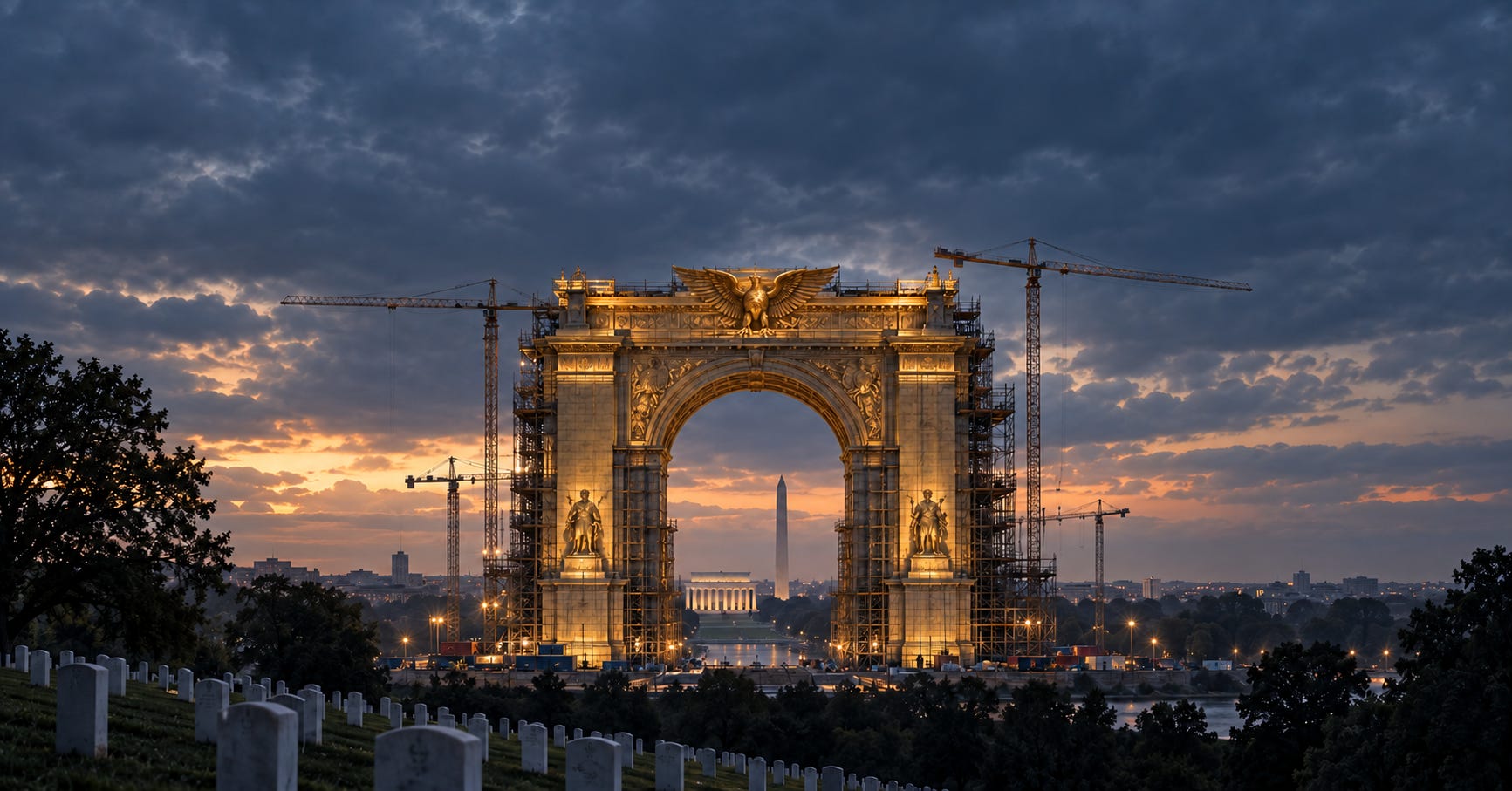
Now comes the proposed triumphal arch, approximately 250 feet of gilded presidential modesty near Arlington National Cemetery. It would stand taller than the Lincoln Memorial and close to the height of the United States Capitol. Opponents, including three Vietnam veterans and an architectural historian, argue that it would disrupt the historic sightline between the Lincoln Memorial and Arlington House. The project still lacks final approval, and a federal judge has limited initial activity to archaeological testing. Even the ground, it seems, must be questioned before it agrees to participate.
The administration says these projects will restore grandeur, improve deteriorating landmarks, and honor the nation’s history. Perhaps that is the plan. But grandeur is a curious national priority when so many Americans are worried about whether they can afford a doctor, keep their insurance, pay their bills, or safely exercise their constitutional rights. A government can polish every monument in Washington and still leave the people looking at them wondering whether anyone inside those buildings remembers they exist.
Medicaid and Affordable Care Act enrollment has declined by approximately eight million people since Trump returned to office. The reasons are complicated and include expiring marketplace subsidies, higher premiums, administrative changes, immigration fears, and state-level decisions. Major provisions of Trump-backed healthcare legislation are expected to produce additional coverage losses as they take effect. These Americans may never attend a White House ball, but they are helping finance a government that has found extraordinary energy for choosing marble.
The childhood vaccination schedule has also been reduced. Vaccines protecting against several diseases are no longer recommended routinely for every child, although they remain available for certain high-risk groups or through consultations between parents and physicians. Leading medical organizations have warned that the changes could weaken protection against preventable disease. The reflecting pool may now be a more vibrant shade of blue, but a child’s immune system remains stubbornly resistant to architectural solutions.
Meanwhile, the administration’s immigration campaign has brought mass arrests, prolonged detention, renewed family separations, and fatal encounters between federal agents and civilians. Two American citizens, Renee Good and Alex Pretti, were shot and killed by federal immigration agents during operations in Minneapolis. Those cases remain under scrutiny, and another ICE officer has been charged with lying to investigators about a separate shooting. These are not abstractions. They are families, names, funerals, and empty chairs.
Then there is Iran. Eighteen American service members have been killed, and the conflict has cost taxpayers more than $37.5 billion. Trump recently called it “small potatoes,” explaining that the number of American deaths was low compared with Vietnam and other wars. The comparison may be numerically accurate, but every military family understands something that casualty tables do not: there is no such thing as a statistically insignificant empty seat at the dinner table.
The damage is not confined within America’s borders. Relationships with some of our closest allies and trading partners have deteriorated sharply. The United States imposed tariffs of up to 50 percent on Canadian products after negotiations collapsed, prompting Canada to retaliate against approximately $20 billion in American goods. Canada remains our neighbor, ally, and one of our largest trading partners, but the relationship now increasingly resembles a homeowners’ dispute conducted with customs declarations and economic artillery.
The fracture extends across the Atlantic. Trump has threatened to consider withdrawing the United States from NATO and has publicly attacked European leaders over trade, defense spending, and their refusal to support the Iran conflict. In a recent survey across fifteen European countries, only 11 percent of respondents described the United States as an ally. A nation can repaint a reflecting pool in two weeks. Rebuilding international trust is unlikely to be completed with a fresh coat of anything.
Whether these relationships have been permanently destroyed cannot yet be known. Alliances developed across generations rarely disappear overnight, but trust can. Even if future administrations attempt to repair the damage, allies and trading partners may remember how quickly agreements, traditions, and mutual commitments were discarded. They may cooperate with America again while quietly preparing for the possibility that America can no longer be depended upon.
That is the contradiction at the center of this architectural presidency. Human suffering is discussed in totals, percentages, projections, and historical comparisons. Buildings receive gold, marble, inscriptions, ceremonies, models, and presidential attention. Eighteen dead service members become “small potatoes,” while a 250-foot arch becomes a national priority. Our allies are told to accept threats and tariffs, while the president builds monuments intended to proclaim American greatness.
Rome built arches, monuments, temples, and arenas even as the foundations of its empire weakened beneath them. That comparison does not prove that the United States is approaching a similar end. It does, however, leave us with an uncomfortable question: Are these merely the excesses of one presidency, or are we watching the beginning of America’s decline as a trusted democratic leader?
Only time will provide the final answer, but Americans will influence the next chapter on November 3. Every seat in the House of Representatives and thirty-five seats in the Senate will be contested in the 2026 midterm elections. The results will determine control of Congress and shape its ability to fund, investigate, restrain, or advance the president’s agenda.
Perhaps the proposed arch is the perfect monument for this moment after all. An arch is not a destination. It is an enormous structure built around an empty space. America does not need another monument proclaiming greatness. It needs citizens willing to decide what greatness means, leaders prepared to defend it, and institutions strong enough to survive those who mistake their own reflection for the nation itself.
Where the absurdity of this moment gets the satire it deserves, and all the gold in the world still can’t buy good taste.
Read The Gilded Toilet at Still Human → https://substack.com/@jhirwin