


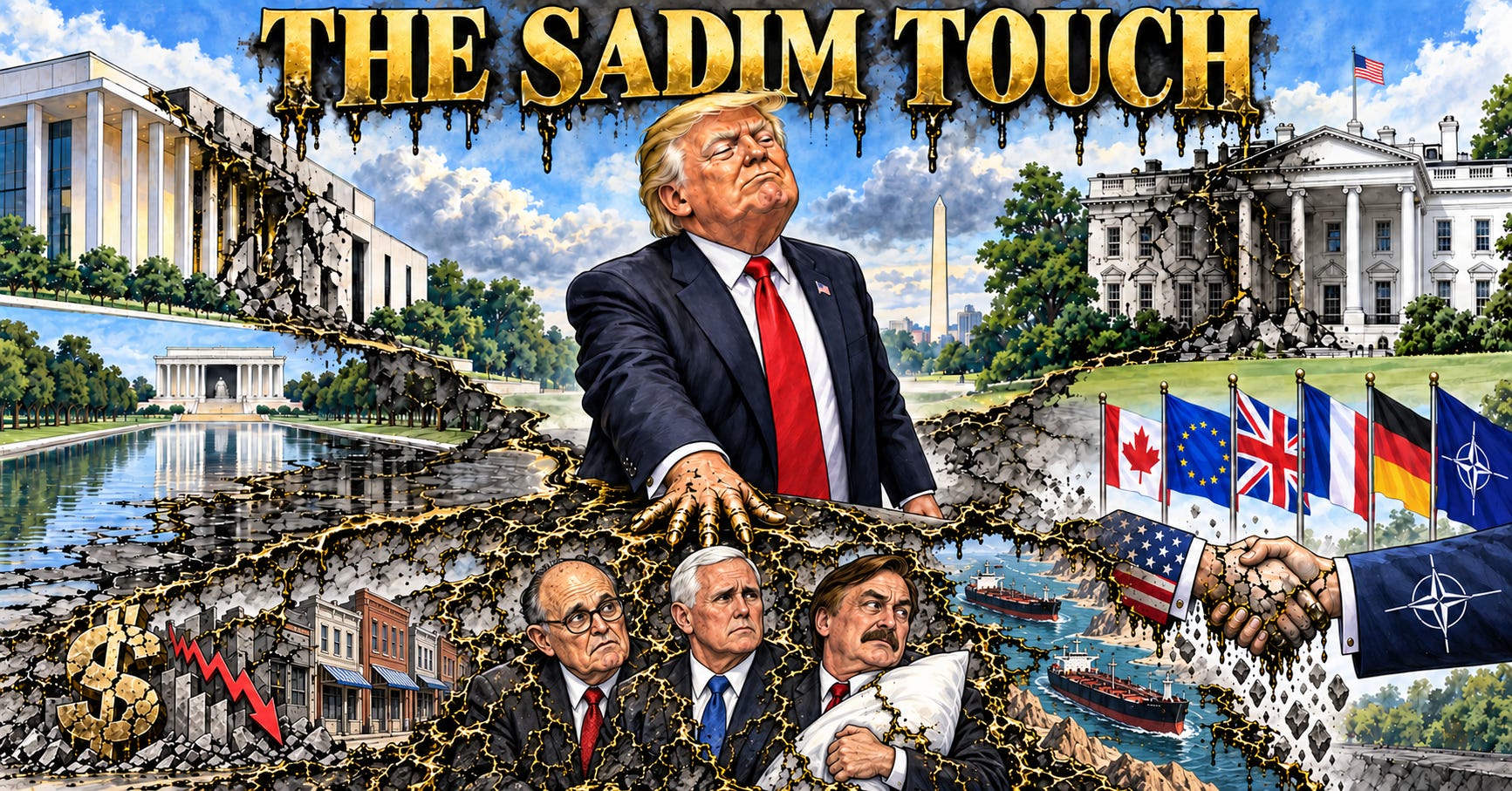
Political Satire based on documented events
By J. H. Irwin
Author | Storyteller | Satirist
A Fact-Based Examination of the Legal, Institutional, Economic, and Diplomatic Fallout Surrounding Donald Trump
In mythology, everything King Midas touched turned to gold. “Sadim,” Midas spelled backward, is a satirical name for a pattern surrounding Donald Trump: political allies have lost careers and law licenses, a vice president faced threats after refusing his demands, national institutions have been thrown into turmoil, relationships with allies have deteriorated, and military decisions have carried consequences far beyond the White House.
This is not simply guilt by association. In the cases that follow, Trump’s involvement was documented and direct. He applied the pressure, promoted the disputed election narrative, changed the leadership, demanded the renaming, ordered the construction, imposed the tariffs, or authorized the military action. Other people remain responsible for their own conduct, but Trump was not standing innocently at the edge of these events.
Loyalty Has Carried a Price
Rudy Giuliani was once celebrated as “America’s Mayor.” After becoming Trump’s personal lawyer and public champion of his efforts to overturn the 2020 election, Giuliani was disbarred in New York and Washington, held liable for defaming two Georgia election workers, and driven into bankruptcy proceedings.
The New York court did not discipline Giuliani for an abstract political disagreement. It found that he made “demonstrably false and misleading statements” while acting as Trump’s lawyer and advancing Trump’s election challenge. A federal jury subsequently awarded Ruby Freeman and Shaye Moss $148 million after Giuliani falsely accused them of election fraud. He later reached a confidential settlement that satisfied the judgment, but no settlement can restore the professional standing he surrendered while carrying Trump’s election claims into courtrooms and television studios.
Mike Lindell followed the same election narrative into a different kind of reckoning. The MyPillow founder used his money, company, media platform, and public reputation to promote claims that voting systems had stolen the election from Trump. In 2025, a federal jury found Lindell and his media company liable for defaming former Dominion employee Eric Coomer and awarded $2.3 million in damages.
Mike Pence discovered what can happen when loyalty reaches its limit. Trump repeatedly pressured Pence to interfere with the electoral count, despite Pence’s conclusion that the Constitution gave him no authority to overturn the result. When Pence refused, Trump publicly attacked him while the Capitol was under siege. Rioters chanted threats against Pence and came within approximately 40 feet of him during his evacuation. Pence later said Trump’s words endangered him, his family, and everyone at the Capitol.
Giuliani and Lindell suffered consequences after advancing Trump’s false election narrative. Pence suffered threats and political isolation after refusing Trump’s demand. Their individual circumstances differ, but the pattern is difficult to ignore: loyalty did not protect those who served Trump, and constitutional resistance did not spare the man who finally told him no.
The Kennedy Center Became a Battlefield Over Trump’s Name
The Kennedy Center was created as a living memorial to President John F. Kennedy and as a national home for the performing arts. After Trump replaced board members and the reconstituted board elected him chairman, performers withdrew, productions were canceled, audiences declined, and the institution entered a growing financial crisis.
The conflict became even more explicit when Trump’s board attempted to add his name to the Kennedy memorial. A federal judge ruled that the board could not do so without congressional authorization. After the court blocked the name change for a second time, the board voted to close the principal venue for as long as two years, and Trump said the $257 million renovation would not proceed unless the ruling were overturned.
The turmoil did not begin because artists suddenly lost interest in the Kennedy Center. Numerous performers specifically cited Trump’s takeover, leadership changes, programming direction, or renaming effort when canceling their appearances. What had been a national cultural institution became entangled in one man’s demand to place his name on a memorial dedicated by law to someone else.
The White House Was Physically Remade
Trump initially said his proposed ballroom would not interfere with the existing White House and would respect the historic structure. The East Wing was subsequently demolished in its entirety.
The White House described the project as a necessary space for large state functions and said private donors would finance it. Official records nevertheless confirm that the historic 15,000-square-foot East Wing was removed and replaced by a proposed structure of approximately 90,000 square feet. The reported cost rose from roughly $200 million to approximately $400 million.
This was not a minor renovation or a decorative adjustment. An existing section of the People’s House was torn down to accommodate a project conceived and directed during Trump’s presidency. The administration calls it an improvement for future presidents, but the physical record is unmistakable: the historic East Wing that existed before Trump’s project no longer exists.
Even the Reflecting Pool Could Not Escape the Pattern
The Trump administration fast-tracked a $14.7 million renovation of the Lincoln Memorial Reflecting Pool ahead of the nation’s 250th anniversary celebration. Within weeks, algae appeared and the newly installed liner began blistering and peeling.
Trump repeatedly blamed vandals. Contractor reports and National Park Service documentation instead identified inadequate primer, incompatible materials, and other design and installation failures. The Justice Department dropped its case against a former Olympian accused of damaging the pool after acknowledging evidence that defective contractor work caused the failure. The Interior Department continues to maintain that some vandalism occurred, but the contractor remains responsible for repairing its work.
The pool was not permanently destroyed, but the episode followed a familiar sequence: a highly publicized Trump project was rushed, failed quickly, and produced accusations that conflicted with the government’s own later findings.
Tariffs Reached American Households
Trump has presented tariffs as payments extracted from foreign countries. In practice, tariffs are collected from American importers, and businesses can pass those costs to consumers through higher prices.
Federal Reserve researchers estimated that tariffs implemented through November 2025 raised core goods prices by approximately 3.1 percent and overall core personal-consumption prices by 0.8 percent through February 2026. The administration maintains that its trade policies protect American workers, reduce trade imbalances, and encourage domestic investment. Those objectives do not erase the documented price increases already absorbed by American businesses and households.
Allies Began Looking Elsewhere
Canada remains one of America’s largest trading partners, but its government and businesses have accelerated efforts to reduce their dependence on the United States. Canada and the European Union are now discussing deeper cooperation in manufacturing, technology, energy, defense, critical minerals, artificial intelligence, and economic security.
The damage extends beyond trade statistics. In a 2026 Pew Research Center survey, the percentage of Canadians describing the United States as a reliable partner had fallen from 83 percent in 2022 to 35 percent. Similar declines appeared across several longtime European and Asian allies.
Trade relationships built over generations cannot always be restored by signing another agreement. Once businesses establish new suppliers, governments build new strategic partnerships, and allied populations stop trusting American commitments, some of those changes can become permanent.
The Consequences Reached the Strait of Hormuz
Trump authorized the February 28 military operation against Iran. Iran subsequently imposed an effective blockade of the Strait of Hormuz, and the United States later blockaded Iranian ports.
The International Energy Agency has described the resulting crisis as the largest oil-supply disruption in market history. Oil and fuel prices surged, shipping traffic collapsed, emergency petroleum reserves were released, and seafarers were killed in attacks involving multiple actors. The International Maritime Organization has correctly cautioned that no single party is responsible for every attack or casualty.
Trump did not personally close the strait, and Iran remains responsible for its own military decisions. The chronology nevertheless matters. Trump authorized the operation that began the conflict, and the resulting escalation disrupted a maritime route that had carried approximately one-quarter of the world’s seaborne oil trade.
The Record Is the Record
“The Sadim Touch” is satire, but the events behind it are not. Giuliani lost his law licenses. Lindell was found liable for defamation. Pence faced threats after refusing Trump. The Kennedy Center lost performers and revenue while becoming consumed by a fight over Trump’s name. The East Wing was demolished. The Reflecting Pool renovation failed. Tariffs raised prices. Allied trust declined. A war disrupted one of the world’s most important energy routes.
Trump was not solely responsible for every consequence, and the people around him were not powerless participants. But he was not incidental to these events. He made the demands, promoted the claims, imposed the policies, changed the institutions, and authorized the military action.
That is the documented pattern behind the metaphor. The closer Trump moved to the center of a person, institution, alliance, or project, the more likely it was to become defined by controversy, litigation, financial strain, damaged trust, or lasting consequences.
Where the absurdity of this moment gets the satire it deserves, and all the gold in the world still can’t buy good taste.
Read The Gilded Toilet at Still Human → https://substack.com/@jhirwin