



By J. H. Irwin
Author | Storyteller | Capturing Life, Memory, and Meaning
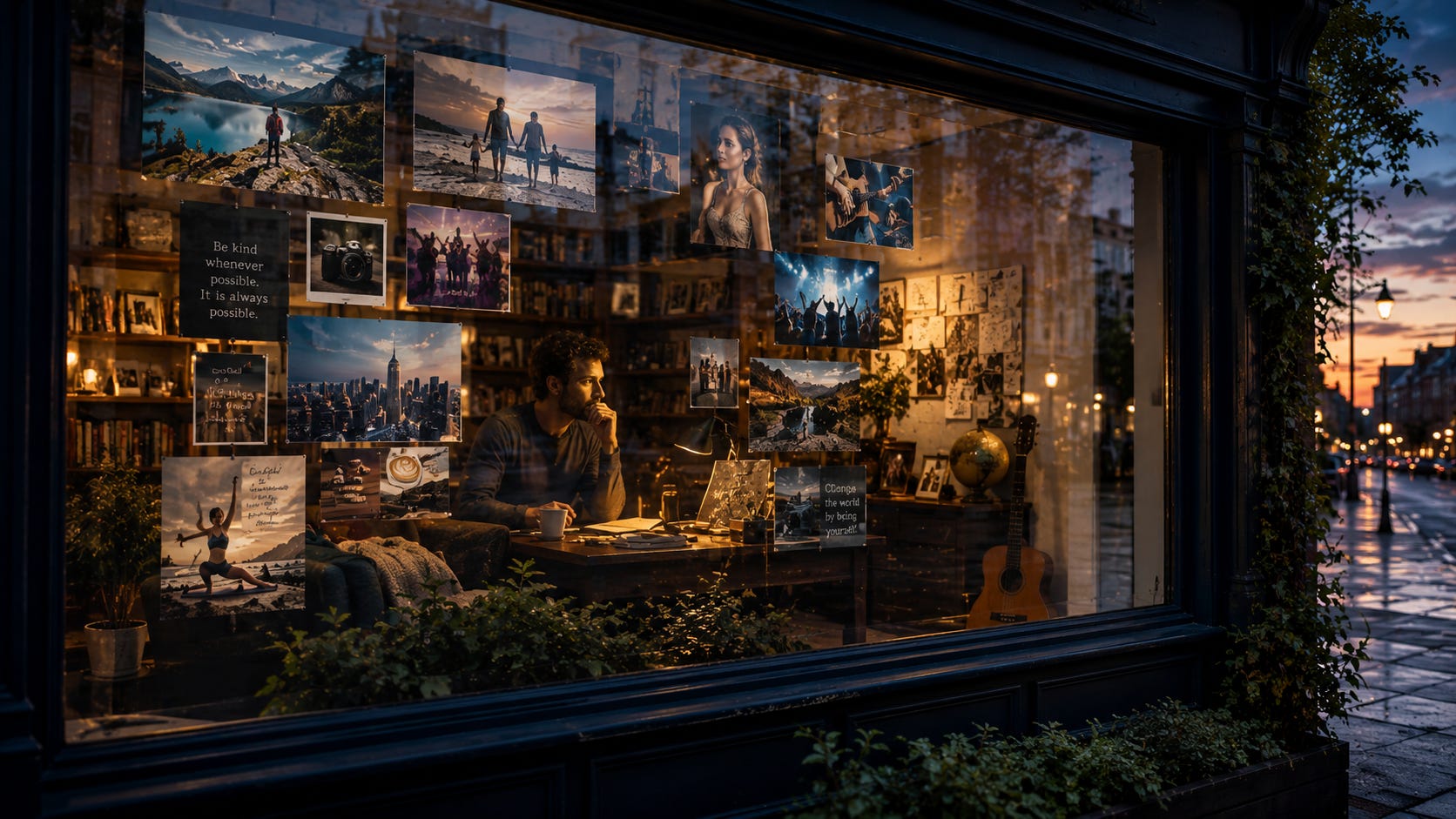
Every storefront is trying to sell you something before you ever walk through the door
Walk down any city street and you’ll notice the same thing.
Some display luxury. Some display comfort. Some display excitement. Others display exclusivity. The items placed in the window are rarely random. They are carefully selected because they are intended to catch your attention and invite you inside.
Social media profiles operate in much the same way.
Every profile is a storefront window.
One of the things I find myself doing when I visit someone’s social media profile is looking at what they chose to place front and center. Not because I am judging them, but because I am curious. Every profile is a collection of decisions. The photographs, the biography, the accomplishments, the opinions, the causes they support, the things they celebrate, and even the things they never mention all combine to create a first impression.
The more time I spend online, the more I have come to view those choices as the digital equivalent of a storefront window. Long before we step inside a store, something in the window catches our eye and invites us to take a closer look. The display is designed to attract attention, spark interest, and encourage us to learn more. Social media works in much the same way.
What fascinates me is not what people choose to display, but why they chose it. Some people place their careers in the window. Others showcase family, travel, hobbies, achievements, political causes, artwork, humor, or personal milestones. Some lead with intelligence. Some lead with creativity. Some lead with physical appearance. Each choice tells us something, not necessarily about who they are, but about what they believe will capture our attention first.
That distinction is important.
In a world where thousands of voices compete for attention every minute, people naturally gravitate toward whatever they believe will help them stand out. A talented photographer shares beautiful images. A musician shares performances. A writer shares stories. Someone proud of their professional accomplishments highlights their career. Someone who is physically attractive may choose to emphasize that aspect of themselves because they know it will be noticed immediately.
After all, attraction has always garnered attention. Long before social media existed, advertisers, entertainers, and marketers understood this reality. It is hardly surprising that individuals would recognize it as well.
What I find interesting is how quickly we sometimes assume that the thing displayed most prominently is the most important thing about a person. Someone whose profile contains provocative photographs risks being dismissed as superficial. Someone who constantly posts about work may be labeled obsessed with success. Someone who shares political content may be reduced to a single belief. We see the display and assume we understand the entire store.
Most of the time, we don’t.
Some of the most thoughtful people I have met initially presented themselves in ways that did not immediately reveal their depth. Likewise, some individuals who appeared to have everything figured out were carrying insecurities, fears, and questions that rarely surfaced publicly. Human beings are complicated, which is precisely why first impressions are often incomplete.
When I encounter a profile built around physical appearance, I sometimes wonder if there is more happening than what appears on the surface. Not because I believe everyone who posts those images is insecure or seeking validation. Making that assumption would be unfair. Some people are simply confident, expressive, and comfortable in their own skin. Others may enjoy the attention. Still others may view those images as a form of personal empowerment.
Yet I also suspect that for some people, physical appearance becomes the easiest path to being noticed. If a photograph consistently generates attention, admiration, compliments, and engagement, it is understandable why someone might continue leading with it. Over time, that attention can become part of the identity they present to the world, even though it may represent only a small portion of who they actually are.
The same pattern exists in countless other forms. The successful executive may become known only for professional accomplishments. The activist may become known only for a cause. The traveler may become known only for destinations. The comedian may become known only for humor. In each case, the thing that attracts attention can gradually overshadow everything else that makes a person unique.
Maybe that is why I find myself paying attention to the smaller details. The passing comment. The favorite book. The causes they quietly support. The way they respond to others. The photographs that appear repeatedly. The things that seem important enough to share even when no one is paying attention. Those subtle clues often reveal far more than the headline attractions placed in the window.
The truth is that all of us curate our own displays to some extent. We choose what to share and what to keep private. We decide which aspects of ourselves will be visible and which will remain in the background. There is nothing deceptive about that. It is simply part of being human.
What matters is remembering that the display is not the destination.
The things that first capture our attention may tell us where to begin, but they rarely tell us where the story ends. Behind every profile is a person with experiences, contradictions, strengths, weaknesses, dreams, disappointments, and dimensions that cannot be captured in a handful of photographs or a carefully written biography.
The storefront window may invite us to stop and look.
The real person is found only after we decide to step inside.
Words can still move the world. Read mine → https://substack.com/@jhirwin