


By J. H. Irwin
Author | Storyteller | Exploring the Human Experience Through Words
This article is written from lived experience, not abstraction. Stonewall, Pulse, Pride flags, and rainbow memorials are not symbols to the LGBTQ+ community. They are survival markers. They are grief made visible. When governments erase them, they are not enforcing neutrality. They are inflicting harm.
When Power Erases Memory, Cruelty Is the Point
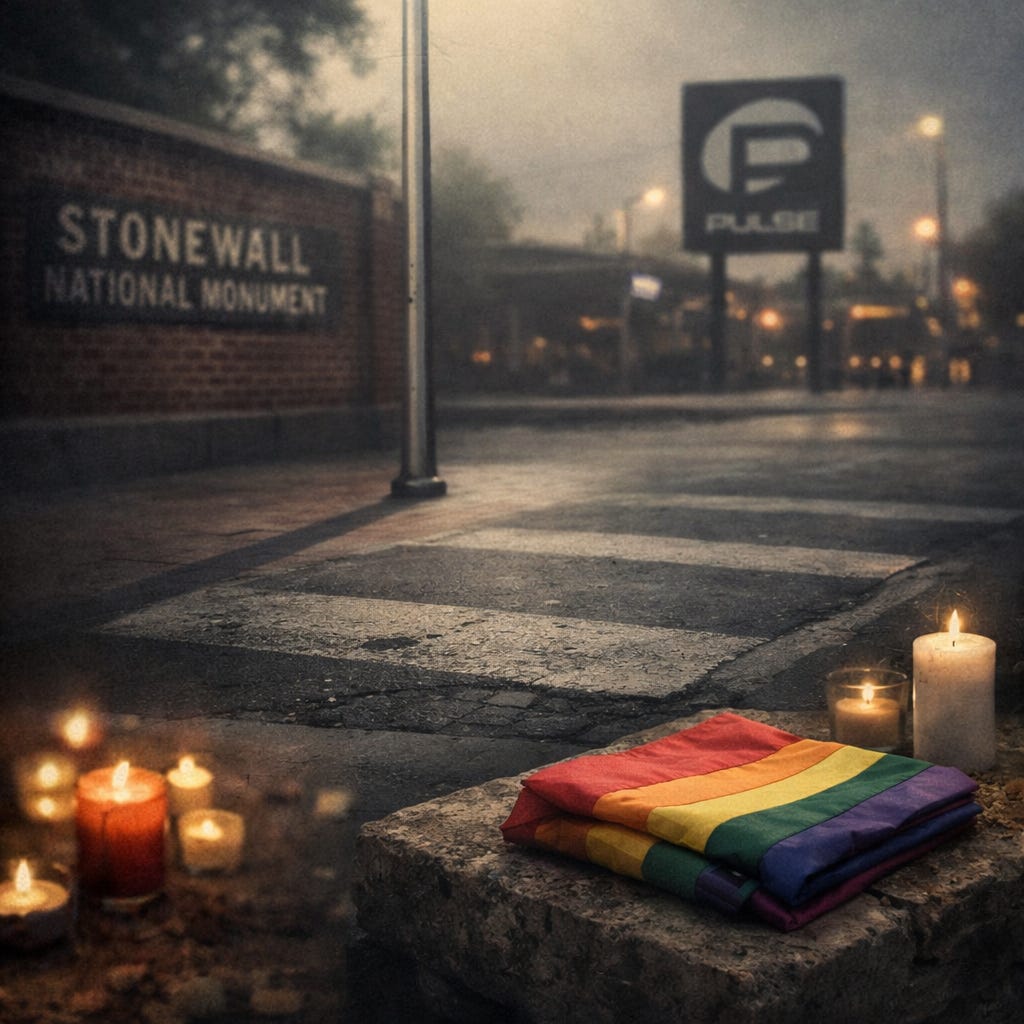
When the Pride flag was removed from Stonewall National Monument earlier this month, I felt something deep and familiar. Not shock. Not surprise. Recognition.
Stonewall is not simply a historic site. It is where a hunted community finally said no more. It is where queer and transgender people, many of them poor, many of them people of color, fought back against state sanctioned violence. Every inch of that place carries memory.
The Pride flag that flew there did not make Stonewall political. Stonewall was already political because our existence had been criminalized. The flag told the truth about what happened there and who made it happen.
When federal officials ordered that flag taken down under a January directive governing which flags may fly on National Park Service property, they were not applying neutral policy. They were asserting control over which histories are allowed to remain visible.
This is how erasure works. It arrives dressed as procedure.
The Pattern Is National, and It Is Deliberate
This administration has shown consistent hostility toward the LGBTQ+ community, particularly toward transgender people. Protections have been rolled back. Language has been stripped from federal guidance. Agencies have been ordered to define sex in ways that erase lived reality. Visibility itself has become a target.
Stonewall did not happen in isolation, and neither did this decision.
Across the country, federal pressure has empowered state level cruelty. Florida provides one of the clearest examples.
At the site of the Pulse Nightclub, where forty nine people were murdered simply for being who they were, a rainbow crosswalk had stood for years as a memorial. It marked sacred ground. It told families, survivors, and the broader LGBTQ+ community that the loss was seen and remembered.
Then, under directives discouraging so called nonstandard roadway markings, Florida quietly ordered the crosswalk painted over. It was done overnight. No consultation. No warning. No respect.
A memorial was erased in the dark.
This was not about traffic safety. It was about power. It was about sending a message to a community that even its dead are inconvenient.
What This Feels Like From Inside the Community
For LGBTQ+ people, symbols are not optional. They are how we survived decades when the law refused to protect us and society refused to see us.
I came out in a time when silence could mean safety and visibility could mean danger. I watched friends die during the AIDS crisis while leaders chose indifference. I learned early that government cruelty often arrives quietly, through neglect, through erasure, through bureaucratic language that masks human cost.
Stonewall tells us that resistance is possible. Pulse reminds us of the price of hatred.
When this administration removes our flags and states erase our memorials, they are not just revising aesthetics. They are reopening wounds. They are telling grieving families that remembrance is conditional. They are telling queer youth that their history can be wiped away when it becomes politically inconvenient.
Cruelty is not always loud. Sometimes it is a paint roller at night. Sometimes it is a flag lowered without ceremony.
This Is About Democracy, Not Decoration
Democracy depends on whose stories are allowed to exist in public space. When governments decide that LGBTQ+ history must be stripped of its symbols, they are not protecting neutrality. They are enforcing exclusion.
Stonewall without Pride is incomplete. Pulse without its colors is dishonored. These acts tell us that this administration and its allies are not merely hostile to policy protections, but to memory itself.
And memory matters because it teaches the next generation that survival is possible, that resistance matters, that dignity is worth fighting for.
We Are Still Here
The LGBTQ+ community has always been told to be quieter, smaller, less visible. Every time power tries to erase us, we respond the same way.
We remember.
We gather.
We repaint.
We raise our flags again.
We do this not because symbols are everything, but because they carry the truth of lives lived, loved, and lost.
You can take down a flag.
You can paint over a memorial.
You cannot erase a people who refuse to disappear.