



By J. H. Irwin
Author | Storyteller | Capturing Life, Memory, and Meaning
The rally did not settle the fight over the Kennedy Center, but it raised the political cost of destroying it
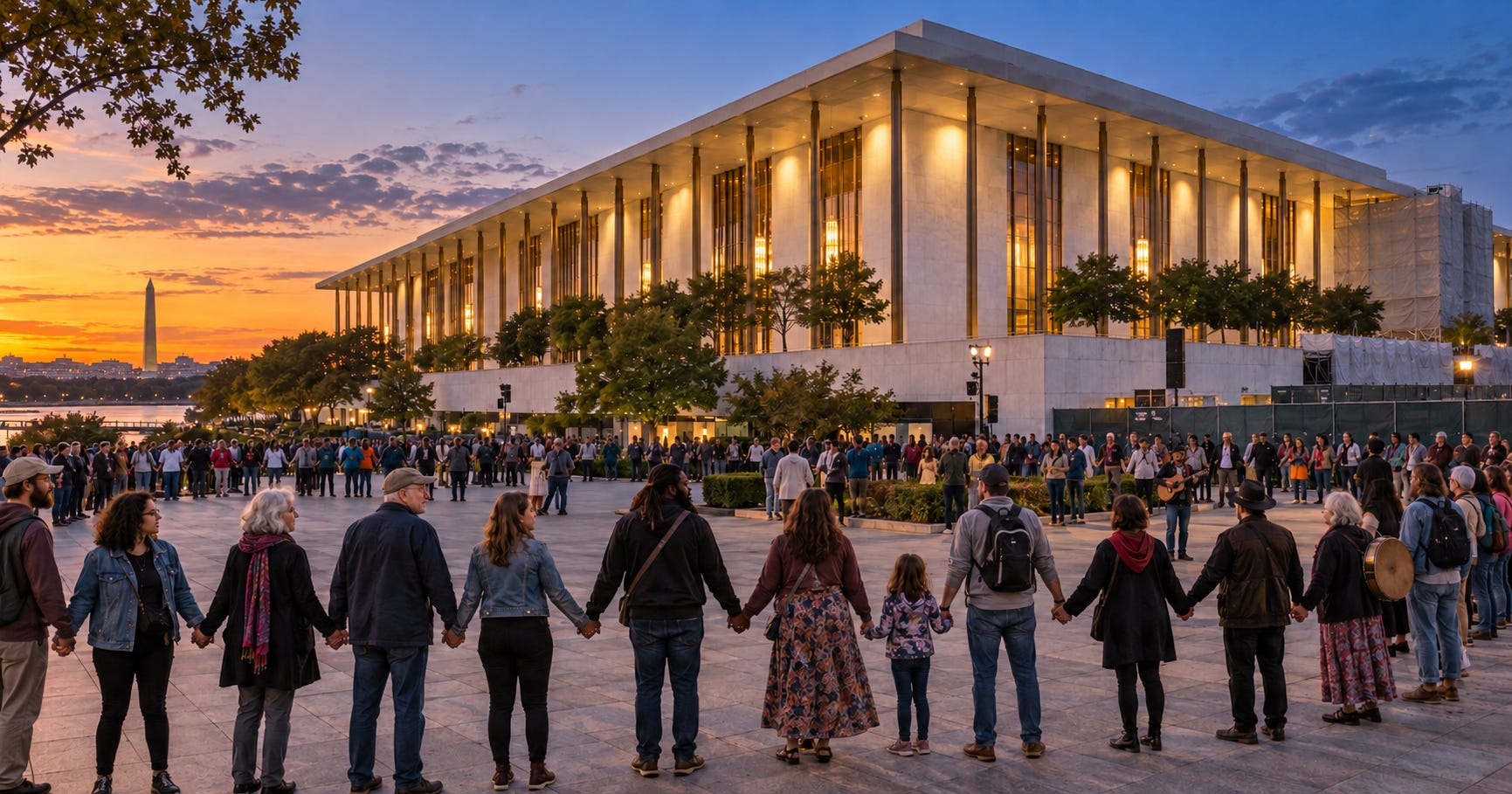
On Friday evening, September 18, thousands of people converged on the John F. Kennedy Center for the Performing Arts as the sun set over the Potomac. They came carrying signs, wearing red “Hands Off the Arts” pins, beating drums, singing, and joining hands in defense of a national cultural institution that has been closed, fenced off, politicized, and threatened with demolition.
What had been planned as a joyful public gathering became something more urgent. Earlier in the week, the Trump-controlled Kennedy Center board voted to close the main building for repairs, fencing appeared around the property, and President Donald Trump again suggested the building could be torn down if his administration did not receive the recognition he believes it deserves. By Friday night, this was no longer simply a celebration of the arts. It had become a visible act of resistance against one man’s attempt to make a national memorial answer to his name, his image, and his demands.
A Crowd Far Larger Than Expected
There is no verified police or official attendance count, and the estimates offered by organizers have varied. The most responsible conclusion is the one supported by several major news organizations: thousands of people attended. The Associated Press, The Washington Post, and The Guardian all described the crowd that way.
That turnout far exceeded the original projection of 400 to 800 participants. More than 950 people had signed up by Friday morning, according to Forbes, and the crowd ultimately grew into the thousands. People streamed from the Foggy Bottom Metro station, filled nearby streets, interrupted traffic, and continued arriving as the program unfolded.
The turnout mattered because it shattered the idea that concern over the Kennedy Center is limited to a small circle of Washington artists or political insiders. Families, union members, former employees, performers, longtime patrons, elected officials, LGBTQ+ advocates, and ordinary citizens stood together. For one evening, a building that had been made to feel like a sealed monument became a living public space again.
What Happened That Evening
The rally opened with speeches from artists, activists, former workers, and political leaders. D.C. Council Member Robert C. White Jr. was among those who addressed the crowd, along with people whose careers and communities had been shaped by the Center. Their stories reminded those gathered that its value cannot be measured only in ticket sales, donor lists, or the ambitions of those temporarily in power. It lives in the memories, education, and creative lives of the people it has served.
Actress and singer Lynda Carter made a surprise appearance and spoke about the role of the arts in human survival, learning, and connection. D.C. drag performer Tara Hoot, one of the event’s organizers, led the crowd in chants demanding that the tarp covering the building’s facade be removed. The crowd answered with “Take it down!” and repeatedly chanted “Hands off!” as speakers described what had been lost under the current leadership.
Music was not merely entertainment that evening. It was part of the protest itself. The Gay Men’s Chorus of Washington performed “Make Them Hear You” from Ragtime, a particularly meaningful return after the Chorus’s WorldPride performance at the Kennedy Center was canceled following Trump’s takeover. The Rapid Response Choir also participated, with a planned program that included “Solidarity Forever” and “America the Beautiful.”
There were also quieter acts of protest. Former employees and longtime volunteers spoke about the jobs, programs, and relationships lost as the Kennedy Center was reshaped under its current leadership. Local arts supporter Bud Wilkinson created a chalkboard covered with Trump’s name, then invited people to erase those names and replace them with hearts. Around them were hand-painted signs, costumes, balloons, drummers, and people who had traveled from outside Washington simply to stand in defense of a place that had shaped their lives.
The human chain did form, but not exactly as originally envisioned. Additional fencing and restricted areas prevented participants from completing an unbroken circle around the main building. Instead, they linked arms around as much of the accessible perimeter as possible, producing a substantial human chain even though the barriers prevented a complete encirclement.
What Was Actually Accomplished?
The honest answer is that the rally did not save the Kennedy Center in a single evening. It did not reopen the building, reverse the board’s closure vote, remove Trump as chairman, restore displaced employees, or secure a binding promise that the structure will not be demolished. As of September 19, Trump had not withdrawn his threat and had again declined to rule out tearing the building down, according to Reuters.
It is also important not to credit the demonstration with a legal protection that came before it. On Thursday, one day before the rally, U.S. District Judge Christopher Cooper ordered the Kennedy Center to provide 30 days’ notice before making any major physical changes, including demolition. That order arose from litigation led by Representative Joyce Beatty. It provides time for legal intervention, but it is not a permanent prohibition against demolition, and it was not an outcome of Friday night’s gathering. The Associated Press reported that the judge issued the requirement to remove any uncertainty over what the Center could do without warning.
What the event accomplished was political, cultural, and organizational. It transformed an issue that could have been dismissed as another Washington dispute into a national story. It brought together artists, workers, patrons, unions, public officials, Kennedy family allies, and citizens in a shared defense of public culture. It gave former employees a platform, returned music to the grounds of a silenced arts institution, and demonstrated that the Kennedy Center still belongs in the public imagination.
Most importantly, it raised the political cost of demolition. Any attempt to destroy or permanently disfigure the Kennedy Center must now contend with a visible record of opposition and a mobilized public prepared to return. Thousands of people showed up with little time, crowded the grounds despite fences, and made clear that they are prepared to defend the building, its workers, its artists, and the democratic ideals it was created to embody.
The Work Begins After the Applause
That does not mean the gathering should be romanticized into a victory it was not. Public demonstrations matter only when their energy is carried into sustained pressure, continued litigation, congressional oversight, financial accountability, voter engagement, and repeated public action. A photograph of joined hands can inspire people, but it cannot by itself restrain a government determined to ignore them.
Hands Around the Kennedy Center succeeded because it made silence impossible. It did not end the fight, but it showed that the fight has a constituency, a voice, and a growing public presence. In an era when authoritarian power depends on exhaustion, confusion, and the belief that resistance is futile, that achievement should not be minimized. It should be understood for what it is: not the conclusion, but the beginning of a much larger effort to protect the institutions that belong to all of us.
Words can still move the world. Read mine → https://substack.com/@jhirwin