



By J. H. Irwin
Author | Storyteller | Capturing Life, Memory, and Meaning
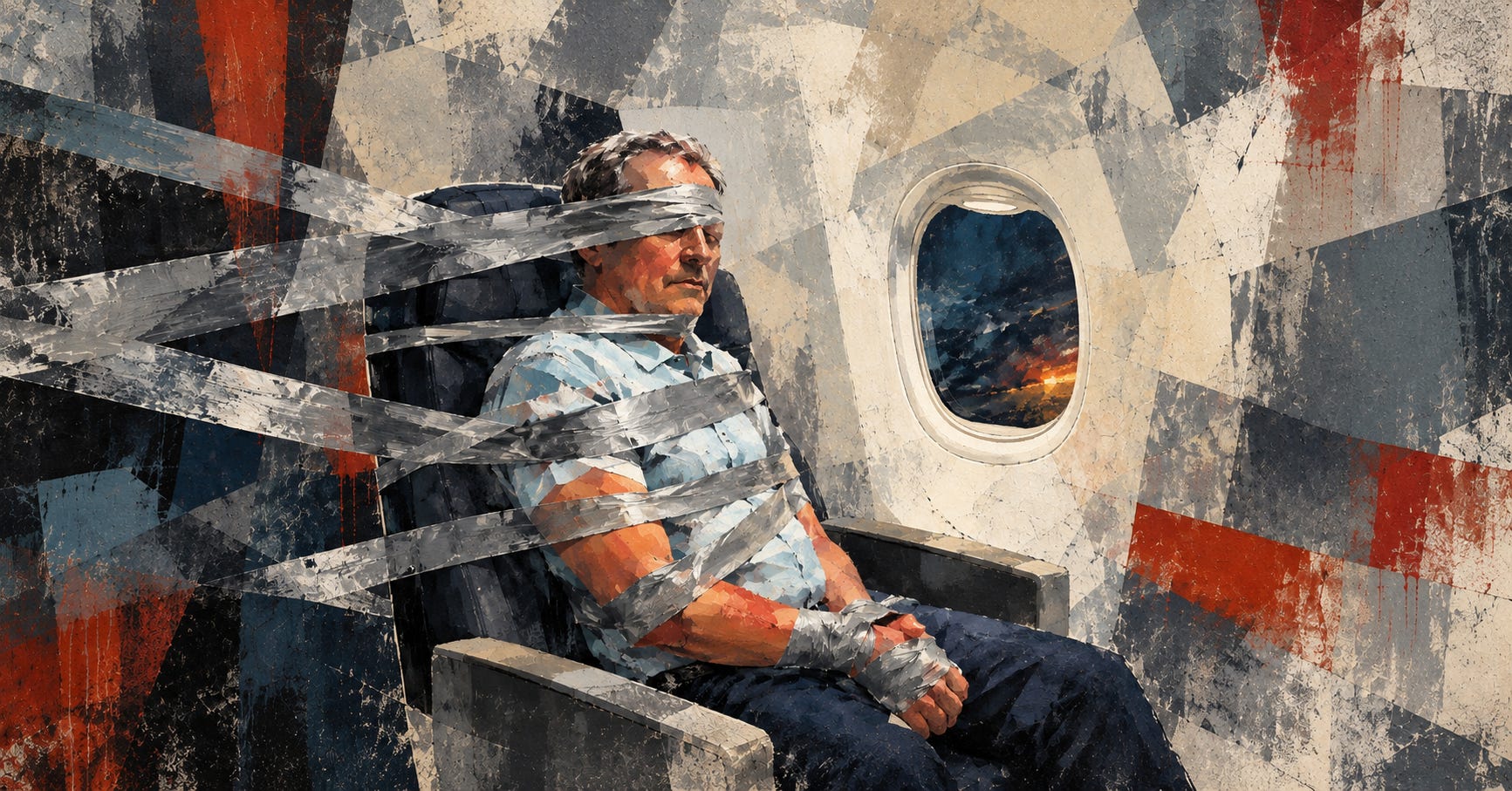
The photograph is difficult to look at and even harder to forget. A 67-year-old man sits bound to an airplane seat with duct tape, his hands restrained and his face partially covered, following what authorities describe as an increasingly hostile and violent outburst.
According to police and court records, Layne Arthur Lundeen was aboard American Airlines Flight 618 from Dallas to Newark on September 3 when he allegedly began shouting profanities and racial slurs, disturbing passengers and becoming physically combative. The flight was diverted to Baltimore, where Lundeen was arrested and charged with second-degree assault and disorderly conduct. The FBI is conducting interviews and will consult with the U.S. Attorney’s Office for Maryland to determine whether federal charges are warranted.
Long Realty, the Arizona real estate firm with which Lundeen had reportedly been affiliated for more than thirteen years, promptly ended its relationship with him after learning of the incident. The company said the reported conduct was inconsistent with the professionalism, integrity, compassion, and respect it expects from those associated with its business.
In a matter of hours, one outburst may have placed a man’s freedom, livelihood, professional standing, relationships, and reputation at risk.
All for what?
That is the question I keep returning to. Is hatred toward people you do not even know worth losing everything you have spent decades building? Is the momentary satisfaction of speaking a slur worth the possibility of arrest, unemployment, public disgrace, broken relationships, and a name forever connected to the worst moment of your life?
Is it worth becoming the person in that photograph?
We are living in the era of MAGA and Donald Trump, when combative political language has become a regular feature of American life. Americans across party lines have expressed concern about where heated rhetoric can lead. In a Pew Research Center survey, 78 percent of Americans said aggressive language from elected officials could make violence against targeted people or groups more likely, a belief shared by majorities of both Republicans and Democrats.
Whatever someone believes politically, no movement, politician, slogan, or red hat can shield a person from the consequences of his own behavior. Political permission is not legal permission. The approval of a crowd cannot protect your career, your family, your reputation, or your freedom when contempt becomes harassment and anger becomes violence.
Hate may be encouraged by the culture around us, but it eventually becomes a deeply personal choice.
No child enters the world knowing a racial slur. No infant understands that one skin color, religion, nationality, sexual orientation, or identity is supposedly more deserving of dignity than another. The language and targets of hatred are taught, sometimes deliberately within families and sometimes quietly through jokes, friendships, fear, resentment, misinformation, or years of hearing entire groups described as dangerous or inferior.
If hatred can be learned it can also be confronted.
That does not mean change is simple. Hatred can become so familiar that it begins to feel like instinct. It can provide a false sense of belonging, especially when surrounded by people who repeat the same grievances and reward the same cruelty. Over time, a person may stop seeing individual human beings and begin seeing only the labels he has been taught to despise.
But familiarity is not destiny. Learned behavior is not an unchangeable identity.
A person can begin asking where those beliefs came from and whether they are actually true. He can listen to people whose experiences differ from his own. He can step away from voices that keep him angry because anger makes him easier to manipulate. He can acknowledge the harm he has caused, seek help, apologize without making excuses, and begin the difficult work of becoming someone different.
None of this erases accountability. Hope does not mean pretending the damage never happened, and compassion does not require abandoning consequences. The passengers and crew members aboard that aircraft deserved to be safe. Those who were allegedly targeted by slurs and physical aggression should not be asked to carry the burden of rehabilitating the person accused of harming them.
Accountability and hope can exist together. Consequences tell us that conduct matters. Hope tells us that our worst beliefs and impulses do not have to govern the remainder of our lives.
I am not writing this from some imagined place of moral perfection. I know what it is to feel anger, resentment, and fear. We all do. Those feelings are part of being human, but what we feed, repeat, excuse, and ultimately release into the world remains our responsibility.
The hatred we direct outward also does something to us internally. It narrows our world, poisons our relationships, and keeps us suspicious of people who have done nothing to us. It asks us to surrender our peace in exchange for a permanent state of grievance. Eventually, it may consume far more of our lives than the people we have been taught to hate ever could.
That is the tragedy hidden inside this story. Hate does not merely injure its target. It can destroy the person carrying it.
Maybe the most important question is not what we think about the man in the photograph, but instead, what each of us is allowing to grow inside ourselves before it reaches that point.
Are we becoming more compassionate or more cruel? Are we learning about people or merely accepting what others tell us about them? Are we building a life rooted in human dignity, or are we allowing strangers, politicians, social media personalities, and grievance merchants to decide whom we should fear?
A different path remains available, but it must be chosen. It can begin with one honest question, one uncomfortable conversation, one rejected prejudice, or one moment when we decide that another human being’s dignity matters more than the anger we have been taught to carry.
Hate may be learned, but it does not have to be permanent. We can interrupt it, unlearn it, and refuse to pass it to the next generation.
The choice belongs to us…and so do the consequences.
Words can still move the world. Read mine → https://substack.com/@jhirwin