


By J. H. Irwin
Author | Storyteller | Capturing Life, Memory, and Meaning
Let’s Start Here
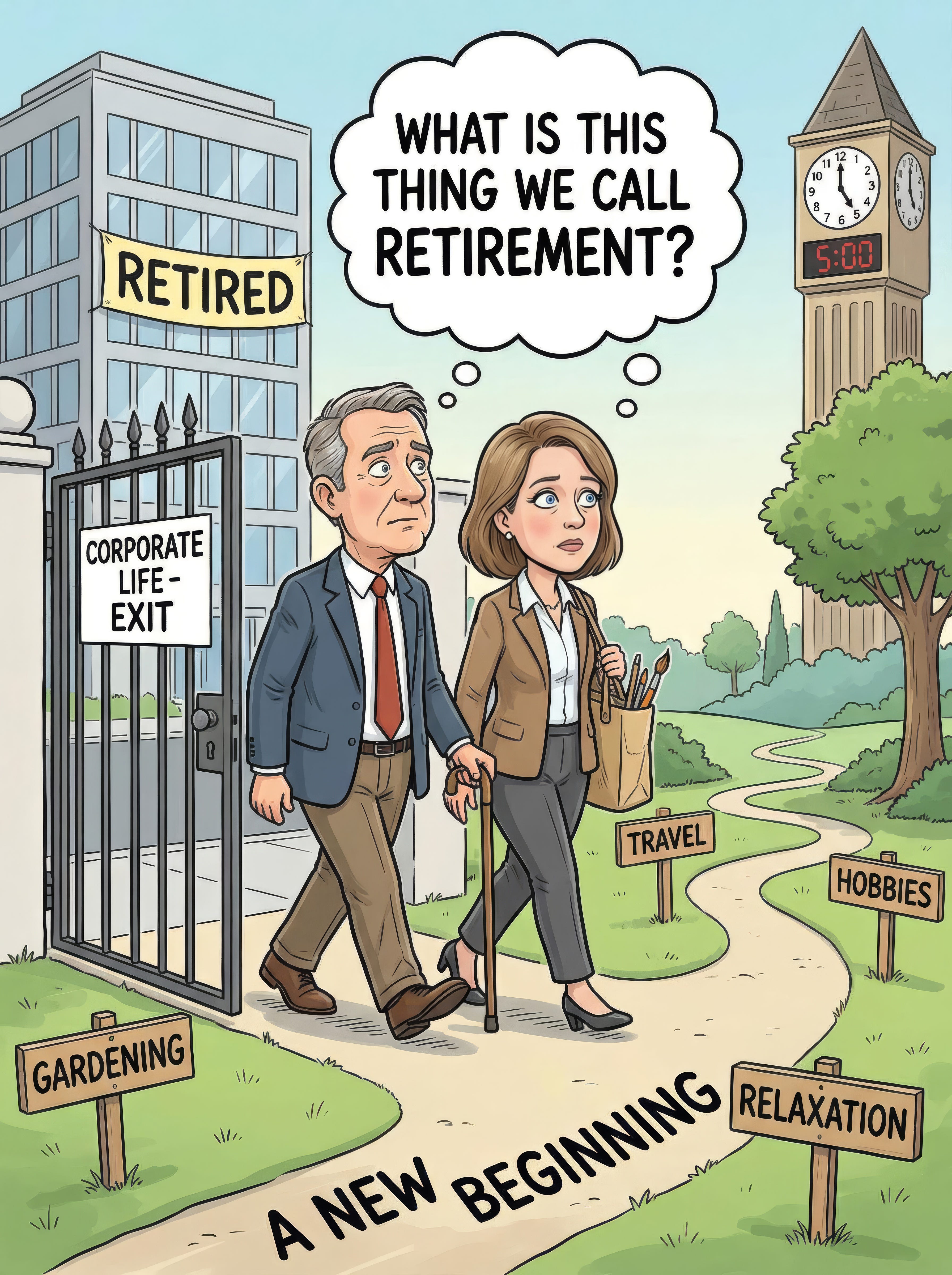
Retirement is one of those milestones we spend decades moving toward, often without ever fully understanding what waits for us on the other side of it. What follows is not a set of instructions. It is a conversation. One grounded in experience, observation, and a simple question that deserves more attention than it gets. What does it actually mean to step away and begin again?
Let’s talk about retirement
Not the polished version. Not the one wrapped in beach sunsets and financial calculators. The real version. The one that lingers quietly in the background while we are still working, still showing up, still telling ourselves we will figure it out when the time comes.
What is it, really?
Is it freedom?
Is it escape?
Is it the long-awaited moment where time finally belongs to us again?
Or is it something far more complicated than that?
Because the truth is, retirement is one of the most misunderstood transitions in modern life.
We plan for it financially with precision. We calculate, save, forecast, adjust. We circle a date on a calendar and call it the finish line.
But very few people stop to ask the question that matters most.
What happens the day after?
Retirement does not look the same for everyone anymore
For some, it is a full stop. Work ends. Structure fades. The days open up. Travel, gardening, slow mornings, long conversations, rediscovering life without urgency. For many, this is exactly what they hoped it would be.
For others, retirement is not an ending at all. It is a pivot. A reinvention. They leave one career behind and step into something new. Consulting. Writing. Creating. Building something that feels more aligned with who they are now.
There is also a quieter version. The one where someone could retire, but chooses not to. Not because they need the income, but because they are not finished contributing. Because purpose still matters.
And then there is the version we do not talk about enough.
The one where retirement arrives… and something feels off.
Most people in the United States retire somewhere in their early to mid sixties. Around sixty four for men, sixty two for women. Full Social Security benefits land closer to sixty six or sixty seven depending on when someone was born.
But statistics only tell part of the story.
A significant number of retirees, often estimated between thirty and forty percent, eventually return to some form of work.
Not always out of necessity.
Often because something is missing.
Structure. Identity. Connection. A sense of being needed.
These are not small things. They are foundational.
It is not uncommon to see someone move carefully and deliberately into retirement. They give proper notice. They train their replacement. They close out their role with professionalism and pride.
And then, not long after, something unexpected settles in.
A quiet sense that something does not feel the way they imagined it would.
It is easy to look at that and assume a mistake was made.
But that is not how it reads to me.
It reads as something far more human.
Because retirement is one of the few transitions in life where we prepare every external detail… and leave the internal experience largely unexplored.
There is another reality that deserves just as much attention
What happens when someone is not yet retired… but the work environment they are in has become increasingly difficult to tolerate?
That slow erosion matters.
The kind that builds over time. The kind that turns each day into something to endure instead of something to engage with.
In those moments, retirement can start to feel less like a transition and more like an escape hatch.
And while the instinct to leave is valid, decisions made purely to escape rarely lead to something fulfilling on the other side.
At the same time, staying in an environment that diminishes well-being simply because it is familiar is its own kind of cost.
So the question becomes more nuanced.
Not should someone leave.
But how.
There is a different way to approach this
Not as a sudden exit, but as a deliberate transition.
A bridge instead of a cliff.
What would it look like to begin living pieces of retirement before fully stepping into it?
To take time off and experience days without structure. Not as a vacation, but as a preview. To understand what it feels like when time is no longer dictated by obligation.
To explore what kind of work, if any, still holds meaning.
Because retirement does not have to mean the absence of work.
It can mean the presence of choice.At its core, retirement is not defined by age
It is not defined by a financial number.
And it is certainly not defined by a universal experience that applies equally to everyone.
It is a shift.
A negotiation between freedom and purpose.
Too much structure, and life feels constrained.
Too little, and it begins to feel unmoored.
Somewhere in the middle is where balance lives. Where intention replaces routine. Where life begins to feel like it belongs to us again.
So perhaps the better question is not when retirement should happen.
Perhaps it is this.
What kind of life is waiting to be built next?
And what needs to change to begin building it now?
Because retirement, at its best, is not an ending.
It is a decision.
One of the most important ones a person will ever make.
Words can still move the world. Read mine → https://substack.com/@jhirwin