



By J. H. Irwin
Author | Storyteller | Capturing Life, Memory, and Meaning
Sometimes fiction reveals truths that are uncomfortable to confront in the real world.
Nearly three decades ago, the James Bond film Tomorrow Never Dies imagined a media tycoon who manipulated global events in order to dominate the information landscape. At the time, the premise felt exaggerated, almost theatrical. Today it feels far less distant.
As billionaires increasingly purchase media empires and digital platforms, the question is no longer theoretical. When the same individuals who shape the news also possess enormous political and economic power, the boundary between reporting events and influencing them can become dangerously thin.
For readers navigating this environment, one of the most important acts of civic awareness is to diversify where you get your information. Large corporate networks are not the only voices available. Independent outlets, investigative journalists, and reader supported publications play an essential role in preserving a healthy information ecosystem.
Platforms such as MeidasTouch, The Bulwark, and other independent news organizations demonstrate how journalism can exist outside traditional corporate media structures. Whether readers agree with them or not, exploring a variety of sources helps strengthen media literacy and protects the pluralism that democracy requires.
The story of Elliot Carver offers a useful lens through which to think about all of this.
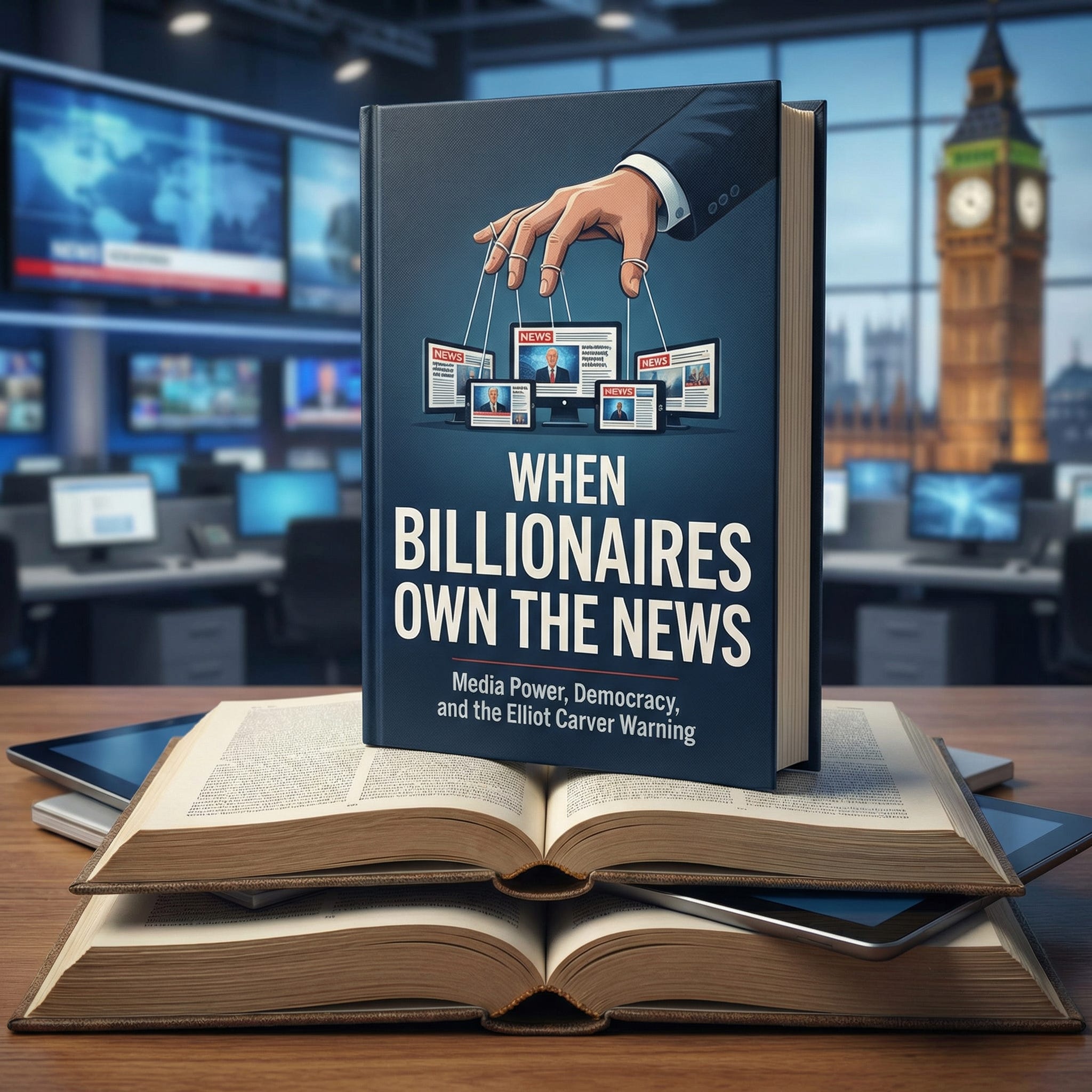
When Billionaires Own the News: Media Power, Democracy, and the Elliot Carver Warning
In the 1997 James Bond film Tomorrow Never Dies, actor Jonathan Pryce portrays one of the franchise’s most unusual villains. His character, Elliot Carver, is not a warlord, a terrorist, or a rogue general.
He is a media mogul.
Carver owns a vast global news empire. His ambition is simple but terrifying. He wants to control the narrative of the world. To accomplish this, he secretly engineers a military confrontation between major powers. The conflict itself is not the objective. The objective is the coverage.
If he can create the war, he can own the story.
And if he owns the story, he controls the public perception of reality.
The film itself treats this idea with the glossy spectacle typical of the Bond franchise. Yet beneath the explosions and spy gadgets lies a disturbing insight about modern power.
Information can be weaponized.
The Carver Strategy
Elliot Carver understands something fundamental about influence. Whoever controls the flow of information shapes how people interpret the world.
In the film, Carver manipulates events behind the scenes, then broadcasts them through his own media network. The audience sees only the story he tells.
He does not merely report the news.
He manufactures it.
This fictional scenario once felt far removed from reality. Today, it reads more like a warning.
The Rise of the Modern Media Billionaire
Across the global media landscape, billionaire ownership of news outlets and digital platforms has expanded dramatically over the past two decades.
Wealthy individuals have purchased major newspapers, television networks, streaming services, and social media platforms that collectively influence the daily information diet of billions of people.
These acquisitions often occur during moments when struggling news organizations need financial rescue. Billionaire buyers frequently frame themselves as patrons of journalism or defenders of free speech.
Sometimes that is true.
But the concentration of media ownership among the ultra wealthy also introduces an unavoidable question: what happens when those with extraordinary political, economic, or ideological interests control the channels through which the public receives information?
Unlike the fictional Elliot Carver, modern media owners rarely need to stage dramatic geopolitical conflicts to influence events.
They can shape narratives more subtly.
Influence Without Orders
Direct censorship is rarely necessary.
Editorial direction can shift through softer pressures. Newsrooms understand the interests of ownership. Investigations that threaten powerful allies may lose urgency. Stories that reinforce certain narratives may receive greater prominence.
Over time, an invisible gravity begins to shape coverage.
Headlines change tone. Editorial priorities shift. Certain voices rise while others fade.
The public may never see the invisible hand guiding the narrative.
But the narrative changes nonetheless.
The Algorithmic Amplifier
The digital era has intensified the Carver problem.
Traditional newspapers once competed with dozens of independent outlets. Today much of the world’s information passes through a small number of digital platforms controlled by extraordinarily wealthy owners.
These platforms do not merely distribute news.
They decide which stories trend, which videos go viral, and which voices are amplified or buried through algorithms invisible to the public.
In other words, the modern media ecosystem contains tools Elliot Carver could only dream of.
He controlled a network.
Modern media barons can influence entire global information systems.
Democracy’s Information Lifeline
Democracy depends on an informed public.
Citizens make decisions about leadership, policy, and national direction based on the information they receive. When that information ecosystem becomes concentrated among a handful of powerful individuals, the risk to democratic discourse grows.
This does not mean every billionaire media owner intends to manipulate public opinion. Many genuinely support strong journalism.
But the structure itself creates vulnerabilities.
A system where enormous wealth intersects with enormous information power invites influence.
The Carver Lesson
What makes Elliot Carver such an unsettling villain is not the action sequences surrounding him.
It is the idea behind him.
He believed that controlling the story meant controlling reality.
That premise once belonged safely inside a spy thriller.
Today it lives much closer to the world we inhabit.
The lesson is not that journalists cannot be trusted. Many continue to do courageous work exposing corruption and defending truth.
The lesson is that healthy democracies require diverse ownership, editorial independence, and a public that understands how media power works.
Because when the same individuals who shape the story also possess extraordinary wealth and influence, the line between informing the public and guiding the public can quietly disappear.
And when that happens, the warning embedded in a decades old Bond film begins to feel less like fiction.
And more like prophecy.
Words can still move the world. Read mine → https://substack.com/@jhirwin
Thanks for reading Truth in the Quiet Hours with J. H. Irwin! Subscribe for free to receive new posts and support my work.