


By J. H. Irwin
Author | Storyteller | Capturing Life, Memory, and Meaning
Lately, I have noticed something happening that extends far beyond my own experience.
Friends who once followed every headline have stopped watching the news. Social media feeds that were once filled with political commentary, breaking events, and heated debates have become noticeably quieter. People who once felt compelled to stay informed about every crisis, every controversy, and every global disruption seem to be stepping back. Some have deleted apps entirely. Others have intentionally limited their exposure to current events. Many have simply chosen silence over engagement.
At first glance, it would be easy to interpret this as apathy. Critics often suggest that people who disconnect from the news or political discourse simply no longer care about what is happening around them. I am not convinced that is true. In fact, I suspect the opposite may be happening. Many of the people stepping away are the very same individuals who cared deeply for years. They followed events closely, invested emotionally in outcomes, advocated for causes they believed in, and carried the weight of concerns far beyond their own daily lives. Eventually, however, caring became exhausting.
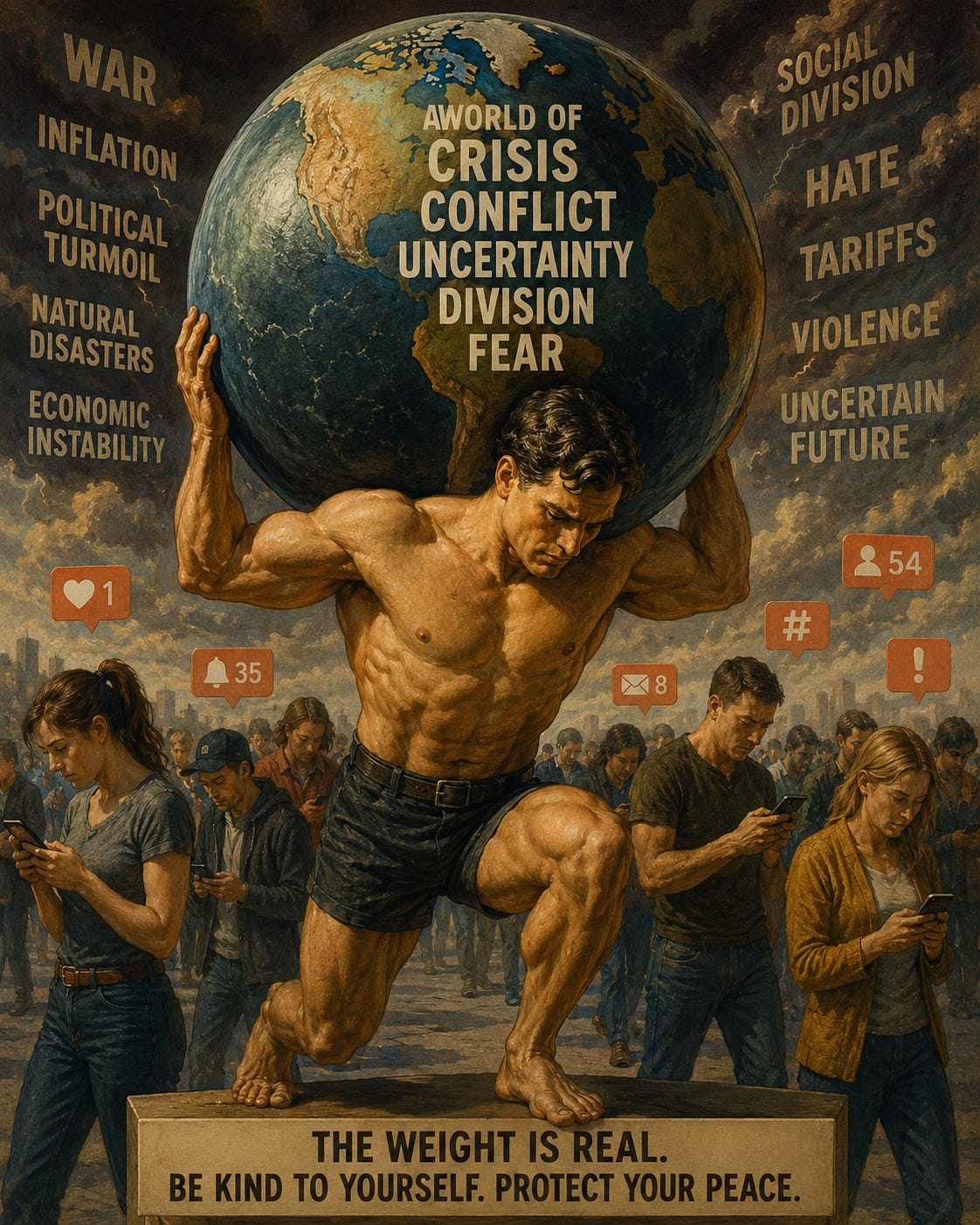
Human beings were never designed to process the volume of information we consume today. For most of human history, our awareness extended only as far as our immediate communities. We worried about our families, our neighbors, our towns, and the events directly affecting our lives. Today, before we finish our morning coffee, we may already know about wars occurring thousands of miles away, economic uncertainty in multiple countries, political conflict on several continents, natural disasters, humanitarian crises, acts of violence, and countless other troubling developments. By lunchtime, another wave of information has arrived. By evening, still more has been added to the pile.
The human mind can absorb only so much before it begins to show signs of strain.
Psychologists have long studied concepts such as compassion fatigue, chronic stress exposure, and information overload. While these conditions were often associated with caregivers, healthcare workers, emergency responders, and others regularly exposed to trauma, modern technology has created a situation in which ordinary people are exposed to a continuous stream of distressing information every day. We may not be standing in a war zone or responding to a disaster, yet our brains are constantly processing reports from those who are. Over time, the emotional impact accumulates.
What emerges is not necessarily despair in the traditional sense. Instead, it often appears as exhaustion, numbness, anxiety, irritability, difficulty concentrating, or a growing sense of helplessness. People begin asking themselves difficult questions. What difference am I actually making? Why do I feel angry all the time? Why am I carrying problems I have no ability to solve? Why does every day seem to begin with another reason to worry?
These questions are becoming increasingly common because many people have reached a point where their emotional reserves are running low.
I recognize this pattern because I experienced it myself. There was a period when I devoted significant time and energy to following political developments, responding to them, and creating content centered around them. I believed I was contributing something meaningful, and perhaps in small ways I was. Yet over time I noticed that my focus on these issues was beginning to consume more of my life than I intended. Every new controversy became another source of frustration. Every headline became another reminder of problems beyond my control. I found myself carrying those emotions throughout the day, allowing them to shape my outlook and affect my overall well-being.
Eventually, I had to acknowledge a simple truth: the constant exposure was changing me, and not for the better.
Stepping back did not mean I stopped caring about the world. It did not mean I became uninformed or indifferent. What changed was my understanding of where my attention could do the most good. Rather than spending my energy immersed in outrage and conflict, I began focusing more on the things that remind us of our shared humanity. I started writing more about kindness, empathy, resilience, creativity, relationships, and the countless examples of ordinary people doing extraordinary things for one another. I became more interested in understanding people than arguing with them. I began looking for stories that offered hope instead of simply documenting despair.
What surprised me most was the effect this shift had on my own life. The problems facing society did not disappear. The world did not suddenly become less complicated. Yet my relationship with those realities became healthier. I felt less consumed by events I could not control and more connected to the people and experiences directly around me. I found myself paying closer attention to moments of joy, acts of kindness, and reminders that goodness still exists even when it rarely dominates the headlines.
Perhaps what we are witnessing today is not widespread indifference but widespread fatigue. After years of uncertainty, division, disruption, economic pressures, global conflicts, and relentless negativity, many people are instinctively seeking balance. They are trying to preserve their mental health, protect their peace, and reclaim parts of themselves that have been buried beneath a constant barrage of alarming information. This does not make them irresponsible citizens. It makes them human.
There is certainly value in remaining informed and engaged with the world around us. Democracies depend on informed citizens, and meaningful change requires participation. At the same time, there is a difference between being informed and being consumed. There is a difference between caring about the world and carrying the weight of every problem it contains. One is sustainable. The other eventually breaks us down.
The truth is that none of us can solve every crisis, heal every division, or fix every injustice. We can, however, choose how we show up in our own communities. We can treat people with dignity. We can extend compassion. We can create, encourage, volunteer, listen, and support one another. We can focus on the areas where our actions genuinely matter instead of allowing ourselves to become overwhelmed by problems too vast for any individual to solve alone.
Perhaps that is why so many people are quietly changing course. They are not giving up on the world. They are recognizing that if they are going to continue contributing to it in meaningful ways, they must first protect their own emotional well-being. The goal is not to care less. The goal is to care in a way that allows us to remain hopeful, compassionate, and fully present in our own lives.
In a world that often seems determined to demand more emotional energy than we possess, that may be one of the healthiest decisions any of us can make.
Words can still move the world. Read mine → https://substack.com/@jhirwin