



By J. H. Irwin
Author | Storyteller | Capturing Life, Memory, and Meaning
Throughout my writing journey, readers have often shared something both humbling and deeply meaningful: that my words helped them feel less alone. Some have told me they cried. Others simply said they felt seen, understood, or finally able to put words to emotions they had carried for years.
I have always accepted those comments with gratitude, but they also left me asking questions of my own. Where did that ability come from and why does my writing affect people that way?
Why do I seem to recognize emotions in others that sometimes remain invisible to the people around them?
Looking back over my life, I think I've finally found the answer.
Empathy is rarely born from comfort. More often, it is born from the places where we once wished someone had understood us.
For me, that journey began long before I had the words to describe it.
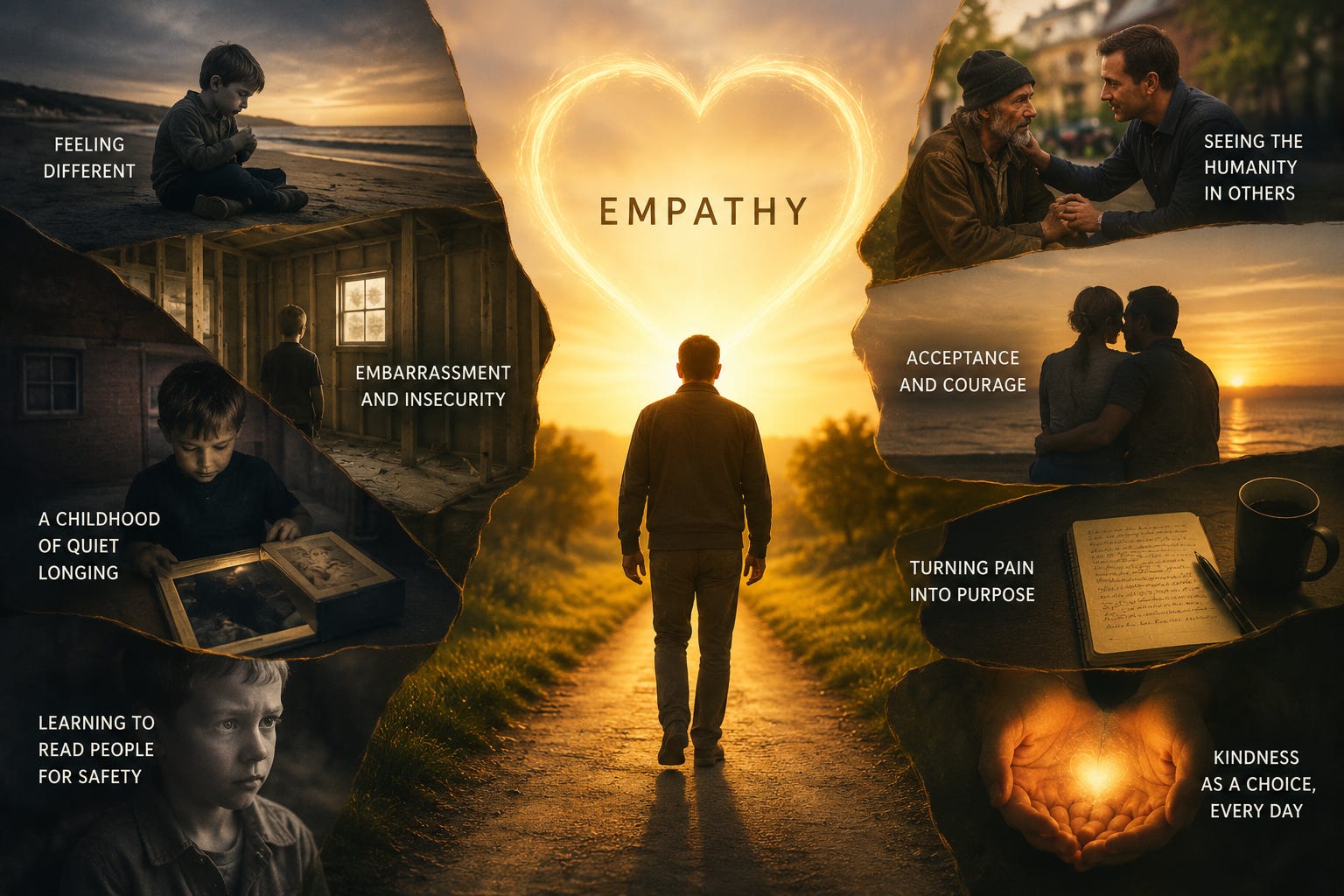
As a child, I often felt different without fully understanding why. I carried questions I couldn’t ask and fears I couldn’t name. Long before I understood my sexuality, I understood what it felt like to stand just outside the circle everyone else seemed to occupy so effortlessly. I watched other boys move confidently through the world while I measured every word, every action, and every glance before allowing myself to take up space.
Children who feel different become extraordinary observers. They have to. You begin studying people not out of curiosity but out of survival. You learn to read expressions, body language, and subtle shifts in tone because they help you decide whether a situation feels safe. Without realizing it, you become fluent in emotions that many people never learn to recognize.
Much of my childhood was spent walking alone along the beaches of Lake Erie. While other children gathered in groups, I wandered the shoreline collecting fish bones, arrowheads, weathered stones, and bits of driftwood. In my imagination, those ordinary objects became spaceships, machines, and inventions that existed nowhere except inside my own mind. Looking back now, I realize those solitary walks were doing far more than nurturing my creativity. They were teaching me how to find beauty and possibility even in lonely places.
The house we lived in reflected much of what I felt inside. My parents had begun renovating it, tearing out walls and plumbing before the project simply stopped. For years we lived inside a home that felt permanently unfinished. Wooden beams stood where finished rooms should have been, and we bathed in the bathroom sink because there was no functioning bathtub or shower.
I was deeply embarrassed by that house. Friends were almost never invited over because I feared what they would think if they saw how we lived. It wasn’t until much later that I understood my embarrassment had very little to do with unfinished walls. It came from believing that if people truly saw where I came from, they might decide I wasn’t enough.
Years later, I opened the baby books my parents had saved for each of their children. My siblings’ books were alive with photographs, milestones, and handwritten memories. Mine became quiet after only a few pages.
It wasn’t the emptiness that stayed with me.
It was what the emptiness explained.
Suddenly, years of vague feelings settled into focus. My parents had already spent decades raising children, building businesses, and carrying the weight of adult life. Without anyone intending it, I had become the child who learned independence earlier than most.
Sometimes a few blank pages can tell a much larger story.
Experiences like these leave lasting marks, but not always the ones we expect. They taught me to notice the people standing quietly at the edges of the room. They taught me to recognize insecurity hiding behind confidence and loneliness hiding behind smiles. When you’ve spent years wondering whether you’ll be accepted, you become remarkably aware of others wondering the very same thing.
My journey as a gay man deepened that understanding even further. Before I ever spoke the words aloud, I knew what it meant to hide parts of myself. I understood the exhausting calculations that come with constantly assessing whether a place, a conversation, or a person feels safe. Living with that awareness for so many years sharpened my sensitivity to anyone carrying burdens the world could not easily see.
But pain alone does not create empathy.
Something else was quietly shaping me at the same time.
My parents, despite their imperfections, gave me extraordinary gifts. My mother possessed an almost effortless ability to connect with people from every walk of life. She never seemed interested in labels, status, appearance, or social standing. If you stood before her, you mattered.
My father was a study in contradictions. The man who could be hard on those closest to him also had a remarkable ability to accept people others dismissed. Whether they were struggling, different, or simply overlooked, he met them with a quiet dignity that left a lasting impression on me.
Through their actions, rather than their words, they taught me that every person carries a story invisible to everyone else.
That lesson stayed with me.
As I have grown older, I have become less interested in deciding whether people are good or bad and far more interested in understanding how they became who they are. Life has taught me that most people are carrying struggles we never witness. Childhood wounds. Quiet grief. Fear. Regret. Loss. Dreams that never unfolded as they hoped.
That understanding changes the questions we ask.
Instead of asking, “What’s wrong with this person?” I find myself asking, “What happened to them?”
That single shift transforms judgment into curiosity and curiosity into compassion.
It has also changed the way I write.
When I sit down to tell a story, I rarely think about making a point or winning an argument. Instead, I hope to gently open hearts. I hope readers recognize themselves or someone they love within the experiences I describe. If my words have ever brought someone to tears, I don’t believe it is because they are sad. I believe it is because, for a brief moment, someone felt understood.
That has become one of the greatest privileges of my life.
Today, I no longer measure my worth through the approval of others. The frightened boy who constantly wondered if he was enough, who feared being judged, rejected, or truly seen, no longer controls my life. It took decades to arrive here, but I eventually discovered something profoundly liberating: I cannot control what others think of me, and I no longer wish to spend my life trying.
What matters to me now is something far more meaningful. I hope people see me not for my age, my profession, my appearance, my sexuality, or any of the countless labels that so often divide us. I hope they see someone who tries to lead with kindness, who listens before judging, who believes every person deserves dignity, and who understands that compassion is not a weakness. It is one of the greatest strengths we possess.
The hardships of my childhood did not determine the course of my life, but they helped shape my heart. They taught me resilience. They taught me courage. Most importantly, they taught me that our greatest wounds can become the very source of our greatest gifts if we allow them to deepen us rather than harden us.
Looking back now, I no longer see my childhood only as a collection of painful memories. I see it as the place where my empathy was born, where my resilience quietly took root, and where the person I would eventually become first began to emerge.
I would never choose to relive those years.
But I would not erase them either.
Without them, I might never have become the man I am today.
Words can still move the world. Read mine → https://substack.com/@jhirwin