


By J. H. Irwin
Author | Storyteller | Capturing Life, Memory, and Meaning
There are moments in life when people quietly begin surrendering to the idea that they are no longer capable of changing.
Sometimes it happens after years of depression. Sometimes after trauma. Sometimes after addiction, heartbreak, failure, grief, or simply the slow psychological erosion that can come with aging in a world obsessed with youth. Over time, many people begin believing their emotional patterns, fears, habits, and ways of seeing the world have become permanent fixtures of who they are.
Science is telling us something very different.
The human brain is not frozen in place once we reach adulthood. It remains adaptive, responsive, and capable of reorganizing itself throughout our lives. That process is known as neural plasticity, and the more researchers learn about it, the more hopeful the implications become not only for medicine and mental health, but for how we understand ourselves as human beings.
Because if the brain can continue changing, then perhaps the story of who we are is not nearly as settled as we once believed.
What Is Neural Plasticity?
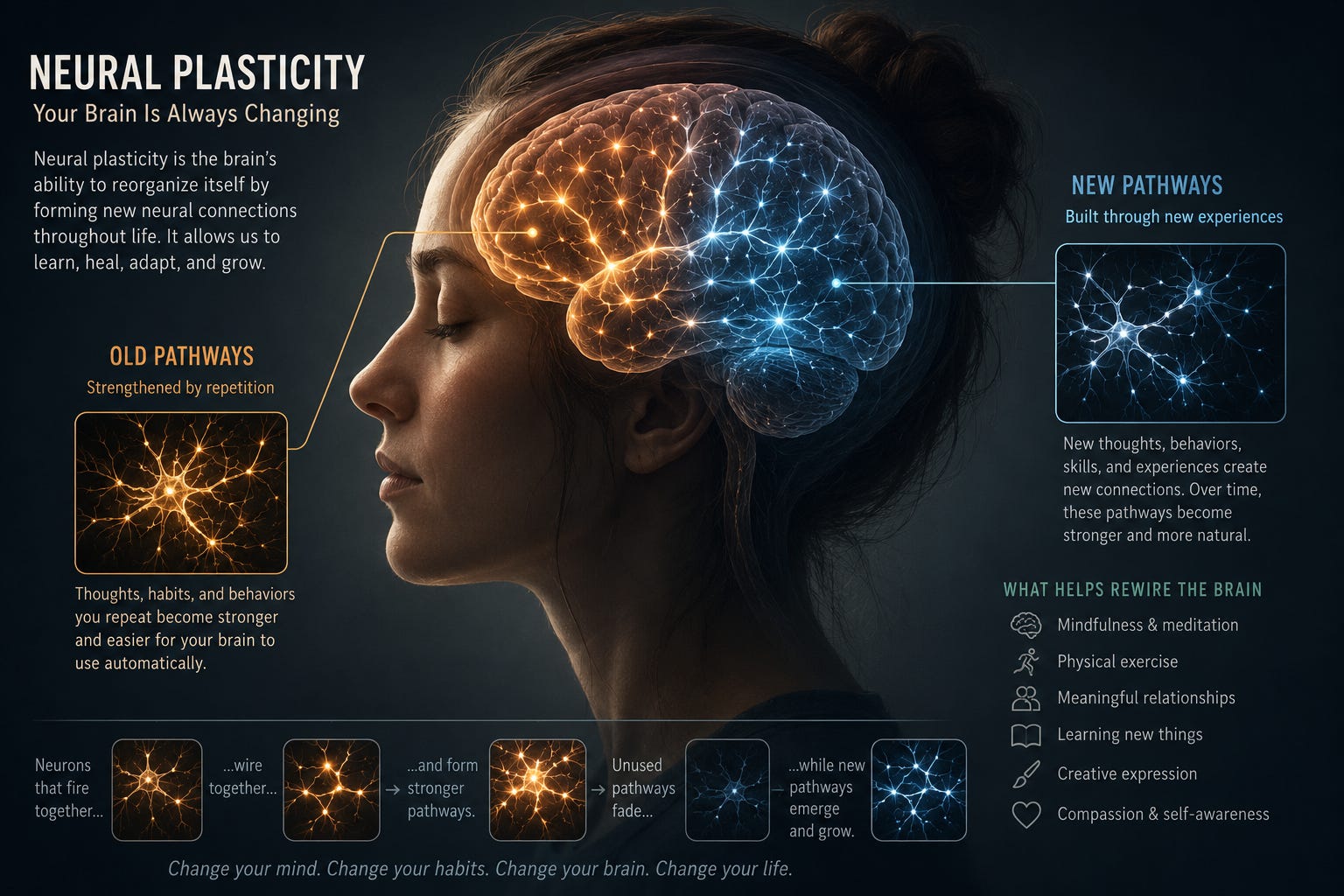
Neural plasticity, often called neuroplasticity, refers to the brain’s ability to reorganize and form new neural connections over time. In practical terms, it means the brain is constantly adapting itself in response to experience, repetition, emotion, environment, learning, and behavior.
Every thought we repeatedly entertain strengthens certain pathways. Every habit reinforces patterns. Every fear rehearsed over years becomes easier for the brain to access automatically. But the reverse is equally true. New experiences, new emotional responses, new routines, and new ways of thinking can begin creating entirely new neural pathways.
The brain is not simply storing memories like a filing cabinet. It is physically reshaping itself around how we live.
That matters enormously, especially when discussing trauma, depression, anxiety, addiction, aging, or recovery. For decades, many people viewed these struggles through a lens of permanence, as if emotional suffering became identity. Neural plasticity challenges that idea. It does not suggest healing is easy or guaranteed, but it does tell us something deeply important: change remains biologically possible far longer than we once understood.
The Brain Learns What We Repeat
One of the most fascinating aspects of neural plasticity is how much repetition shapes the architecture of the mind.
If someone spends years living in chronic stress, emotional isolation, fear, or shame, the brain adapts to those conditions. Over time, those emotional responses become neurologically efficient. The brain becomes practiced at anxiety. Practiced at despair. Practiced at expecting danger or disappointment.
That does not mean the person is weak. It means the brain learned survival.
But because the brain remains adaptable, it can also begin learning something else.
This is one reason therapies, mindfulness practices, exercise, creative expression, social connection, and intentional behavioral changes can genuinely affect mental health. They are not merely distractions or motivational exercises. They are experiences capable of helping the brain establish healthier patterns over time.
The process is rarely dramatic. Most often it happens slowly, through repetition and consistency. A healthier thought repeated often enough begins competing with an older destructive one. A safe relationship can gradually teach the nervous system that not every connection leads to pain. Creative work can restore emotional engagement where numbness once existed.
The brain listens closely to the life we repeatedly give it.
Depression and Trauma Leave Physical Imprints
Modern neuroscience has increasingly shown that depression and trauma are not simply emotional experiences floating abstractly in the mind. They leave measurable effects on the brain itself.
Long-term depression can weaken neural connections associated with motivation, pleasure, emotional regulation, and cognitive flexibility. Trauma can condition the nervous system into states of hypervigilance where the brain remains constantly prepared for danger, even in relatively safe environments.
For many people, this creates an exhausting cycle. The brain begins anticipating pain before it arrives. Emotional exhaustion becomes normalized. Hopelessness starts feeling rational because the nervous system itself has adapted around survival rather than peace.
This is why emerging treatments focused on neuroplasticity have generated so much interest. Therapies involving ketamine, TMS, mindfulness-based cognitive therapy, and even certain structured lifestyle interventions are being explored not simply because they make people “feel better,” but because they may help the brain establish new patterns and reconnect pathways that depression disrupted.
There is still much science does not fully understand, and no treatment works universally for everyone. But the underlying principle remains powerful: the brain is not necessarily trapped in its current state forever.
For people who have spent years feeling psychologically imprisoned inside themselves, that realization alone can feel life changing.
Aging Does Not End Human Growth
One of the most damaging cultural myths is the idea that meaningful growth belongs primarily to the young.
Society often treats aging as a gradual closing of doors rather than an evolution of identity. People begin hearing subtle messages that reinvention has an expiration date, that curiosity should quiet down, and that emotional or intellectual transformation somehow becomes less available with time.
Yet the aging brain still retains plasticity.
Yes, certain cognitive functions may slow. Memory retrieval can become less immediate. Processing speed may shift. But older adults continue forming new neural connections when they remain engaged emotionally, socially, intellectually, and creatively.
Learning a language. Writing stories. Traveling. Building relationships. Creating art. Developing new perspectives. Even confronting long-held beliefs honestly and allowing them to evolve can stimulate meaningful neurological activity.
What often disappears first is not the brain’s capacity for growth, but the belief that growth is still possible.
And once people stop believing they can still evolve, life itself can begin shrinking psychologically long before the body truly fails.
The Digital Age Is Reshaping the Human Mind
There is another side to neural plasticity that deserves attention, particularly in modern society.
If the brain adapts to what it repeatedly experiences, then the digital environments surrounding us matter enormously.
Social media platforms, outrage-driven news cycles, algorithmic reinforcement, and constant emotional stimulation are not passive experiences. They actively shape attention spans, emotional regulation, stress responses, and even how people perceive one another.
The more often the brain rehearses outrage, division, fear, impulsivity, or anxiety, the more neurologically efficient those emotional states can become.
Entire industries are built around capturing and monetizing human attention. The emotional activation people experience online is not accidental. Fear and anger keep people engaged, clicking, reacting, and returning.
That reality places a profound responsibility on individuals to protect their mental environment. The conversations we engage in, the media we consume, the people surrounding us, and the emotional energy we absorb all become part of the neurological ecosystem shaping the brain itself.
In many ways, neural plasticity is both hopeful and cautionary. The brain can heal, adapt, and grow, but it can also be conditioned toward exhaustion, hostility, and despair if those are the states it repeatedly inhabits.
Hope Is Biological
Perhaps one of the most remarkable implications of neural plasticity is that hope itself carries neurological importance.
Hope is not merely emotional optimism. It is often the beginning of re-engagement with life. When people believe change remains possible, they become more likely to pursue the behaviors that help create it. They seek treatment. They reconnect socially. They create. They move. They try again.
Hopelessness, by contrast, convinces the brain to stop reaching.
This is why preserving hope matters so deeply during periods of depression, grief, aging, or emotional collapse. Not because hope magically fixes suffering, but because hope keeps the door open for adaptation and recovery to continue.
The brain responds to possibility.
And human beings, even after extraordinary hardship, often remain far more capable of healing and transformation than they realize.
Final Thoughts
What I find most moving about neural plasticity is not merely the science itself, but what the science quietly says about being human.
It suggests we are not as fixed as we fear.
A painful chapter in life may shape us deeply without becoming the final definition of who we are. Depression may alter the landscape of the mind without permanently erasing the possibility of joy. Aging may change the body while still leaving room for reinvention, creativity, wisdom, and emotional growth.
None of this means life becomes easy. It does not erase suffering or guarantee healing. But it does challenge the idea that people are forever trapped inside the worst versions of themselves.
The brain remains alive, adaptive, and responsive to experience for far longer than we once believed.
And perhaps that means the human spirit does too.
Words can still move the world. Read mine → https://substack.com/@jhirwin